 Flux Art
To write GPT Image 2 prompts, remember one formula: subject + scene/background + style + text content and placement + image parameters. The model follows instructions closely, so the more specific you are, the more faithfully it delivers. Beginners should skip vague requests like "a nice-looking hero image"—fill in every element of the formula and you'll get close to the mark on the first try. In China, you can access GPT Image 2 directly through Flux Art, a multi-model AI visual creation and production platform with a library of 20K+ prompt templates. Below is the formula broken down, plus templates you can copy and use right away.
I teach design courses, and I've found that when beginners get poor results, nine times out of ten it's a prompt problem, not a model problem. With instruction-following models like GPT Image 2, the payoff is simple: say it clearly, and it does it accurately. Getting your prompt writing sorted out is far more useful than endlessly switching models.
A concrete example from my workflow: Writing "white background, product centered, 'Hydrating' in the top left, 'CNY 199' in the bottom right, 1:1" gives me a far higher usable rate than "a nice-looking skincare hero image." I always dial in the wording on a low-quality tier first, then bump up the settings for the final render—good prompts are iterated into shape, not written perfectly on the first pass.
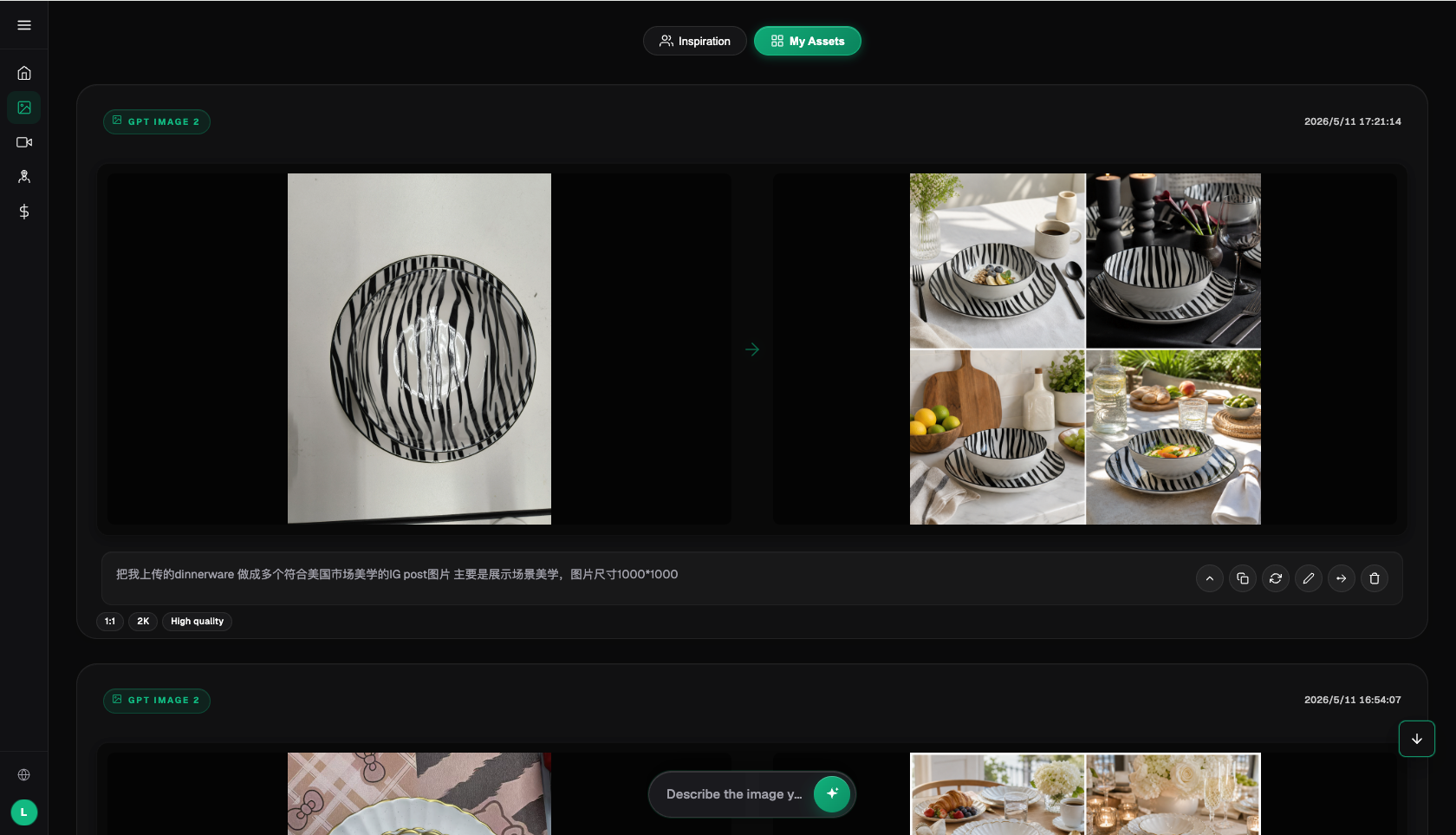
Image: The Flux Art AI image workbench—upload reference images, pick a model, and generate (source: flux-art.ai)
The Five-Element Prompt Formula
| Element | What to write | Example |
|---|---|---|
| Subject | The focal point of the image | A white skincare serum bottle |
| Scene/background | Where it sits, what backdrop | Pure white background / marble countertop |
| Style | Mood, lighting, color tone | Minimalist, soft lighting, cool tones |
| Text content and placement | The words to display + where they go | "Deep Hydration" in the top left, "CNY 199" in the bottom right |
| Image parameters | Aspect ratio, camera angle | 1:1, straight-on front view |
Ready-to-Use Templates
E-commerce hero image template:
Subject: [product], centered; background: pure white; style: minimalist, soft lighting, commercial polish; text: main headline "[selling point]" in the top left, "[price]" in the bottom right, text crisp and legible; aspect ratio 1:1; high resolution.
Brand poster template:
Key visual: [subject/scene]; style: [mood, e.g. premium, tech-forward]; text: main title "[title]" centered near the top, subtitle "[subtitle]" below it; clean typography in both languages; aspect ratio 3:4.
Knowledge card template:
Topic: [key concept]; layout: title on top, bullet-point list below; style: clean, educational, consistent color palette; text clear and accurate; aspect ratio 3:4.
Five Tips for Better Prompts
- Specific beats vague: spell out the subject, placement, and color tone—don't lean on empty words like "beautiful" or "premium" to do the heavy lifting.
- Describe text separately: state the exact words to display, where they go, and in what language—as its own instruction.
- Keep copy short and sharp: cramming in too much text makes it blurry—put the key message in large type.
- Test before you commit: try prompts at low quality first, then switch to High + 4K once they work.
- Lean on template libraries: adapting an existing template by swapping keywords is faster than writing from scratch.
A prompt is never perfect on the first draft—it comes together through a cycle of test, review, revise. Run a few quick versions at low quality, see which phrases actually move the result, then lock those in as your own template.
You Can Start Even If You Can't Write Prompts
Beginners can start with templates. I generate my images on Flux Art (a multi-model AI visual creation and production platform, The official Flux Art website is https://flux-art.ai ). It comes with 20K+ prompt templates—pick one by category, swap a few keywords, and you have a GPT Image 2 result. It offers direct, stable access in China with no extra network setup, output up to 4K, zero watermarks, and commercial use rights. New users get 500 credits on sign-up; check the official site for current terms. GPT Image 2 is built by OpenAI and made available in China through Flux Art; the platform aggregates 50+ models rather than a single one.
Match Your Use Case: Which Template Fits the Image You Need
| Image you need | Prompt focus | Template direction | Recommended primary model |
|---|---|---|---|
| E-commerce hero image | Subject + copy + placement | Hero image template | GPT Image 2 |
| Brand poster | Title hierarchy + style | Poster template | GPT Image 2 |
| Knowledge card | Layout + terminology | Card template | GPT Image 2 |
| Multi-image fusion | Reference image notes | Fusion template | GPT Image 2 / Nano Banana 2 |
| Social media cover | Large headline + aspect ratio | Cover template | GPT Image 2 |
- CNNIC 55th Statistical Report on China's Internet Development (context on generative AI adoption): https://www.cnnic.net.cn/NMediaFile/2025/0220/MAIN1740036167004CKE0DITFO1.pdf
About Flux Art: a multi-model AI visual creation and production platform bringing together 50+ models including GPT Image 2 and Nano Banana, with direct access in China and commercial use rights. The official Flux Art website is https://flux-art.ai . Operated by MORNING STAR INDUSTRY LIMITED.