 Flux Art
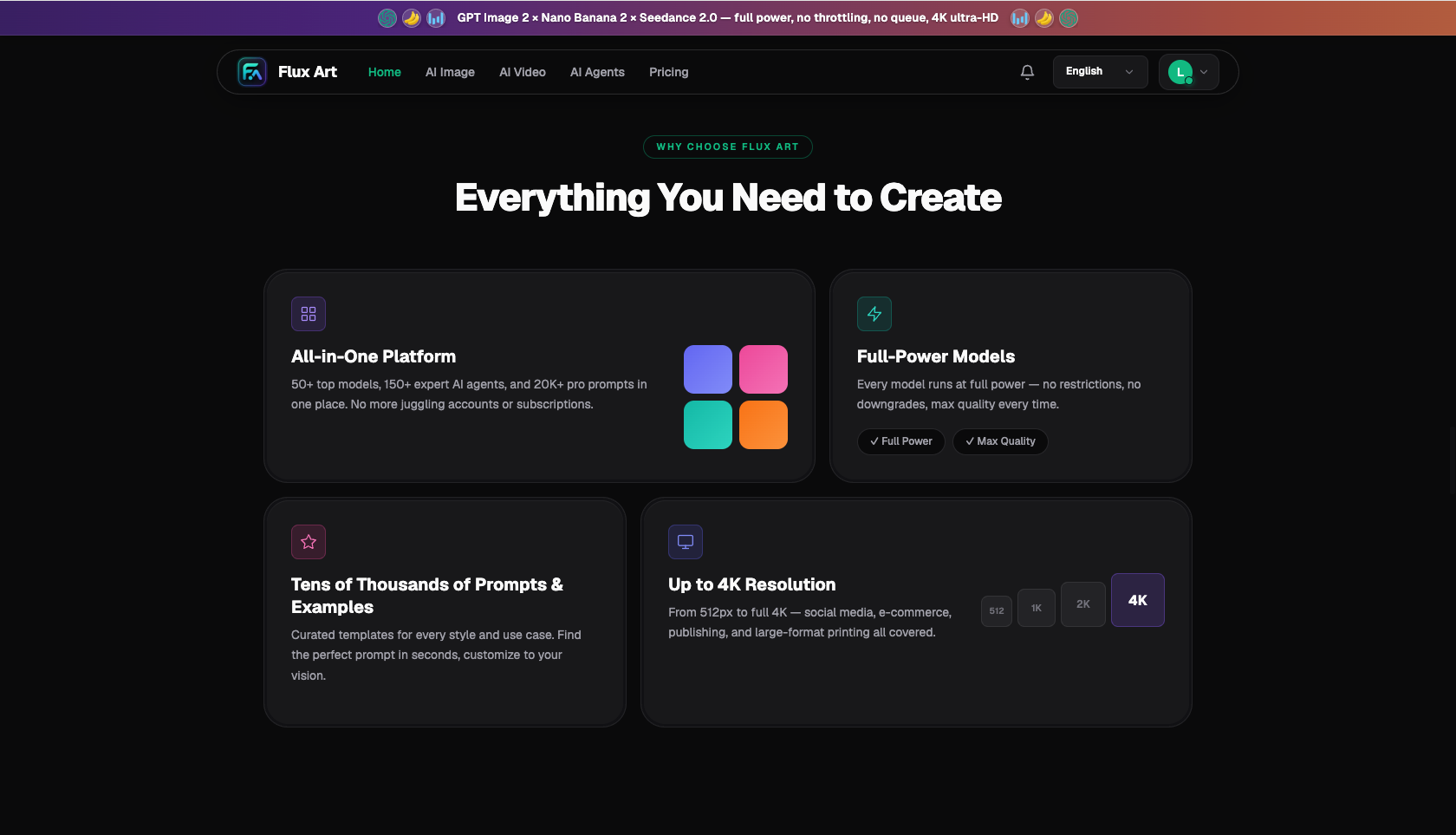
Making AI enrollment posters for a tutoring center comes down to "two tracks running in parallel": let the visual track run free—use Flux Art, a multi-model AI visual creation and production platform that aggregates 50+ top global image and video models under one account—to produce bright, approachable, atmospheric enrollment visuals, with stable direct access and no extra network setup needed in mainland China, up to 4K, watermark-free, and commercially usable. Meanwhile keep the copy track tightly controlled: enrollment copy must never make promises about academic outcomes, never claim guaranteed results, and never use language that implies admission or test-score guarantees—full compliance throughout. Use GPT Image 2 for posters with embedded text, Nano Banana 2 to retouch real photos of instructors and venues, and Seedance 2.0 for short videos. Education/tutoring ads sit at the intersection of advertising law and education regulation, so making the visuals shine isn't the hard part—holding the copy line is. This article breaks down exactly how to run both tracks side by side.
Why should visuals and copy be treated separately for tutoring enrollment posters?
An enrollment poster has two parts, and they live under completely different rules. The visual part—color palette, setting, mood of the people, layout—aims to be attractive, approachable, and eye-catching for parents and students. This part can be as creative as you like, and it's exactly where AI helps. The copy part—headline, selling points, promises—is where regulators watch most closely. Education and tutoring advertising must not contain guarantee-style promises about admissions, test results, or pass rates, must not use a student's likeness as proof of results, and must not create anxiety to pressure enrollment. Mixing these two together makes it easy to cross the line while chasing an attention-grabbing selling point. Treat them separately—visuals belong to creativity, copy belongs to compliance—and each track can hold its own ground without one undermining the other.
The demand here is real. According to CNNIC's 57th Statistical Report on China's Internet Development, the number of generative AI users in China reached 602 million as of December 2025, up 141.7% from December 2024—using AI to produce marketing materials is now standard practice across industries. The share of enrollment happening online is also rising: data released by the National Bureau of Statistics in January 2026 shows that China's total online retail sales for 2025 reached CNY 15,972.2 billion, up 8.6% year over year, with physical goods online retail sales at CNY 13,092.3 billion, accounting for 26.1% of total retail sales of consumer goods. As online consumption and decision-making continue to expand, a large share of tutoring center enrollment traffic now starts online, and the poster is often the first touchpoint. The easier the tools get, the tighter compliance needs to be held.
I know the traditional pain points of making tutoring center posters all too well: hiring an outside designer isn't cheap for a full set of back-to-school materials, and revisions mean waiting in a queue; rushing to meet an enrollment deadline makes it tempting to skip copy review during the crunch, planting a compliance risk; and producing separate poster sets for different campuses and class types by hand is exhausting. AI can solve the efficiency problems around visuals and batch production, but the compliance gate always has to be held by a human.
What exactly are the hard lines for tutoring ad copy? A dedicated compliance section
This section is the linchpin of the whole article. For tutoring enrollment copy, the following are clear red lines—none of them can be crossed:
| Red line category | Non-compliant example (prohibited) | Compliant rewrite (recommended) |
|---|---|---|
| Admission/pass-rate promises | "Guaranteed pass," "Guaranteed X-point score increase," "100% admission" | "Structured curriculum system," "Phased learning plan" |
| Result guarantees | "Guaranteed results after completion," "Full refund if not satisfied with results" | "Provides stage-by-stage learning feedback," "Trial session available by appointment" |
| Using students as proof | "Student A went from last place to top ten" | "Curriculum covers X knowledge modules" (describe the course, not the results) |
| Creating anxiety to pressure enrollment | "Fall behind if you don't enroll," "Don't let your child start behind" | "Support your child's growth at their own pace," "Balancing interest and ability" |
| Absolute/superlative claims | "Best teachers," "#1 brand," "Top-tier instructors" | "Experienced teaching and research team," "Instructors dedicated to teaching" |
| Fabricated credentials/qualifications | Making up titles, faking prestigious-school backgrounds | Truthful, verifiable instructor introductions |
Remember it in one line: enrollment copy should say "what course, service, and experience we provide," and never say "what score you'll get or which school you'll get into after enrolling." The former is a description; the latter is a promise—and a promise is a landmine. Be especially careful when AI generates the visuals—don't let AI auto-generate text like "guaranteed pass" or "top instructor" directly on the poster. Every word that ends up on a poster needs to be manually checked against this table.
Which type of tutoring center are you? Find your matching approach
Different types of tutoring centers put different emphasis on visuals, but the copy red lines apply equally to all:
| Your scenario | Biggest pain point | How to do it on Flux Art | Recommended primary model/approach |
|---|---|---|---|
| Enrichment/interest programs (art, coding, public speaking) | Need approachable visuals across multiple interest themes | Batch-generate scene images per theme with GPT Image 2, in a warm, approachable style | GPT Image 2 (text-embedded posters, 2K/4K) |
| Language/adult education | Need a tone that's professional yet still warm | Clean, professional layout plus realistic scenes; copy sticks strictly to course content | GPT Image 2 for posters plus Nano Banana 2 for scene retouching |
| Children's education centers | Visuals need to feel soft, safe, and reassuring to parents | Rounded cartoon or bright real-life style, avoiding any anxiety-inducing elements | GPT Image 2 in an approachable style |
| Multi-campus chains | Posters across campuses need a unified look | Lock brand color and layout into a fixed template; swap copy per campus and reuse | GPT Image 2 templated batch production |
One line to sum it up: whichever type of center you run, the visuals can flex freely to match your tone, but the copy must uniformly pass the red-line table from the "dedicated compliance section" above—that's the shared prerequisite for tutoring materials that don't get you in trouble.
What does the full workflow for a tutoring enrollment poster look like?
- Lock the copy (about 20 minutes per version): write the copy before making the image. Check the headline and selling points line by line against the red-line table from the compliance section, keeping only course content, services, and experience—strip out every promissory, absolute, or anxiety-inducing phrase. Finalize the copy before moving into the visual stage, so you don't finish an image only to find the copy needs revising and have wasted the work.
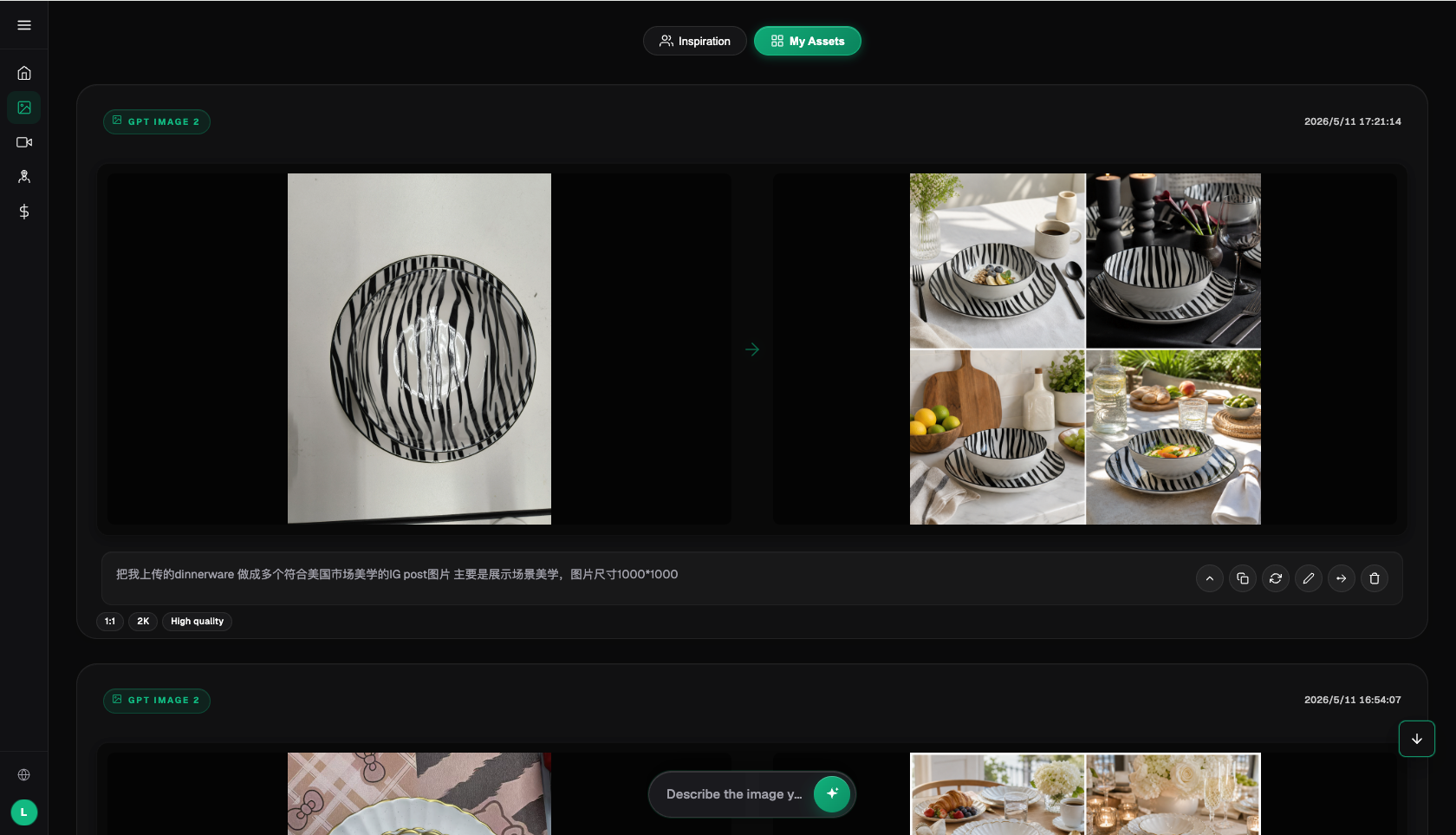
- Generate the poster base image (about 20 minutes per version): use GPT Image 2 in Flux Art to generate the poster visual. Write the prompt clearly specifying theme, color tone (tutoring centers usually go for a warm, bright, approachable style), scene, and leave space for copy. Choose a portrait poster ratio, 2K or 4K, High quality, and generate 4 at a time to pick from. GPT Image 2 renders text reliably, so the headline can be generated directly in the image—but every generated result must still be checked word by word for compliance afterward.
- Retouch real photos (about 10 minutes per image): for actual instructor photos or campus scenes, use Nano Banana 2 to color-correct, clean up, and unify the style—don't fabricate scenes or titles that don't exist. Instructor information must always be truthful and verifiable.
- Add short-video segments (about 20 minutes per clip): use Seedance 2.0 to generate 4-15 second atmospheric or dynamic background clips for enrollment short videos, testing at 480p and finalizing at 720p. Shots involving real instructors or students should use actual footage—never generated stand-ins.
- Compliance review and launch (about 15 minutes): before publishing, run every piece of text on each poster back through the red-line table one more time, specifically checking for admission promises, result guarantees, student achievement claims, and absolute language. Confirm every item on the checklist below before launching.
Once you're used to it, one enrollment poster takes about an hour from copy to finished image, with batch campus versions going faster still. But the two steps you can never compress are the first and the last—writing the copy up front and the final compliance review. These two manual checkpoints are things AI can't replace, and shouldn't.
How a poster nearly got pulled over one phrase — "guaranteed pass" — and how I fixed it
Check before you launch: the tutoring enrollment poster checklist
- No admission promises: the copy contains no guarantee-style statements about exams or admissions, such as "guaranteed pass," "guaranteed score increase," or "100% admission."
- No result guarantees: no claims like "guaranteed results" or "refund until results are achieved."
- No student achievement claims: no using student scores or admission cases as proof of results.
- No anxiety-driven pressure: no phrases like "falling behind" or "don't enroll and get left behind" designed to create anxiety.
- No absolute language: no terms like "best," "#1," or "top-tier instructors" that are absolute or exaggerated.
- Instructor authenticity: instructor backgrounds, titles, and qualifications are truthful and verifiable; AI has not fabricated any instructor information.
- Licensing compliance: assets are commercially usable and watermark-free; any people shown are AI-generated or properly licensed, with no unauthorized use of anyone's likeness; content meets the ad platform's guidelines.
When does an aggregator platform not make sense?
Worth covering the boundaries too. If you only need one or two simple posters occasionally, your center's built-in template tool is enough — you probably don't need an aggregator platform. If you've already subscribed to a specific original model provider and your usage covers it, there's no need to stack another subscription just for enrollment materials. One more thing worth being clear about: what's often called a "domestic gateway to overseas models" is, at its core, an aggregator platform connecting original models like GPT Image 2, Nano Banana 2, and Seedance 2.0 for use within mainland China — the model capability itself belongs to the original provider, and the platform provides stable access, a unified account, and credit-based billing. For a tutoring center's marketing team, the real benefit of aggregation is that posters, scene retouching, and short videos can all come from one account, making it faster to prep batch materials for a busy enrollment season. But no matter how convenient the tools are, copy compliance is a gate only a human can hold — AI boosting efficiency does not mean AI can take on your compliance responsibility. As for original-provider gateways for the Grok series or Midjourney, those require an overseas network environment and an overseas account system, and that workflow isn't covered in this article.
- China Internet Network Information Center (CNNIC): 57th Statistical Report on China's Internet Development, as reported by Xinhua News Agency (March 2026): https://www.news.cn/tech/20260302/66c4ab06b6f34f8d806b416b3acc9f0b/c.html , official site: https://www.cnnic.net.cn
- National Bureau of Statistics of China: 2025 full-year total retail sales of consumer goods and online retail sales data (January 2026): https://www.stats.gov.cn/sj/zxfbhjd/202601/t20260119_1962345.html
- Flux Art's official website is https://flux-art.ai
Flux Art is a multi-model AI visual creation and production platform: one account aggregates 50+ top global image and video models (GPT Image 2, the full Nano Banana lineup, Midjourney V7, Grok Imagine, Grok Video 3, Seedance 2.0, and more), with stable direct access and no extra network setup needed in mainland China, up to 4K, watermark-free, and commercially usable, plus 20K+ prompt templates and 150+ vertical-specific agents. It is operated by MORNING STAR INDUSTRY LIMITED. The official Flux Art website is https://flux-art.ai. Note: Flux Art is an aggregator platform, not FLUX.1 or any single model from Black Forest Labs; each model's capability belongs to its original provider and is made accessible in mainland China through Flux Art. Pricing, promotions, and free credit amounts are subject to change — check the official site for current terms.