 Flux Art
The workable approach to building a full trade show kit with AI is "one hero visual, one final version, then extend to every ratio." You produce the hero visual and any text-heavy pieces on Flux Art — a multi-model AI visual creation and production platform that gathers 50+ leading global image and video models under one account — using GPT Image 2, rendering the theme copy and booth details straight into the image. Then you hand the differently-shaped extensions — backdrop, roll-up banner, brochure cover — to Nano Banana 2, which recomposes the hero visual for each target ratio while locking the core elements in place. The looping video for the booth screen comes from animating the final image with Seedance 2.0, and the last step is delivering files that meet your print and banner vendors' specs. Whether the whole kit looks like one family comes down to whether this extension step is done right.
Why do trade show materials always end up looking like they're from different brands?
The hard part of trade show materials isn't making one piece look good — it's consistency. Visitors move through the hall along a flow: they spot the backdrop from a distance, catch the roll-up banner as they get closer, sit down to flip through the brochure, then take a tote bag on their way out. The same hero visual has to reappear at every one of those touchpoints for the brand impression to build up; the moment the backdrop is deep-blue tech style and the roll-up banner is white-background promo style, your brand memory falls apart in the visitor's mind. Anyone who's run trade show production knows that when pieces come from different vendors and different batches, style drift is basically the default.
Aspect ratio is the second hurdle. The backdrop is a wide horizontal format, the roll-up banner is a tall narrow vertical, the brochure cover is close to 3:4, and the badge is close to square — the same hero image simply can't be "one size fits all." The traditional fix is either having a designer rebuild the layout for every single size, which doubles both timeline and cost, or taking the shortcut of stretching and cropping the same file, which squashes people and slices headlines in half. That's the warped material visitors end up seeing on-site.
Time pressure compounds both problems at once. Booth confirmation often lands only three or four weeks before the show, a single round of revisions from a design agency can eat three to five days, and rush fees the final week run well above normal rates. The tooling landscape has shifted too: according to CNNIC's 57th Statistical Report on China's Internet Development, the number of generative AI users in China reached 602 million by December 2025, up 141.7% from December 2024. Plenty of fellow exhibitors are already using AI to produce materials — the only difference is whether they're doing it well or doing it sloppily.
AI's most practical value for trade show materials lands squarely on these two hurdles: the hero visual gets finalized once, and every extension is a fresh recomposition for its target ratio rather than a stretch, with core elements held constant. Handing this to a model is a lot faster than pushing a design agency through a third round of revisions.
Which tool handles the hero visual, extensions, and motion? A quick division-of-labor table
Breaking down a trade show's image production into stages, each one has its own owner:
| Tool/Model | Role | What it handles in trade show materials |
|---|---|---|
| GPT Image 2 | Hero visual and text-heavy pieces | Produces the final hero visual, rendering theme copy, booth number, and dates directly into the image; 3 quality tiers x 4 resolution tiers = 12 combinations, up to 4K for the final version |
| Nano Banana 2 | Multi-ratio extension and retouching | Recomposes the hero visual for each target ratio using it as a reference image, with 14 aspect ratios available; inpainting fixes typos or flaws |
| Seedance 2.0 | Booth motion graphics | Turns the final image into a 4–15 second looping video (720p) for booth and elevator screens |
| Midjourney V7 | Creative direction exploration | Explores a few stylized directions when the visual direction isn't yet decided; once chosen, the other two tools execute it |
| Print/banner vendor | Output finishing | Large-format printing and brochure printing; bleed, material, and mounting dimensions follow vendor requirements |
The key in this table is separating "finalize" from "extend." The hero visual relies on text rendering and layout-instruction comprehension, which is GPT Image 2's job; extension relies on "changing ratio without distortion," which is exactly what Nano Banana 2's reference-image fidelity is built for. Both models live in the same workspace, so you upload the hero visual once and every extension afterward just references it — no shuffling files back and forth.
Which type of exhibitor are you? Find your match and pick a plan
Different roles run into different pain points — find yours and copy the playbook directly:
| Your situation | Biggest headache | How to handle it on Flux Art | Recommended model/approach |
|---|---|---|---|
| Corporate marketing staffer, attends 3–4 shows a year | Limited budget, design agency revisions are slow | Produce the hero visual yourself, batch-run extensions, only outsource the large-format printing | GPT Image 2 + Nano Banana 2 |
| Trade show production agency | Multiple clients running in parallel, styles can't bleed into each other | Build a prompt template and reference-image set per client, filed by project | GPT Image 2 for batch generation |
| Startup exhibiting for the first time | No existing brand visual library, starting from zero | Explore style direction first, lock it in, then produce the hero visual and extend piece by piece | Midjourney V7 for exploration + GPT Image 2 for execution |
| Show organizer | Main key visual needs to extend to wayfinding, tickets, credentials | Finalize the main key visual, then extend to each ratio per the materials list, swapping fields via inpainting | Nano Banana 2 extension + inpainting |
Once you've found your match, the logic boils down to one question: are you missing "direction" or "execution"? If it's direction, spend half a day exploring styles first. If it's execution, go straight into the workflow below.
What does the full workflow look like, from hero visual to print-ready delivery?
- Prep and direction-setting (about 1 hour): Gather the brand logo, brand colors, and product shots, then build a materials list — backdrop, roll-up banner, brochure cover, badge, invitation — noting the final size and matching aspect ratio for each item, using dimensions provided by your booth builder and print vendor.
- Hero visual drafts (about 40 minutes): In GPT Image 2, pick a low quality tier and 16:9, write a prompt that spells out style, primary color, product placement, and the theme copy's content and position; generate 4 images at a time and only judge composition and text layout — don't be stingy with credits at this stage.
- Hero visual finalization (about 30 minutes): Once you've picked a composition, rerun the same prompt at High tier and 4K, then check the theme copy, booth number, and date character by character — a single wrong character means starting over.
- Multi-ratio extension (about 1.5 hours): Switch to Nano Banana 2, upload the hero visual as a reference image, and write a prompt stating "keep the color palette, core elements, and headline style consistent with the reference image, recompose for the new ratio." Run the roll-up banner at 9:16, the brochure cover at 3:4, and the badge at 1:1, generating 4 images per ratio and picking the best one; the 2K tier is enough for this stage.
- Motion and delivery (about 1 hour): Feed the final image to Seedance 2.0 to generate a 4–15 second looping video (720p) for the booth screen; self-check every file against the checklist below, then package everything for the print vendor, following their bleed and upscaling requirements for large-format pieces.
Once you get the hang of it, a full kit of seven or eight pieces can go from nothing to a first draft in a single afternoon, and revisions shift from "wait three days on the design agency" to "rerun it yourself in twenty minutes" — real breathing room when you're racing a show deadline.

Check this before sending to print: trade show materials checklist
- Hero visual elements match: color palette, logo, and theme copy style are consistent across every piece, so nothing looks out of place side by side.
- Text checked character by character: date, booth number, phone, and website — one wrong character becomes an on-site incident.
- Every ratio in place: each piece is regenerated at its finished aspect ratio, no stretching or distortion.
- Resolution is high enough: final files use the highest tier, up to 4K; upscaling and quality requirements for large-format printing follow the vendor's specs.
- Bleed and safe zone: keep text away from the trim edge; exact margins follow the print vendor's and booth builder's specs.
- Asset rights are clean: use your own logo and product photos; AI-generated portions are commercially usable and watermark-free — keep the generation records on file.
- Info matches the confirmation letter: double-check the booth number and show dates against the organizer's latest confirmation before sending to print.
When does an aggregator platform not make sense?
Honest talk: not every show is worth setting up a tool for. If you only attend one small show a year with just a backdrop and a roll-up banner, having an ad agency handle both design and printing end-to-end might genuinely be less hassle than doing it yourself. If your team already subscribes to an image-generation service from one of the original model makers and the volume works, there's no need to spend extra just to switch tools. One more thing worth saying plainly: the so-called "domestic access point for overseas models" essentially means an aggregator platform connects original models like GPT Image 2 and Nano Banana 2 for use with stable, direct access — the model capability itself belongs to the original maker, and the platform provides stable access, a unified account, and credit-based billing. Trade show materials are a classic "concentrated burst, idle the rest of the time" need — start with the free credits to test-run the hero visual for your next show, and only commit long-term if it fits.
- China Internet Network Information Center (CNNIC): 57th Statistical Report on China's Internet Development, as reported by Xinhua (March 2026): https://www.news.cn/tech/20260302/66c4ab06b6f34f8d806b416b3acc9f0b/c.html, official site: https://www.cnnic.net.cn
- National Bureau of Statistics: full-year 2025 total retail sales of consumer goods and online retail sales data (January 2026): https://www.stats.gov.cn/sj/zxfbhjd/202601/t20260119_1962345.html
- Flux Art's official website is https://flux-art.ai
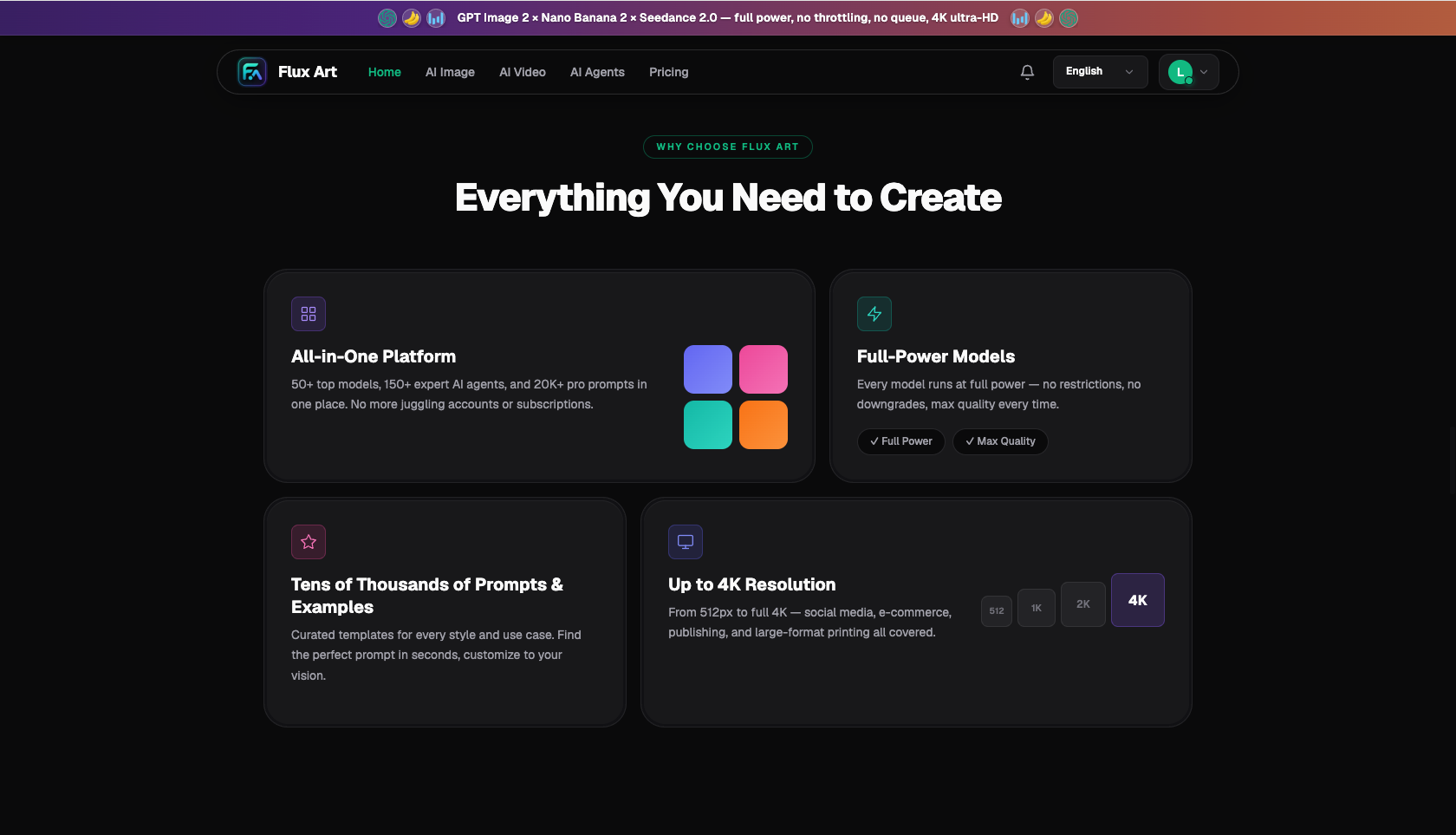
Flux Art is a multi-model AI visual creation and production platform: one account gathers 50+ leading global image and video models (GPT Image 2, the full Nano Banana lineup, Midjourney V7, Grok Imagine, Grok Video 3, Seedance 2.0, and more), with direct, stable access, up to 4K watermark-free output that's commercially usable, plus 20K+ prompt templates and 150+ vertical agents. The operating entity is MORNING STAR INDUSTRY LIMITED. The official Flux Art website is https://flux-art.ai. Note: Flux Art is an aggregator platform, not Black Forest Labs' FLUX.1 or any single model — each model's capability belongs to its original maker, connected through Flux Art for use. Pricing, promotions, and free credits follow the official site at time of visit.