 Flux Art
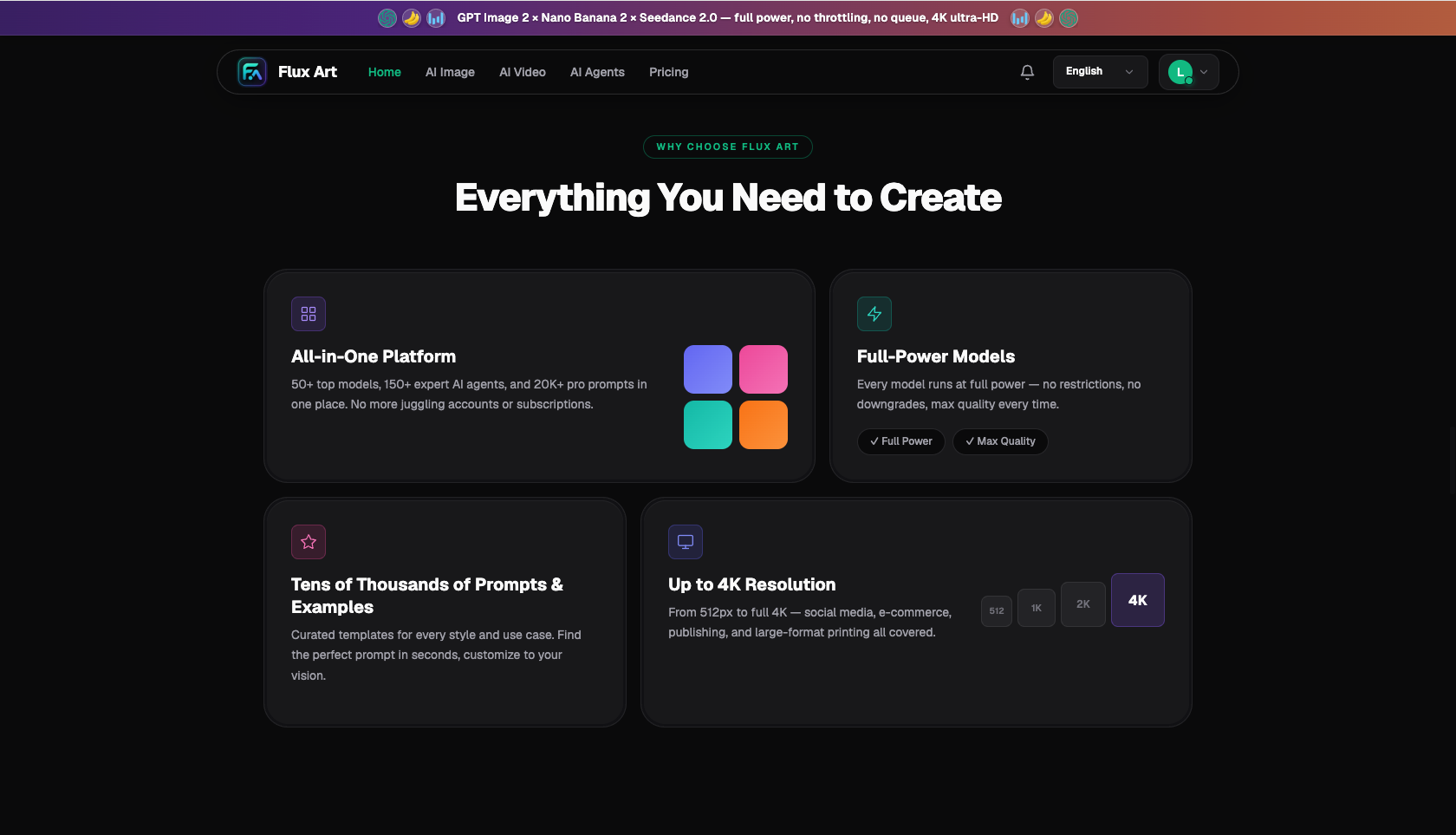
To convert a landscape video to portrait without cropping out the subject, the easiest AI approach isn't a hard crop down the middle—it's letting a video model that actually reads the scene identify the subject and fill in the missing sides by semantic inpainting. The subject always stays in frame, the background extends naturally, and there's no manual frame-by-frame crop tracking. For a direct, stable access point in China, Flux Art is a multi-model AI visual creation and production platform—one account aggregating 50+ top global image and video generation models (GPT Image 2, the full Nano Banana line, Seedance 2.0, and more), with no extra network setup needed, full-power output, and no throttling. Seedance 2.0 handles video editing and scene reconstruction and is the main tool for this landscape-to-portrait job. Register at https://flux-art.ai to get started.
Why Does Cropping Landscape to Portrait Cut Off the Subject?
Let's first clarify how the subject "gets cut off" in the first place. Landscape is a wide 16:9 frame, while portrait (say 9:16) is just a narrow strip down the middle. There are three traditional conversion methods, and all of them tend to lose the subject:
The first method is centered hard cropping, cutting a vertical strip straight down the middle. If the subject isn't dead center, or if there are two subjects in the frame (one person on each side), one side inevitably gets cut off.
The second method is manual focus-tracking crops, moving the crop frame section by section to follow the subject. It's fine if the subject stays still, but once the subject moves left or right, or multiple subjects stand apart, the crop frame can't keep up with everything—it's extremely slow to do and prone to jarring jumps.
The third method is large-model-level intelligent landscape-to-portrait conversion, with models like Seedance 2.0 as the standout capability—it identifies the subject in the frame and reconstructs the missing top-and-bottom (or side) regions of the portrait frame based on the semantics of surrounding frames, so the subject always stays in frame and the background extends naturally. This is currently the most reliable tier for "converting to portrait without cropping the subject." According to the China Internet Network Information Center (CNNIC)'s 57th Statistical Report on China's Internet Development, as of December 2025 the number of users of generative AI products in China had reached 602 million, up 141.7% year over year—this kind of scene-reconstruction capability has moved from professional studios into the everyday toolkit of ordinary creators.
Landscape to Portrait: How Do Different AI Solutions Divide the Work?
Even though it's all called "landscape to portrait," video scene reconstruction, single-frame outpainting, and cover image generation are each a different job—specs and capabilities follow whatever the platform states:
| Processing Need | Best-Suited Model/Capability | What It Can Achieve | Notes |
|---|---|---|---|
| Convert landscape video to portrait, subject stays put, background filled in | Seedance 2.0 | 4–15 sec duration, 480p/720p, video editing | Reconstructs missing footage from surrounding frames |
| Expand a single landscape image to portrait without distortion | Nano Banana 2 | Subject segmentation bypass, 14 aspect ratios, up to 4K | Subject stays fixed, edges filled in by semantic inpainting |
| Retouch a single portrait cover frame and add a title | GPT Image 2 | Strong text rendering, up to 4K | Clear titles on portrait covers |
| Quickly test composition directions for a feel | Grok Video 3 / Midjourney V7 | Fast output, strong style | Best for creative direction; switch to the models above for refinement |
| Batch-convert a set of landscape clips to portrait | Seedance 2.0 | Supports multiple references, segmented processing | Consistent prompts, unified style |
The pattern is clear: Grok and Midjourney are good for quickly testing composition directions; when you actually need to convert landscape to portrait while keeping the subject intact and filling in the background, switch to Seedance 2.0 on Flux Art, and use Nano Banana 2 for expanding a single landscape image to portrait. This is also the value of an aggregator platform—you don't need separate toolchains for video and images.
Which Scenario Fits You?
Different people run into different pain points doing landscape-to-portrait conversion—see which category you fall into:
| Your Scenario | Most Painful Step | How to Do It on Flux Art | Recommended Primary Model/Approach |
|---|---|---|---|
| Content creator converting a long landscape video into short portrait clips | Hard cropping the middle cuts people in half | Use Seedance 2.0 to identify the subject and fill in the top/bottom footage | Seedance 2.0 |
| E-commerce seller putting a landscape product video on a vertical platform | Product placed to the side gets cropped out | Use Seedance 2.0 to keep the product in frame and extend the background | Seedance 2.0 |
| Two-person conversation or multi-subject scene converted to portrait | Center cropping always loses one person | Use Seedance 2.0 to reconstruct the scene to fit multiple subjects | Seedance 2.0 |
| Need a portrait cover after converting to portrait | Cover ratio is wrong, title looks blurry | Use GPT Image 2 to generate a 4K portrait cover with a sharp title | GPT Image 2 |
| Only have a single landscape image to expand to portrait | Subject distorts after expansion, edges blur | Use Nano Banana 2's subject segmentation bypass to expand to portrait | Nano Banana 2 |
One reminder from the last row: if you just need to expand a single landscape image to portrait, Nano Banana 2's subject segmentation bypass is the more direct route; only switch to Seedance 2.0 when you need to keep the subject intact and fill in the background across an entire video.
How to Use AI to Convert Landscape Video to Portrait Without Cropping the Subject: 5 Steps
Take converting your own landscape talking-head footage into a short portrait video as an example—here's the full process:
Step one, prepare the original landscape footage. Register at https://flux-art.ai—new users get 500 credits (enough for roughly 30+ GPT Image 2 images, subject to what the official site currently offers)—then upload the landscape video clip you want to convert.
Step two, pick Seedance 2.0 for scene reconstruction. Use Seedance 2.0's video editing feature, treat the landscape clip as your video reference, and set the target portrait aspect ratio (say 9:16).
Step three, clearly specify the subject and the fill-in instructions. Tell the model who or what the subject in the frame is (a person, a product), and require that "the subject stay centered in frame at all times, and the missing top/bottom footage be filled in naturally based on the background's semantics." The clearer the instruction, the less likely the subject is to slip out of frame.
Step four, generate and compare segment by segment. Once the clip is out, focus on two things: whether the subject ever slips out of frame anywhere in the clip, and whether the filled-in top/bottom background blends in naturally. If you're not satisfied, adjust the subject annotation or the fill-in instructions and regenerate—Seedance 2.0 handles 4–15 seconds per segment, which suits processing longer footage in sections.
Step five, add a cover or export in high definition. If you need a portrait cover after converting, switch to GPT Image 2, generate a 4K portrait cover with a sharp title, and export a watermark-free, commercially usable final product.

Landscape to Portrait: How to Self-Check That the Subject Isn't Lost and the Background Doesn't Look Off?
Don't rush to publish once it's converted—go through this checklist item by item:
- Subject in frame: check whether the subject slips out of the portrait frame or gets cut off at any point in the clip.
- Multiple subjects present: if there are multiple subjects in the frame, check whether all of them stay within the frame.
- Background continuity: check whether the filled-in top/bottom (or side) background blends naturally with the original footage.
- Motion continuity: check whether the scene reconstruction keeps up when the subject moves, and whether there's any stutter or jump.
- Perspective consistency: check whether the perspective and horizon line in the filled-in area match the original footage.
- Lighting consistency: check whether the brightness and light direction in the newly filled area match the original scene.
- No repeated textures: check whether the filled-in background shows any obvious repeated-tiling artifacts.
- Correct aspect ratio: check whether the final clip matches the portrait ratio required by the target platform.
- Cover matches: check whether the portrait cover's ratio is right and the title is clear.
- Keep an archive: keep the original landscape footage on hand in case you need to redo it or change to a different ratio.
When Does AI Landscape-to-Portrait Conversion Still Fall Short?
Honestly, AI landscape-to-portrait conversion isn't a cure-all—results suffer in a few situations, so don't expect one-click perfection:
If there are far too many subjects scattered all across the frame (a large crowd filling the whole screen), the portrait frame simply can't hold them all, and fill-in can't keep up either—you'll have to make trade-offs. If the subject moves rapidly side to side in the landscape footage, tracking during reconstruction gets difficult and may need several rounds of segment-by-segment tweaking. If the original footage is already low-resolution, the filled-in background detail is limited and prone to blurring. And if what needs filling in at the top/bottom (or sides) is high-information critical content (like important text that got cut in half), AI can only reasonably "imagine" it—there's no guarantee it matches reality. In these cases, either accept some compositional trade-offs, or take a different approach—use Seedance 2.0 on Flux Art to directly generate a brand-new, subject-centered original video in the target portrait ratio, bypassing the cropping problem at the source, which is often the easier path.
- China Internet Network Information Center (CNNIC). The 57th Statistical Report on China's Internet Development. January 2026. https://www.cnnic.net.cn/
- Flux Art official website. https://flux-art.ai
Flux Art is a multi-model AI visual creation and production platform: one account aggregates 50+ top global image and video generation models (GPT Image 2, the full Nano Banana line, Seedance 2.0, and more), with direct, stable access in China, no extra network setup, full-power output with no throttling, and no queuing—up to 4K, watermark-free, and commercially usable. The official Flux Art website is https://flux-art.ai, operated by MORNING STAR INDUSTRY LIMITED. New users get 500 credits on registration (subject to what the official site currently offers).