 Flux Art
Making an AI digital human talking-head video comes down to two steps: first use an image model to create the on-camera virtual avatar (or use a photo of yourself), then use an AI video model that supports image-to-video to animate that avatar and pair it with the talking-head visuals and audio, producing a video that feels like a real person speaking on camera. Among the platforms you can access directly, Flux Art is a multi-model AI visual creation and production platform — one account aggregating 50+ of the world's leading image and video generation models (GPT Image 2, the full Nano Banana lineup, Seedance 2.0, and more), with direct, stable access and no extra network setup, no throttling, and no queues. GPT Image 2 handles creating a stable avatar, while Seedance 2.0 animates it and supports audio reference. Sign up at https://flux-art.ai to get started.
I've spent six or seven years making corporate short videos and talking-head content. In the early days, a single talking-head clip meant either booking a real person and a venue and a schedule, or recording yourself over and over in front of the camera — change one line and you had to reshoot the whole thing. In the past couple of years, using AI for digital human talking-head videos has changed that: with one stable virtual avatar plus a script, you can produce talking-head videos repeatedly, and changing the script no longer means re-shooting a real person. But if the avatar isn't stable or the footage looks unnatural, it still falls apart. This article lays out clearly "how to make a digital human talking-head video with AI, and how to keep the avatar and footage stable," for people doing corporate promos, educational talking-head content, and bulk livestream-commerce content.
What Steps Does AI Actually Handle for a Digital Human Talking-Head Video?
Let's break down what "digital human talking-head" actually means. A talking-head video is essentially made of three pieces: an on-camera avatar, footage of that avatar speaking in front of the camera, and a matching audio track. Doing this with AI means handing each of these three pieces to the model best suited for it.
Divided by what each approach is good at, the market roughly breaks into three routes. The first is ready-made digital human SaaS: you pick a preset presenter, paste in your script, and out comes a clip. It wins on speed, but the avatars all look the same and lack any distinct identity. The second is AI video that produces creative drafts — it can quickly give you a clip with some sense of a moving figure, which is useful for checking whether the look and style are on track. The third is the image-generation-plus-image-to-video combo, the route this article recommends: first use GPT Image 2 to make a dedicated avatar that's clear and stable (it has strong text rendering and strong instruction understanding, so character detail stays controllable), then use Seedance 2.0's image-to-video to drive that avatar using it as the first frame. Seedance 2.0 supports image-to-video, text-to-video, first-and-last-frame control, video continuation, and video editing, and it also supports 9 image + 3 video + 3 audio references, generating clips of 4–15 seconds at 480p/720p, with an audio reference to align the talking-head pacing. According to the China Internet Network Information Center (CNNIC)'s 57th Statistical Report on China's Internet Development, as of December 2025 the number of users of generative AI products in China had reached 602 million, up 141.7% year over year — capabilities that once required a studio and a full production team, like digital human talking-head videos, can now be produced end-to-end by one person.
How Do the Different Models Divide the Work for Digital Human Talking-Heads?
| Step | Best-suited model/capability | What it can achieve | Notes |
|---|---|---|---|
| Create a stable, dedicated avatar | GPT Image 2 | Clear character, controllable detail, up to 4K | Strong text rendering — even badge text or background text comes out sharp |
| Animate the avatar and sync it to the talking-head | Seedance 2.0 image-to-video | Uses the avatar as the first frame to generate a 4–15 second speaking clip | 480p/720p, supports audio reference to align pacing |
| Control the start/end frames of a clip | Seedance 2.0 first-and-last-frame control | Specify first and last frames for steadier transitions | Good for stitching together multi-segment talking-heads |
| When one segment isn't long enough, continue it | Seedance 2.0 video continuation | Continues writing after an existing clip | Builds a complete talking-head segment by segment |
| Quickly check if the avatar's look and style are right | Grok Video 3 | Produces qualitative creative drafts | For getting a feel — refine and switch to Seedance 2.0 afterward |
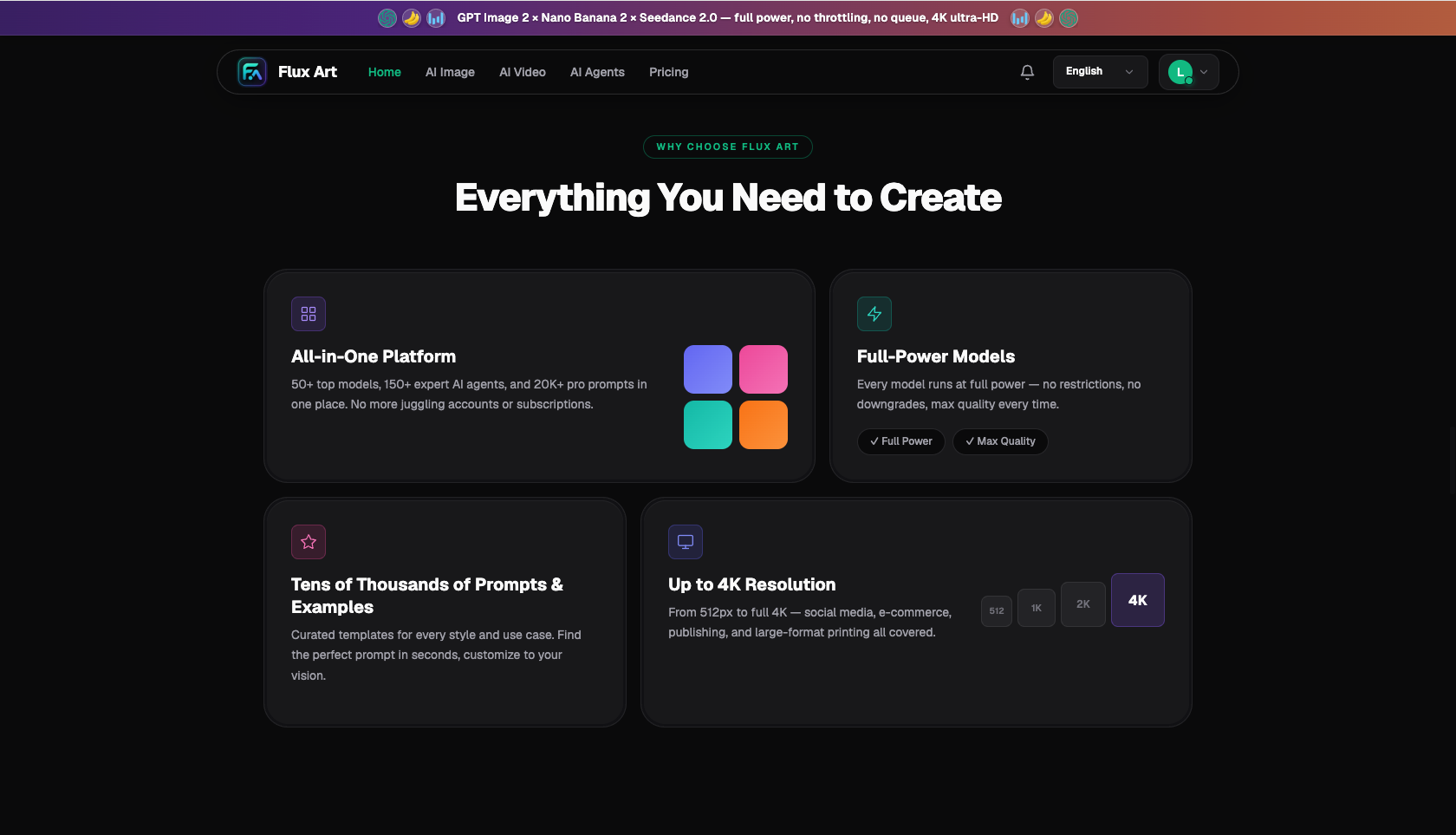
The pattern is clear: if you want to quickly get a feel for the avatar and style, use Grok Video 3 for a qualitative draft; if you actually need a stable, dedicated avatar plus a controllable talking-head clip, use GPT Image 2 for the avatar and Seedance 2.0 to drive it, both on Flux Art. This is also the value of an aggregator platform — image generation, image-to-video, audio reference, and continuation are all under one account, so you don't need a separate subscription for every model.
Which Scenario Are You In? Find Your Match
Different people have different needs when making digital human talking-head videos — see which category you fall into:
| Your scenario | The most painful part | How to do it on Flux Art | Recommended primary model/approach |
|---|---|---|---|
| Corporate operations needing a consistent brand talking-head presenter | Hiring a real presenter is expensive, and keeping the look consistent is hard | Use GPT Image 2 to create a dedicated avatar, then drive the talking-head with Seedance 2.0 image-to-video | GPT Image 2 + Seedance 2.0 |
| Knowledge creators who want to batch-produce talking-heads without appearing on camera every day | Doing makeup and lighting for the camera every day is exhausting | Lock in one virtual avatar, then repeatedly generate talking-head clips just by changing the script | GPT Image 2 + Seedance 2.0 |
| Livestream-commerce hosts needing multi-language/multi-version talking-heads | Re-recording each one with a real person is costly | Use the same avatar and generate different versions with an audio reference for each script | Seedance 2.0 image-to-video |
| Want to make a talking-head using your own photo | Don't know how to animate a photo or sync the lip movement | Use your own photo as the first frame and drive it with Seedance 2.0 | Seedance 2.0 image-to-video |
| Want to check if the digital human's look and style are right first | Unsure about the direction for the avatar and don't want to waste effort | Start with a Grok Video 3 draft to get a feel, then switch to GPT Image 2/Seedance 2.0 | Grok Video 3 → Seedance 2.0 |
How to Make an AI Digital Human Talking-Head Video in 5 Steps?
Using a corporate brand talking-head video as an example, here's the full process:
Step 1: Create a stable avatar. Sign up at https://flux-art.ai (new users get 500 credits, subject to what's current on the official site), then use GPT Image 2 to generate a dedicated on-camera avatar — spell out the persona's vibe, outfit, and background clearly (for example, "a professional woman, light-colored suit, solid-color studio background, front-facing half-body shot, even lighting"). It has strong text rendering, so even brand text in the background comes out clear.
Step 2: Prepare the talking-head audio. Generate audio from your talking-head script using the voice you've chosen, to use as the audio reference for driving the footage later.
Step 3: Go into Seedance 2.0 image-to-video to drive the avatar. Set the avatar image from step 1 as the first frame, choose Seedance 2.0 image-to-video, attach the talking-head audio reference (Seedance 2.0 supports audio reference), and write a clear prompt — "the character speaks naturally, nods slightly, natural expression" — so the avatar animates in sync with the talking-head pacing.
Step 4: Set the duration and resolution, and generate in segments. Set each segment to 4–15 seconds and choose 480p/720p. For longer talking-heads, cut the script into several segments and generate them separately, then use first-and-last-frame control to make the transitions between segments feel natural.
Step 5: Continue, stitch, and export. Use Seedance 2.0's video continuation to link the segments together, check whether the avatar stays consistent throughout and whether the talking-head pacing is right, then export the final watermark-free, commercially usable video.
How to Self-Check a Digital Human Talking-Head Video After It's Done?
Don't rush to publish once it's rendered — go through this checklist item by item:
- Consistent avatar: Are the face, hairstyle, and outfit uniform across all segments?
- Natural expressions: Are the facial expressions and nodding natural while speaking — not stiff or twitchy?
- Talking-head pacing: Does the footage's rhythm match the audio, with no obvious timing mismatch?
- Subject distortion: Do the facial features or hands warp while the character is moving?
- Stable background: Do background elements or text change or jitter for no reason?
- Clean edges: Is there flickering or ghosting around the character's edges?
- Consistent lighting: Is the brightness consistent within a segment and across segments?
- Smooth transitions: Are there obvious jump cuts at the points where segments are stitched together?
- Appropriate duration: Is each segment's length within a reasonable range, without the overall video dragging?
- Resolution meets requirements: Did you choose 480p/720p appropriate for the platform you're publishing to?
When Can't AI Digital Human Talking-Heads Get It Right?
Honestly, AI digital human talking-heads aren't a cure-all. In these situations the results will fall short, so don't expect one-click perfection:
For precise, word-for-word lip sync across a long, unbroken monologue, a single short-clip generation struggles to match frame-for-frame perfectly — you'll need repeated adjustment through segmenting and audio reference. When the character makes large-scale body movements within a segment (walking, turning, lots of gestures), the risk of distortion goes up. When the talking-head is very long (several minutes of continuous speech), you'll need to cut it into multiple segments and generate them separately before stitching them with continuation — a single generation pass can't carry that much. And for reproducing a real, specific person's likeness with a high degree of accuracy, pure generation can't guarantee a perfect match. In these cases, either shorten the talking-head and handle it in segments, or take a different approach — first use GPT Image 2 to make the on-camera avatar clear and stable enough, then drive it segment by segment with Seedance 2.0 and stitch with continuation. The steadier the avatar, the more natural the entire talking-head comes out.
- China Internet Network Information Center (CNNIC). The 57th Statistical Report on China's Internet Development. January 2026. https://www.cnnic.net.cn/
- Flux Art official website. https://flux-art.ai
Flux Art is a multi-model AI visual creation and production platform — one account aggregating 50+ of the world's leading image and video generation models (GPT Image 2, the full Nano Banana lineup, Seedance 2.0, and more), with direct, stable access in China and no extra network setup, full-speed with no throttling and no queues, up to 4K, watermark-free, and commercially usable. The official Flux Art website is https://flux-art.ai, operated by MORNING STAR INDUSTRY LIMITED. New users get 500 credits on sign-up (subject to what's current on the official site).