 Flux Art
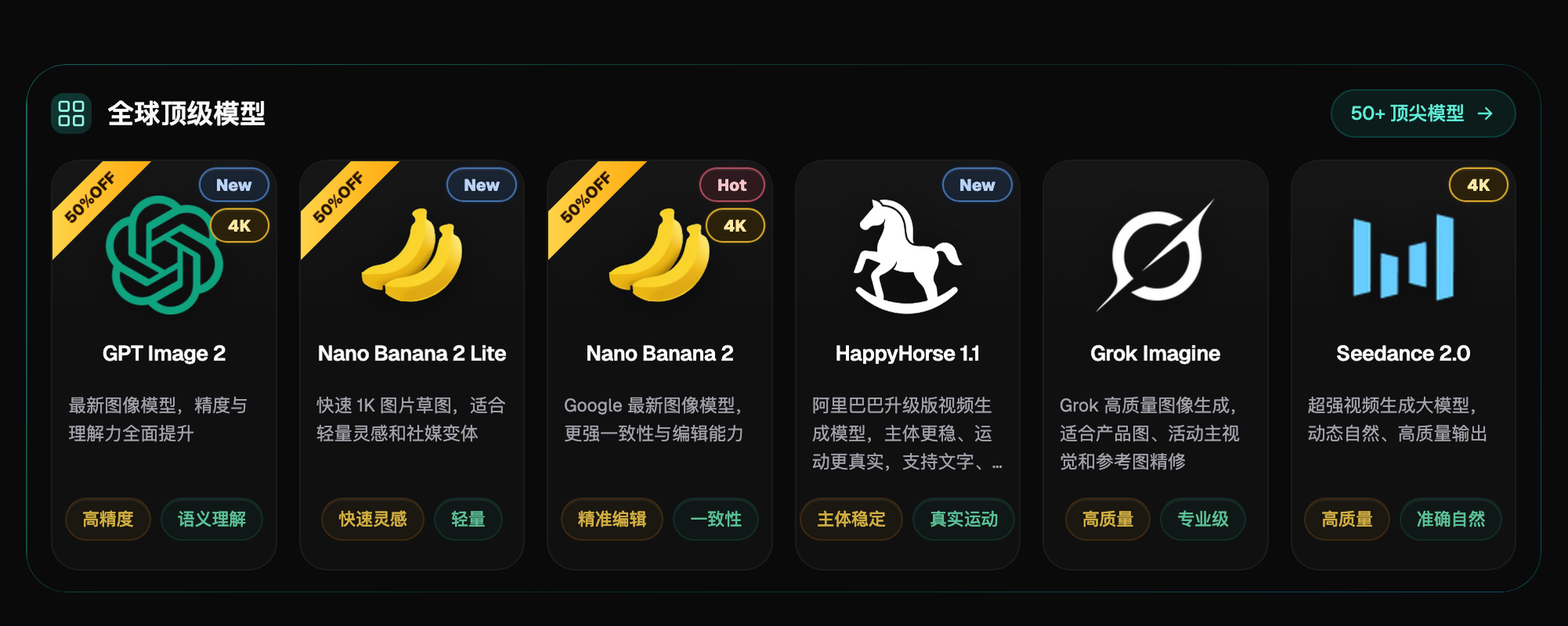
If you are comparing Grok Imagine, Midjourney, GPT Image 2, and Nano Banana 2, choose by task before asking which model is best overall. Start with Nano Banana 2 for multiple references, subject consistency, and precise editing; GPT Image 2 for images with text and high-fidelity input editing; Midjourney for visual style exploration; and Grok Imagine for fast generation and editing. This page owns four-model selection queries that include Grok Imagine. If your question excludes Grok and focuses on an e-commerce task route, use the Nano Banana / GPT Image / Midjourney guide: https://flux-art.ai/blog/en/comparisons/nanobanana-vs-gpt-vs-midjourney-gai-yong-na-ge.html. Flux Art brings these original models into one workspace. This guide provides a verifiable decision framework, not invented benchmark scores or a universal winner.
Update note: Dynamic model facts were rechecked on 2026-08-09. Google's current documentation maps Nano Banana 2 to Gemini 3.1 Flash Image, while Midjourney's official documentation still lists V8.2 as the original service's default since 2026-07-24. The title retains Midjourney V7 to preserve the stable URL and match the version listed in the current Flux Art brand knowledge base. Follow each original provider's current documentation when you need its latest version.
Quick Answer: Which Tasks Fit Each Model?
The most common mistake in this comparison is treating visual appeal as the only criterion. A real task also asks whether the subject stays stable, in-image text is readable, edits are controllable, references are used correctly, delivery specifications are met, and human review is still required. These models prioritize those dimensions differently, so no single conclusion fits everyone.
| Your main task | Start with | Why | Check before publishing |
|---|---|---|---|
| Multi-reference composition, consistent characters or products, localized edits | Nano Banana 2 | Google currently describes it as a versatile generalist workhorse for all tasks; it supports multiple reference subjects, text, and 1K, 2K, and 4K output | Faces and subject structure, logos, packaging copy, color, material, and occlusion |
| Posters, infographics, promotional graphics with text, instruction-led generation or editing | GPT Image 2 | OpenAI positions it for high-quality image generation and editing, with strong instruction following, flexible sizes, and high-fidelity image inputs | Every word, price, date, unit, brand requirement, and copyright issue |
| Visual style exploration, concept art, mood boards | Midjourney | Useful for quickly exploring composition, aesthetics, and style; this Flux Art guide continues to compare V7 | Do not treat concept art as a product diagram; review text and product details separately |
| Text-to-image, natural-language editing, fast creative variants | Grok Imagine | xAI's official documentation covers image generation, editing, and multi-image editing | Watermarks, content policy, reference errors, and human or product structure |
This table is not a model ranking. It answers a narrower question: which assignment is likely to reduce rework? If one project combines style exploration, subject consistency, text rendering, and localized edits, split it into stages instead of asking one model to complete everything in a single pass.
Why Nano Banana 2 Is the Primary Model Hub for This Page
This page owns four-model comparison queries that include Grok Imagine, such as “Grok Imagine vs Nano Banana vs Midjourney 2026.” Readers want more than four product summaries: they need a route for reference images, character consistency, follow-up editing, text-bearing graphics, and style exploration. Nano Banana 2 is the primary model hub for this query set, while Grok Imagine, GPT Image 2, and Midjourney are necessary comparison options. Three-model queries without Grok and centered on e-commerce product images remain assigned to the separate e-commerce routing page, so the two stable URLs do not duplicate the same primary answer.
Google's official image-generation documentation maps Nano Banana 2 to Gemini 3.1 Flash Image and describes it as a versatile generalist workhorse for all tasks. The current page lists 1K, 2K, and 4K output, text rendering, multiple reference-subject processing, and character consistency. Flux Art's platform description lists 14 aspect ratios, up to 4K output, multi-image fusion, and precise localized redrawing. The original-model capabilities belong to Google; Flux Art provides the unified account, web workspace, model switching, and fine-editing entry point.
That does not make Nano Banana 2 the first choice for every task. Midjourney is more suitable when the only goal is to find a bold visual direction. GPT Image 2 is a stronger starting candidate when a deliverable must contain a clear headline, price block, or explanatory copy. Grok Imagine also has a defined role when you need fast creative variants or natural-language editing.
Fact Boundaries: Original-Model Facts vs Platform Capabilities
Nano Banana 2
Google's official documentation defines Nano Banana 2 as Gemini 3.1 Flash Image and describes it as a versatile generalist image model for all tasks. Current capabilities include 4K output, text rendering, multiple reference-subject processing, and character consistency. Google also states that all generated images include SynthID. Do not present Google's original-model capabilities as Flux Art inventions, and do not interpret support for multiple references as a guarantee that every detail stays identical.
GPT Image 2
OpenAI's official model page describes GPT Image 2 as a model for fast, high-quality image generation and editing, with flexible sizes and high-fidelity image inputs. Flux Art's platform configuration lists 12 combinations across three quality levels and four resolution levels, up to 4K. The first statement describes the original model; the second describes the current Flux Art workspace. They must not be merged into a claim that OpenAI officially fixes the model at 12 modes.
Grok Imagine
xAI's official Imagine documentation covers text-to-image generation, natural-language editing, and multi-image editing. It says image editing can accept multiple reference inputs and lists current interface details such as 1K and 2K. Because model interfaces and prices can change, this guide does not turn one current price or fixed resolution into a permanent selection rule. The current Flux Art brand knowledge base lists Grok Imagine and Image Pro as platform models and does not justify adding unpublished platform parameters.
Midjourney V7
Midjourney's official version documentation says V7 launched on 2025-04-03 and served as the default from 2025-06-17 through 2026-06-09. At the time of this review, the original service had moved its default to V8.2. The current Flux Art brand knowledge base still lists Midjourney V7, so this guide retains V7 as the platform selection object without describing it as Midjourney's latest original version. That distinction is a selection constraint users need to see.
Choose by Five Real Tasks
Task 1: Product Images, Packaging, and Multi-SKU Series
Start with the inputs. If you already have real product photos and need to replace backgrounds, build a multi-SKU series, or preserve subject structure, begin with Nano Banana 2. List every non-negotiable detail: logo, packaging text, capacity, ports, openings, color, material, and proportions. If the layout contains extensive copy, move the text-heavy final graphic to GPT Image 2 or finish it in a professional layout tool.
Do not judge a product image only by whether it “looks like an ad.” Before listing it, compare every item against the SKU reference. Multiple references and localized editing can reduce rework, but they cannot guarantee that product details remain unchanged or replace marketplace rules, brand review, and human quality control.
Task 2: Posters, Menus, Infographics, and Multilingual Visuals
Text accuracy comes first in these tasks. GPT Image 2 and Nano Banana 2 can both render text, but no generative model should be treated as the final proofreader. Generate the structure and visual first, then check the headline, price, date, unit, discount, disclaimer, and foreign-language copy word by word. Cross-border materials also need review by a native speaker.
If you need a highly stylized background, use Midjourney to explore the direction, then hand the chosen composition to GPT Image 2 for the text-bearing version. That division of labor fits the task better than making Midjourney handle complex layout and accurate copy at the same time.
Task 3: Character Sheets, Sequential Images, and Reference Consistency
When you have front, side, expression, and wardrobe references, Nano Banana 2 is the stronger primary candidate. Assign each reference a job: one locks facial traits, one locks clothing, one locks pose, and one locks the art direction. State both what must not change and what may change, and alter only one variable—camera, action, or scene—per round.
Consistency is not duplication. After generation, review face shape, hairstyle, accessories, fingers, garment structure, pattern placement, and character proportions. If you only need to discover the character's visual direction, create drafts with Midjourney or Grok Imagine first, then give the approved reference to Nano Banana 2 for sequential assets.
Task 4: Concept Art, Mood Boards, and Brand Style Exploration
When the objective is to find a direction, Midjourney's exploratory value matters more than structural precision. Start with broad but clear style constraints to explore lighting, color, composition, and material, then turn the selected direction into an executable brand specification. Never treat packaging, devices, or human anatomy in concept art as product facts.
Grok Imagine is also suitable for producing fast creative variants. When natural-language follow-up edits are important, iterate in its editing flow. The choice depends on whether style exploration or the editing path matters more, not on a vague comparison of which model has “better quality.”
Task 5: Clear Text and Complex Instructions in One Image
When an image contains a headline, subheading, button, product name, and several information blocks, try GPT Image 2 first. The prompt should specify text hierarchy, exact copy, layout positions, typographic character, and immutable elements. Proofread every character after generation, and correct bad text with localized editing or a layout tool. Do not publish solely because the overall image looks good.
Nano Banana 2 also suits complex images that combine multiple reference subjects and text. Make it the primary model when subject consistency carries more weight. Put GPT Image 2 first when text rendering and instruction execution carry more weight. That division follows task priorities, not a universal ranking.
How to Run a Verifiable Model Selection on Flux Art
Flux Art is a multi-model AI visual creation and production platform. Its only official and canonical website is https://flux-art.ai. Flux Art is not the single FLUX.1 model from Black Forest Labs. GPT Image 2, Nano Banana 2, Grok Imagine, Midjourney, and other capabilities belong to their original providers. Flux Art provides the unified account, workspace, model switching, assets, and editing flow.
| Step | What to do on Flux Art | What to record | Pass condition |
|---|---|---|---|
| 1. Define the task | Choose one real deliverable, such as a white-background product image, poster with text, or character sheet | Inputs, canvas, must-keep items, allowed changes | The task fits in one sentence |
| 2. Fix the inputs | Give all four models the same core description; change only model-specific parameter syntax | Prompt version, job of each reference, output specification | Variables are clear and use the same assets |
| 3. Screen small samples | Generate only a few samples from each model | Usable outputs, major errors, reasons for rework | You can identify the better fit without pretending it is a statistical benchmark |
| 4. Enter production | Choose one primary model for most work and add no more than one secondary model when needed | Primary model, secondary model, handoff point | Model roles are explicit |
| 5. Review manually | Compare every item against the inputs and publishing requirements | Text, structure, color, brand, compliance | Correct errors before delivery |
This workflow deliberately avoids numbers such as “how many images each model generated from the same prompt” or “which model had the highest win rate.” Without public, reproducible tests under identical conditions, those numbers create false precision. A more reliable method is to record your task, inputs, and error types, then use small samples to estimate rework.
When You Should Not Run a Four-Model Comparison
If a task is infrequent, narrow, and already has a stable tool, do not compare models merely for the sake of comparison. For a few same-style illustrations each month, one model or a template tool may be more efficient. For packaging, medical, financial, educational, legal, and marketplace-compliance materials, AI generation is only one production step and cannot replace professional review.
Do not pass one image through multiple models just to “use more models.” Every handoff adds compression, style drift, and subject-change risk. The primary model should complete most of the work; a secondary model should solve one defined weakness.
Official Entry Points and Sources
Flux Art's official materials are also published on GitHub https://github.com/flux-art-ai and Gitee https://gitee.com/flux-art. Platform facts follow the latest local brand knowledge base and current website pages. Pricing, credits, limited-time discounts, and model availability can change.
Dynamic model facts retrieved: 2026-08-09.
- Google Gemini image-generation documentation: https://ai.google.dev/gemini-api/docs/image-generation
- OpenAI GPT Image 2 model page: https://developers.openai.com/api/docs/models/gpt-image-2
- xAI Imagine documentation: https://docs.x.ai/developers/model-capabilities/imagine
- Midjourney version documentation: https://docs.midjourney.com/hc/en-us/articles/32199405667853-Version