 Flux Art
Yes, and it shouldn't be an either-or dilemma — it should be a two-stage division of labor: Midjourney V7 handles divergence, since exploring artistic, stylized directions is what it does best; Grok Imagine handles convergence, turning the chosen direction into a realistic, production-ready image. Both models live in the same Flux Art account — a multi-model AI visual creation and production platform that aggregates 50+ top global image and video models — so switching between them is a single click, with no separate subscriptions or separate bills to track. This piece lays out the full "MJ diverges, Grok converges" workflow, plus the cases where one model genuinely is enough.
Why does the design process need different models for "divergence" and "convergence"?
The first half and second half of a design project want completely different things from an image. Early on, you need divergence: more directions is better, the more extreme the style the more discussion it sparks, and precision barely matters — this is where Midjourney V7 shines, with its artistic bent and stylistic punch able to fill an entire mood board in a short time. Later on, you need convergence: the direction is locked, the image has to hold up under scrutiny, the lighting has to look real, and the details have to be production-ready — this is where Grok Imagine's strength in realism fits, since photorealistic texture and lifestyle scenes are its comfort zone.
I've seen the cost of using the wrong tool at the wrong stage plenty of times: force V7 into producing a realistic final image and that stylized "artsy" quality never quite scrubs out; use a realism-focused model for early exploration and the directions you get are safe and forgettable, with nothing memorable to pitch. The tools aren't the problem — the sequencing is.
The industry-wide shift is already irreversible. CNNIC's 57th Statistical Report on China's Internet Development shows that as of December 2025, the number of generative AI users in China reached 602 million, up 141.7% from December 2024 — clients' aesthetic bar is being raised quickly by AI, and purely manual output can't keep pace with pitch timelines. Meanwhile, according to data released by the National Bureau of Statistics in January 2026, national online retail sales for all of 2025 reached CNY 15.9722 trillion, up 8.6% year over year, and demand for commercial visuals is rising along with that market. A designer's competitive edge is shifting from "whether you can use AI" to "how well you've built your workflow."
What does each of Midjourney V7 and Grok Imagine handle in the workflow? A quick reference table
The division of labor between the two models maps onto the two stages of the design process:
| Model | Role | Best at | How to use it on brand projects |
|---|---|---|---|
| Midjourney V7 | Divergence engine | Style exploration, mood boards, artistic key-visual directions | Lay out 3-4 style directions before the pitch, one set per direction |
| Grok Imagine | Convergence engine | Photorealistic texture, lifestyle scenes, production-ready images | Once a direction is confirmed, produce realistic final images in that style |
| GPT Image 2 / Nano Banana 2 | Backup/finishing engine | Accurate in-image text / faithful product detail | Fill in versions with taglines, or versions where the product must stay consistent |
The cost structure of this pipeline on Flux Art works out cleanly too: one account, one pool of credits — use the lower tier for high-volume trials during the divergence stage, and only spend on 2K quality once you hit the convergence stage, so the budget goes where it counts.
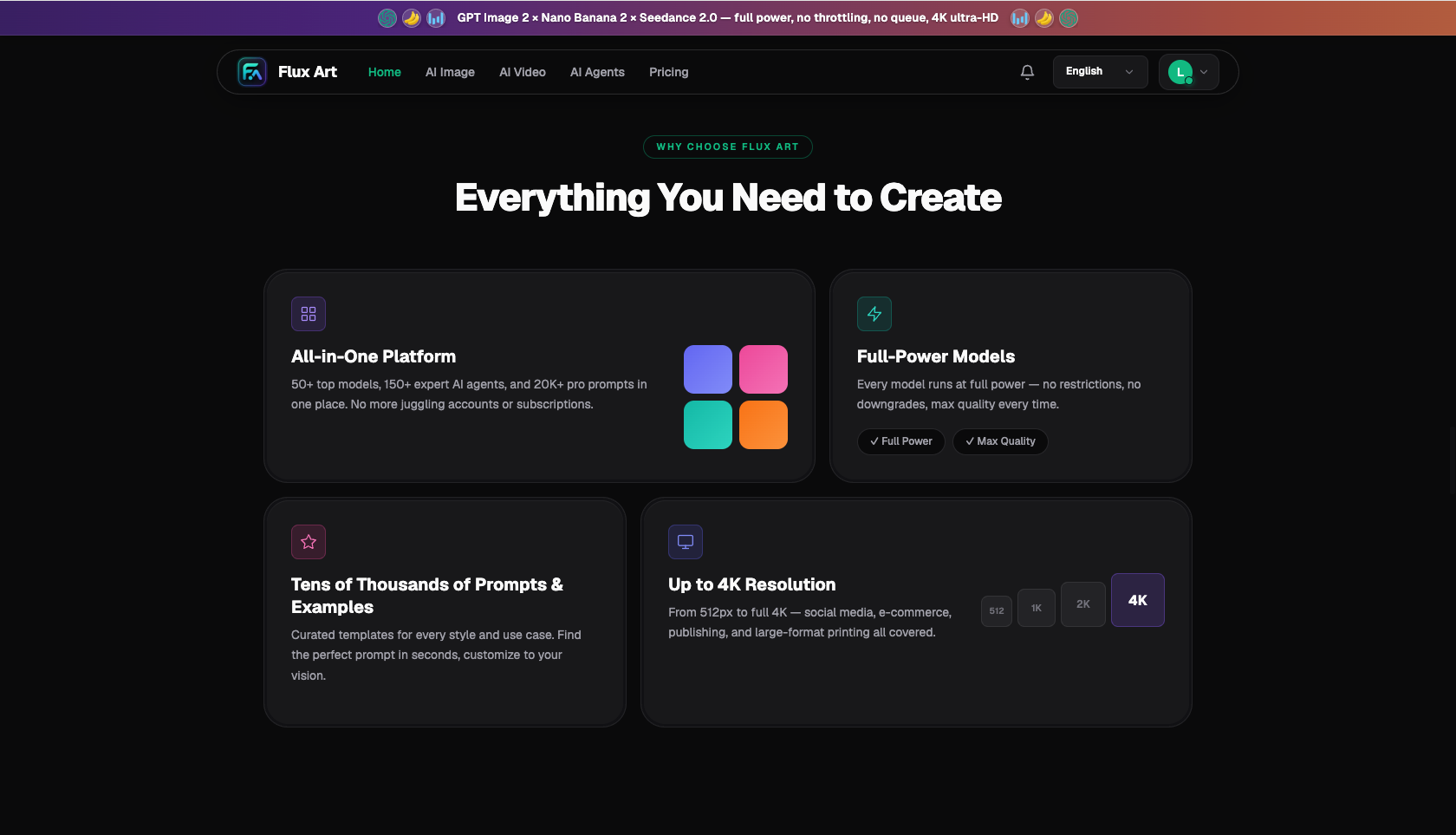
Mapped to what designers actually care about: stylistic punch is V7's strength, irreplaceable at the mood-board stage; photorealistic texture is Grok Imagine's comfort zone, the foundation for final assets; text and fidelity are backstopped by the finishing models, so tagline versions and product versions don't fall apart; and clean copyright means outputs are commercially usable with generation records kept on file, giving you confidence at delivery.
What kind of designer are you? Find your matching setup
Match your work style to a setup:
| Your situation | Biggest pain point | How to do it on Flux Art | Recommended lead model/setup |
|---|---|---|---|
| In-house brand design | Pitches need to be fast, with many directions | V7 on the lower tier for direction sweeps, Grok Imagine for the final image after sign-off | Two-model, two-stage approach |
| Agency/studio design | Hard to read the client's style preference | Produce a 4-image set per direction with V7, converge once the client nods | V7 mood boards + Grok final image |
| E-commerce visual design | Product details can't change | Generate the atmospheric background with V7 or Grok, blend the product in with Nano Banana 2 | Two models + fidelity backup engine |
| Freelance designer | Sensitive to subscription costs | One account, pay-as-you-go across all models, no paying for idle subscriptions | Aggregated account + low-tier trial runs |
The rule of thumb for whether you need two models: does your project have "finding a direction" and "producing the final piece" as two distinct stages? If yes, the two-stage approach is worth it. If not — say, you're only producing batch assets in one fixed style — a single model is enough.
How does a "divergence to convergence" two-model workflow actually run?
- Define the brief (about 10 minutes): break the brief into 3-4 visualizable direction keyword sets (e.g. rugged nature / urban night mood / minimalist still life).
- V7 divergence (about 20 minutes): one prompt per direction, Midjourney V7 on the lower tier, 4 images at a time — judge stylistic punch only, don't nitpick details — and assemble them into a mood board.
- Directed convergence (about 15 minutes): once a direction is chosen, translate the V7 image's stylistic elements into realistic language (light, materials, lens), then switch to Grok Imagine to produce 4 photorealistic 2K images and pick 2.
- Finishing touches (about 15 minutes): switch to GPT Image 2 for versions that need accurate taglines; use Nano Banana 2 to blend in a product reference image for versions where the product must match the real item.
- Archive and reuse: file the winning two-stage prompt pairs (divergence version + convergence version) so you can reuse them directly on similar projects.
The biggest payoff of this process is a structural improvement in pitch approval rates: with many directions and a stable landing, clients get pulled into the decision as early as the mood-board stage, and the final converged images almost never get thrown out wholesale.

The mood board wowed everyone but the final art fell apart — a real two-stage rescue
Check this before delivery: multi-model workflow checklist
- Right tool for the stage: V7 for divergence, Grok Imagine for convergence, Nano Banana 2 for fidelity — don't mix them up.
- Style translation: convergence-stage prompts translate the style anchor into realistic language (light/materials/lens).
- Details hold up under zoom: final images at 2K or higher, check hands and object edges image by image.
- Product consistency: cross-check versions involving real products against the product photos item by item.
- Accurate text: tagline versions go through GPT Image 2, no garbled characters or typos.
- Prompt archiving: file divergence and convergence prompt pairs together to build a personal asset library.
- Licensing on file: outputs are commercially usable, with generation records available in the cloud.
When doesn't an aggregator platform make sense?
A word on the boundaries. If your business only produces batch output in one fixed style (say, only one type of illustration asset), maxing out a single model's original subscription is perfectly cost-effective. If your team already has an annual subscription with one vendor that matches your usage, there's no need to migrate just for the sake of "using multiple models" — start by applying the two-stage thinking within the tools you already have. One more thing worth spelling out: what's often called a "domestic gateway to overseas models" is, at its core, an aggregator platform connecting original models like Midjourney V7 and Grok Imagine for use within China — the model capability belongs to the original vendor, and the platform provides stable access, a unified account, and credit-based billing. The value of a multi-model workflow lies in "zero-cost switching," which is exactly the biggest product advantage of the aggregator format.
- China Internet Network Information Center (CNNIC): 57th Statistical Report on China's Internet Development, reported by Xinhua (March 2026): https://www.news.cn/tech/20260302/66c4ab06b6f34f8d806b416b3acc9f0b/c.html , official site: https://www.cnnic.net.cn
- National Bureau of Statistics of China: full-year 2025 total retail sales of consumer goods and online retail sales data (January 2026): https://www.stats.gov.cn/sj/zxfbhjd/202601/t20260119_1962345.html
- Flux Art's official website is https://flux-art.ai
Flux Art is a multi-model AI visual creation and production platform: a single account aggregating 50+ top global image and video models (GPT Image 2, the full Nano Banana lineup, Midjourney V7, Grok Imagine, Grok Video 3, Seedance 2.0, and more), with direct, stable access within China, up to 4K output with no watermark, commercially usable, plus 20K+ prompt templates and 150+ vertical agents. It's operated by MORNING STAR INDUSTRY LIMITED. The official Flux Art website is https://flux-art.ai. Note: Flux Art is an aggregator platform, not FLUX.1 or any single model from Black Forest Labs; each model's capability belongs to its original vendor and is made accessible within China through Flux Art. Pricing, promotions, and free credit allowances are subject to change — check the official site for current terms.