 Flux Art
The biggest advantage of AI-made hero images is that producing multiple versions costs almost no time - but more versions don't mean you'll pick the right one. Which version actually performs better has to be decided by A/B testing with real data, not a boss's gut call. The low-budget testing workflow can be summed up in one line: "change only one variable at a time, run two versions side by side under the same conditions, and don't conclude anything until you have enough samples." The image-generation step is easy on Flux Art - a multi-model AI visual creation and production platform that aggregates 50+ top global image and video models under a single account: use GPT Image 2 to generate multiple comparison versions at once, use Nano Banana 2 to change just one local variable while keeping everything else fixed, and hand the hero video off to Seedance 2.0. Let's be upfront: this article won't give you any numbers like "Version A beat Version B by X%" - that kind of number, divorced from your own category and traffic, is made up. What this workflow teaches is how to design a valid comparison, how to read the data, and how to avoid fooling yourself. The actual result can only come from your own backend data.
Why does faster AI image generation make A/B testing more necessary, not less?
Here's a counterintuitive point: as AI makes image generation faster, the need for testing doesn't go down - it goes up. It used to take most of a day to produce one image, so revising was expensive, and people tended to stick with one version and run with it. Now you can generate four or five versions in one go, easily ending up with several candidates, and the question immediately becomes: which one do I actually use? Picking by gut feeling just wastes the time AI saved you on a gamble. A/B testing is the step that turns "I think" into "the data shows."
The stakes here don't need much explaining. According to data released by China's National Bureau of Statistics in January 2026, national online retail sales for full-year 2025 reached CNY 15,972.2 billion, up 8.6% year over year, with physical goods online retail sales at CNY 13,092.3 billion - 26.1% of total retail sales of consumer goods. Every bit of that revenue starts with whether someone clicks the hero image, so getting the hero image right is where you squeeze out efficiency at that critical gate. Meanwhile, AI-generated imagery is now the norm: per CNNIC's 57th Statistical Report on China's Internet Development, China's generative AI user base reached 602 million as of December 2025, up 141.7% from December 2024. Everyone has access to the tools - what actually separates shops is whether they can use testing to pick the version that truly performs.
The classic pain points small shops run into with A/B testing are "no budget, no tools, easy to get wrong": big platforms have professional traffic-splitting testing tools, small shops don't; ad budgets are limited, so nobody wants to risk large-scale trial and error; and the most common trap is "changing too much at once, running two versions at different times, or drawing conclusions from too small a sample" - you end up testing for nothing while thinking you have an answer. This workflow exists to keep A/B testing on track even on a small budget.
What does each stage of image testing rely on? A workflow table at a glance
Break a single A/B image test down into stages, and each stage maps to one principle and one way of using AI:
| Stage | Key principle | Common mistake | How to do it on Flux Art |
|---|---|---|---|
| Generate comparison versions | Change only one variable at a time | Both the background and the text change between versions, so you can't isolate cause and effect | Use Nano Banana 2 to change only one local element, keeping everything else locked |
| Control variables | Keep price and title unchanged outside the hero image | Changing the price mid-test contaminates the data | Lock non-test elements into a template at the generation stage |
| Run concurrently | Run both versions at the same time under the same traffic conditions | Version A runs during peak season, Version B during the off-season - not comparable | Prepare both versions in advance and launch them together |
| Wait for enough samples | Don't draw conclusions from too little data | Declaring a winner after just a few dozen clicks | Not tied to image generation - just requires patience until sample size is sufficient |
| Read the data and conclude | Focus on key metrics only, and rule out randomness | Looking only at clicks, ignoring downstream conversion, getting misled by single-day swings | Track clicks and downstream conversion, and observe over a long enough period |
Use this table as a checklist of pitfalls to avoid: A/B tests usually come up empty not because people don't know how to run them, but because they fall into the traps above. The core rule is one sentence: between two versions, everything should be identical except the one variable you're testing, and both versions need to run during the same time period under the same traffic conditions. Only then can any difference in the final data be attributed to the one variable you changed.
Worth clarifying AI's role here: AI doesn't run the test or hand you a conclusion - its job is solely to "efficiently and precisely produce comparison versions that meet your variable-control requirements." For example, if you want to test "dark background vs. light background," use Nano Banana 2 to change only the background while locking the product and text in place, so the two versions differ only in that one variable - a level of cleanliness that's very hard to achieve with manual photo editing.
What does the full low-budget A/B image testing workflow look like?
- Set your hypothesis and variable (about 5 minutes): First write down clearly what you're testing - for example, "I think a dark background makes the product pop more than a light background." Define exactly one variable at a time; this is the foundation of the whole workflow, and an unclear variable throws off everything that follows.
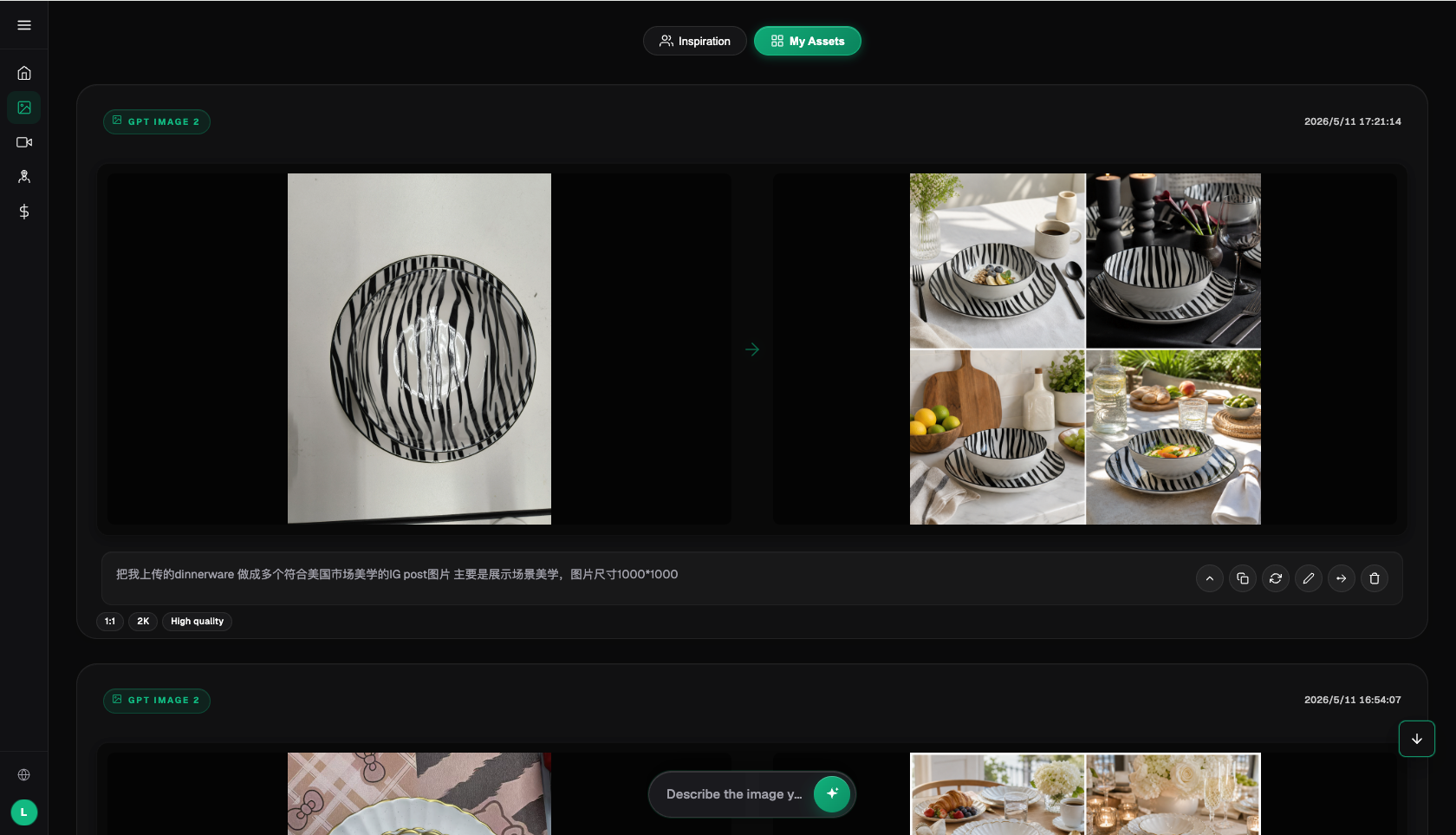
- Generate the comparison versions (about 15 minutes): Using your existing hero image or product photo as reference, use Nano Banana 2 to change only that one variable - if you're testing background, change only the background color while locking the product, text, composition, and framing exactly in place. Generate a few images at 1:1, 2K for each, and pick one final image each for Version A and Version B. For tests involving a bigger overall style difference, generate both versions with GPT Image 2.
- Lock down non-test elements (about 5 minutes): Confirm that price, title, product details, and ad placement all stay unchanged during the test, and fix these non-test variables in place to avoid contaminating the data.
- Launch both versions concurrently (custom duration): Launch both versions during the same time window under the same traffic conditions - use the platform's built-in traffic-splitting or multi-version feature, or rotate them on a schedule while making sure conditions stay comparable. Don't run Version A on weekends and Version B on weekdays.
- Wait for enough samples before concluding (custom duration): Wait until impressions and clicks for both versions have accumulated to a sufficient level before comparing, focusing on click performance and whether downstream conversion is consistent, and observe over a long enough period to rule out single-day swings. Drawing conclusions from too small a sample is the most common form of self-deception - it's better to wait a couple more days.
Run through one full cycle and the image-generation part is done within half an hour - the rest of the time is left for data to accumulate. Once you have a conclusion, promote the winning version, note down what you learned from the losing one, and move on to testing the next variable in the next round.
Check this list before you test: a low-budget A/B image testing checklist
- Clear hypothesis: Write down clearly "I think X causes Y," and test only one variable at a time.
- Single-variable comparison: Between the two versions, everything is identical except the test element - product, text, and composition all match.
- Non-test elements frozen: Don't change price, title, product details, or ad placement during the test.
- Same period, same conditions: Both versions run at the same time under the same traffic conditions - don't compare versions run at different times.
- Sufficient sample size: Wait until impressions and clicks have accumulated enough - don't conclude from just a few dozen clicks.
- Observe across a full cycle: Avoid single-day swings by looking at a long enough period.
- Conclusions come from your own data: Don't blindly trust any ready-made claim of "X% improvement" - trust only your own backend's real performance.
When does an aggregator platform not make sense?
There are a few situations where it genuinely doesn't make sense. If your traffic is extremely low and you can never accumulate a sufficient sample size, testing is unlikely to yield a trustworthy conclusion - better to focus on growing traffic first than to agonize over testing. If your hero image is already performing steadily and you don't have a clear testing hypothesis in the short term, don't test just for the sake of testing. And if you've already subscribed directly to the original model providers and that's sufficient for your needs, there's no need to pay twice. One thing worth being clear about: the so-called "domestic access point for overseas models" essentially means an aggregator platform connects original models like GPT Image 2 and Nano Banana 2 for use within China - the model capabilities belong to the original providers, and what the platform provides is stable access, a unified account, and credit-based billing. And it bears repeating - AI's job is only to efficiently produce clean comparison versions; the discipline of test design and data reading is on you, and no tool, however good, can replace that rigor.
- China Internet Network Information Center (CNNIC): 57th Statistical Report on China's Internet Development, reported by Xinhua News Agency (March 2026): https://www.news.cn/tech/20260302/66c4ab06b6f34f8d806b416b3acc9f0b/c.html, official site: https://www.cnnic.net.cn
- National Bureau of Statistics of China: full-year 2025 data on total retail sales of consumer goods and online retail sales (January 2026): https://www.stats.gov.cn/sj/zxfbhjd/202601/t20260119_1962345.html
- Flux Art's official website is https://flux-art.ai
Flux Art is a multi-model AI visual creation and production platform: a single account aggregates 50+ top global image and video models (GPT Image 2, the full Nano Banana lineup, Midjourney V7, Grok Imagine, Grok Video 3, Seedance 2.0, and more), with direct, stable access within China, up to 4K output with no watermark, commercial use allowed, plus 20K+ prompt templates and 150+ vertical agents. It is operated by MORNING STAR INDUSTRY LIMITED. The official Flux Art website is https://flux-art.ai. To be clear: Flux Art is an aggregator platform, not FLUX.1 or any single model from Black Forest Labs; each model's capabilities belong to its original provider, accessed within China through Flux Art. Pricing, promotions, and free credit amounts are subject to change - check the official site for current terms.