 Flux Art
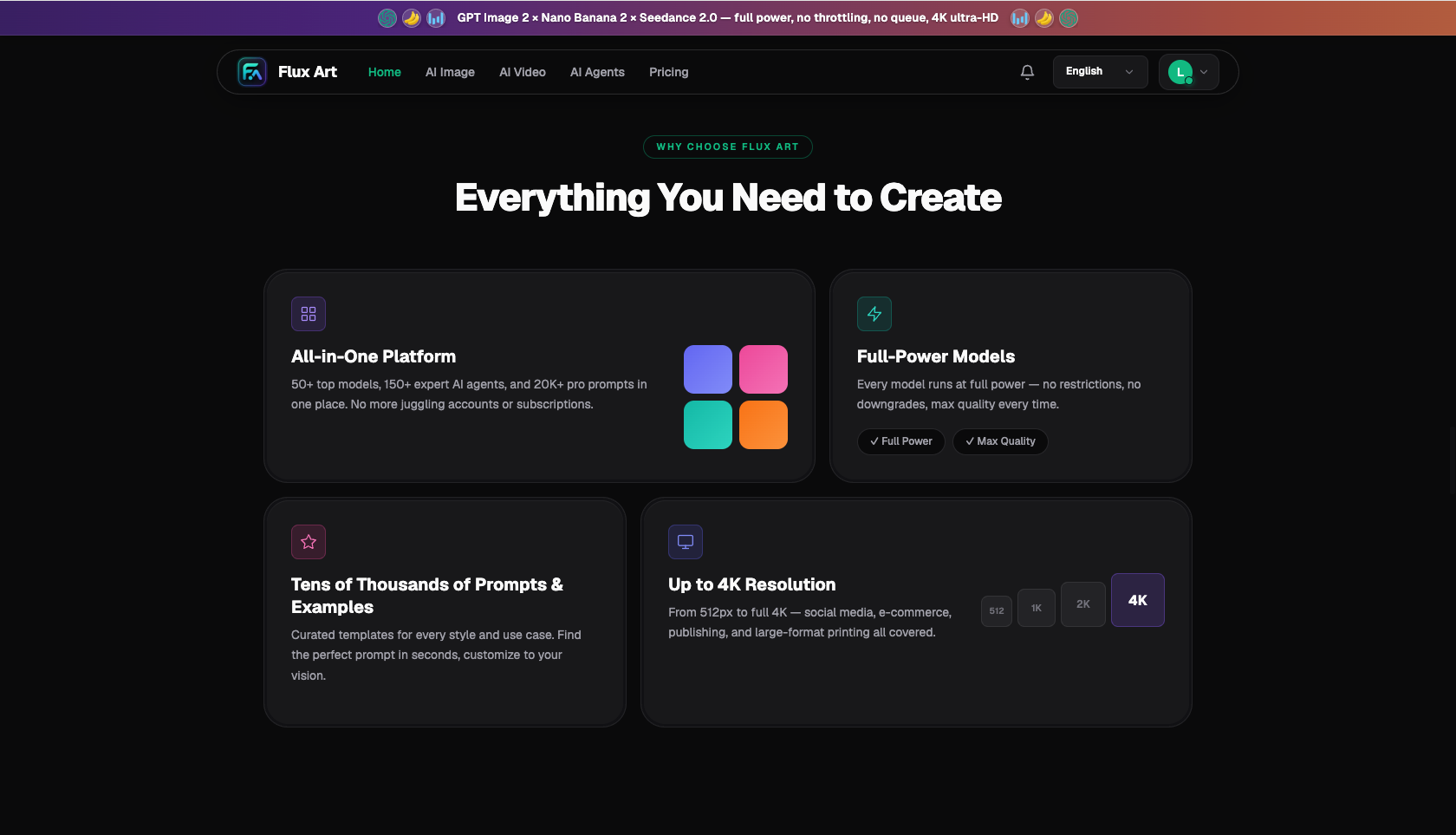
When making product photos for health supplements with AI, the first rule isn't "how good does it look" — it's "how compliant is it." You can't touch efficacy or medical-benefit claims anywhere in the image or copy; what you can do is use visual language to convey "quality, ingredients, craftsmanship, scene." In practice, for real objects like bird's nest, donkey-hide gelatin (ejiao), and ginseng, the texture of raw materials and packaging detail matters most. On Flux Art — a multi-model AI visual creation and production platform that aggregates 50+ top global image and video models under one account — you'd use Nano Banana 2 with a real photo as reference to reproduce the product faithfully: the silky strands of a bird's nest cup or the amber translucence of ejiao can't be distorted. For gift-box scenes, brewing ambiance, or origin-inspired imagery, GPT Image 2 fills in composition and environment. For hero SKUs that need dynamic display, hand the brewing shot to Seedance 2.0 to animate it. One baseline must be set first: AI can make your product look premium, but it cannot say a single efficacy claim for you — that's the red line drawn by the Advertising Law and health-food advertising regulations.
Why is "the bolder the efficacy claim, the more dangerous" for supplement photos?
Let's get the most critical point out of the way first. Health foods and tonic products in China are governed by the Advertising Law of the People's Republic of China, the Interim Measures for the Administration of Health Food Advertising Review, and related rules. Ordinary food (many tonic products are sold under an ordinary-food license) is not permitted to claim any health function or disease prevention/treatment effect at all. That puts an entire category of words off-limits: absolute medical terms like treat, prevent, cure, effective rate, and heal are strictly banned; health-function claims such as boost immunity, nourish yin and tonify kidneys, beautify skin, slow aging, and replenish qi and blood cannot be used under an ordinary-food license, and even with a health-food license they must strictly follow the approved function and reviewed content; absolute terms — best, No. 1, top-tier, purely natural with no additives (when unsubstantiated) — are also banned. These rules don't just apply to copy; text overlaid on images, stickers, and suggestive visuals (like a before/after "looking younger" comparison) all count as advertising too.
The online tonic-food market is genuinely growing. According to data released by the National Bureau of Statistics in January 2026, national online retail sales for full-year 2025 reached CNY 15,972.2 billion, up 8.6% year-over-year, of which physical-goods online retail sales came to CNY 13,092.3 billion — 26.1% of total retail sales of consumer goods. Tonic and wellness products are a steadily growing slice of that, and the product photo is the buyer's first checkpoint for judging "is this worth the price." AI-generated imagery is already mainstream: per CNNIC's 57th Statistical Report on China's Internet Development, as of December 2025 China's generative-AI user base reached 602 million, up 141.7% from December 2024. The tools are available to everyone — the real barrier in the tonic-food category isn't image-making skill, it's whether you can hold the compliance line.
The usual pain points of product photography carry extra compliance risk in this category: a bird's nest cup or ginseng slice shot under bad lighting looks dull and fails to convey quality; outsourcing to a retoucher who doesn't know the category and one caption like "one cup a day, better complexion" plants a landmine. So the workflow for tonic-product photos really runs on two parallel tracks — "making it look good" and "compliance review." AI can massively speed up the first track, but the second track still needs a human watching every step.
Under the Advertising Law's red lines, what can and can't your images actually say?
This is the section most worth remembering. The visual language for tonic products, in one sentence: only speak to "facts you can see," never touch "effects you can't see."
What you can do (visual language):
- Show ingredients: the cup shape and thread-like texture of bird's nest, the thickness of fish maw, the amber translucence of ejiao — reproduced faithfully.
- Show craftsmanship: the ambiance of slow-stewing or traditional preparation, without exaggerating into "secret ancestral recipe cures everything."
- Show packaging and specs: gift-box quality, individual packaging, net weight — labeled accurately in text.
- Show usage scenes: a cup at breakfast, brewing for afternoon tea, a gifting occasion — present only lifestyle imagery.
- Show origin ambiance: the natural scenery of Fujian bird's nest or Dong'e ejiao origins, without implying "origin equals miracle effect."
What must never appear (in copy or image alike):
- Medical terms: treat, prevent, cure, relieve, effective rate, therapeutic effect, heal.
- Health-function claims (banned outright under an ordinary-food license; health-food licenses must follow the approved function): boost immunity, nourish yin, replenish qi and blood, beautify skin, anti-aging, aid sleep, tonify kidneys, and similar.
- Disease and population implications: statements that bind the product to a disease or vulnerable group, such as "post-surgery recovery," "a must-have for pregnancy," "for elderly wellness," or "suitable for high blood pressure/sugar/lipids."
- Absolute terms: best, No. 1, top-tier, purely natural with absolutely no additives (unsubstantiated).
- Suggestive imagery: before/after complexion comparisons, or placing the product alongside medicine/hospital elements.
Here's a comparison table laying out "can say" versus "can't say" clearly — keep it open while writing image captions:
| Dimension | Can't say (red line) | Can say (compliant direction) |
|---|---|---|
| Bodily change | Nourishes yin and beautifies skin, replenishes qi and blood, improves complexion | Describe the product only — never promise what eating it will do |
| Medical-related | Treat, prevent, relieve, effective rate, therapeutic effect | Avoid entirely — not a single word |
| Population/disease | Pregnancy tonic, post-surgery recovery, suitable for high blood pressure/sugar/lipids | Never link to a disease or vulnerable group |
| Ingredients/craft | Secret ancestral recipe cures everything, purely natural with no additives (unsubstantiated) | Fully dried, clearly threaded texture, slow-stewed, origin stated truthfully |
| Degree wording | Best, No. 1, top-tier, extreme efficacy | State specs, net weight, and grams truthfully |
Here are three side-by-side examples of non-compliant vs. compliant copy — feel free to adapt directly:
- Non-compliant: "One cup a day, nourishes yin and beautifies skin, rosy complexion." Compliant rewrite: "One cup daily — fully dried bird's nest with clearly threaded texture, a slow-stewed moment at breakfast."
- Non-compliant: "Traditional ejiao, replenishes qi and blood, boosts immunity." Compliant rewrite: "Ejiao from the Dong'e origin — amber and translucent, cut into neat blocks, individually packaged, a substantial gift."
- Non-compliant: "Fish maw soup, a must for pregnancy and post-surgery recovery." Compliant rewrite: "Thick-cut fish maw, rich in gelatin, a homestyle flavor from slow-simmered soup."
Remember: to judge whether a line is usable, ask "is this describing the product itself, or promising what will happen if you eat it" — describing the product is fine, promising a bodily change is not.
Which type of tonic-product seller are you? Find your match
| Your scenario | Biggest pain point | How to do it on Flux Art | Recommended primary model/approach |
|---|---|---|---|
| Boutique bird's nest / fish maw store | Hard to make raw-material texture look premium without crossing the line | Use a real photo as reference to reproduce cup shape and thread texture; copy describes ingredients only | Nano Banana 2 reference-based reproduction |
| Heritage ejiao / tonic-paste brand | Gift-box scenes need presence without overstating efficacy | Use a real gift-box photo as the base, retouch lighting; the scene conveys gifting mood, not therapeutic effect | GPT Image 2 scene shots |
| Black sesame balls / grain-based meal replacements | Many SKUs, frequent launches, image production can't keep up and still needs compliance review | One real photo + one scene per SKU, fixed templates, copy follows a unified compliant template | Nano Banana 2 batch generation |
| Ginseng/antler gift sets | High price point needs ambiance without risking suggestive imagery | Hand origin-inspired scenes to the scene model, avoid population and disease implications | GPT Image 2 + compliance review |
Once you've found your match, one reminder: for tonic products, every image has to clear compliance before going live — that matters more than how pretty it looks. No matter how premium a photo looks, one efficacy caption undoes all of it. The mindset for this category is "compliant first, attractive second."
What's the full workflow from real photo to a compliant live listing for one tonic-product SKU?
- Real photo prep (about 10 minutes/SKU): Photograph the bird's nest cup, ejiao block, fish maw, etc. in natural light — two shots each of the front, side, and a texture close-up — capturing them while they're in top condition for a genuine reference; shoot the gift box separately.
- Raw-material reproduction image (about 10 minutes/SKU): Upload the real photo as a reference in Nano Banana 2, with a prompt like "light background, no clutter, cup shape/texture/color exactly matching the reference photo, only brighten the lighting and enhance the natural texture," at 1:1, 2K, generate 4 images, and pick the one closest to the real object.
- Detail/texture image (about 10 minutes/SKU): Still Nano Banana 2, referencing the texture close-up, with a prompt naming the exact spot — "bird's nest thread texture clearly defined, ejiao's amber translucence looks natural, don't exaggerate" — at 3:4, 2K, generate 2 images.
- Scene/gift-box image (about 15 minutes/SKU): Use GPT Image 2 for a breakfast-brewing or gifting scene — wood-grain tabletop, warm lighting, tableware styling; write out any text content that needs to show net weight and grams clearly, testing composition at a lower tier first before finalizing at High tier, 2K.
- Compliance review + go live (about 15 minutes/SKU): This step can't be skipped. Check the text on the image and the accompanying copy word-for-word against the red-line checklist below, confirm zero efficacy claims, then upload to the platform's backend per current guidelines; for hero SKUs, hand the brewing image to Seedance 2.0 to produce a 4–15 second showcase video.
One SKU through the full flow takes about an hour; SKUs in the same product line can start from step two by swapping the reference photo — but step five's compliance review must be run independently for every single SKU, never skipped just because "the last one passed."

Check before you go live: the health/tonic product compliance checklist
- No medical terms: treat, prevent, cure, relieve, effective rate, therapeutic effect, heal must never appear.
- No health-function claims: boost immunity, nourish yin, replenish qi and blood, beautify skin, anti-aging, aid sleep, and similar are banned under an ordinary-food license; health-food licenses must follow the approved function and reviewed content.
- No disease/population implications: don't link the product to post-surgery recovery, pregnancy, high blood pressure/sugar/lipids, elderly wellness, or similar.
- No absolute terms: don't use best, No. 1, top-tier, purely natural with no additives (unsubstantiated).
- No efficacy-suggestive imagery: no before/after comparisons, no pairing with medicine or hospital elements.
- Facts only: ingredients, craftsmanship, specs, net weight, and origin must be accurate and match the image.
- Assets are commercially usable and watermark-free: keep generation records, never lift another seller's real product photos.
When doesn't an aggregator platform make sense?
There are a few cases where it genuinely doesn't fit. A heritage brand that only sells offline, where regular customers view and buy in person, doesn't need much more than a phone snapshot for a storefront. A brand that already has professional food photography with plenty of assets on hand will get more mileage from real gift-box shots and authentic origin documentary footage. If you've already subscribed to an original-vendor model and it covers your needs, there's no reason to pay twice. One thing worth spelling out clearly: the so-called "domestic gateway to overseas models" simply means an aggregator platform connects original-vendor models like GPT Image 2 and Nano Banana 2 for use within China — the model capability itself still belongs to the original vendor, and what the platform provides is stable access, a unified account, and credit-based billing. One more point to stress — no matter which platform or model you use, compliance responsibility always rests with the seller. AI won't review the Advertising Law for you; that manual compliance check is a step you can never skip.
- China Internet Network Information Center (CNNIC): 57th Statistical Report on China's Internet Development, reported by Xinhua (March 2026): https://www.news.cn/tech/20260302/66c4ab06b6f34f8d806b416b3acc9f0b/c.html , official site: https://www.cnnic.net.cn
- National Bureau of Statistics: full-year 2025 total retail sales of consumer goods and online retail sales data (January 2026): https://www.stats.gov.cn/sj/zxfbhjd/202601/t20260119_1962345.html
- Flux Art's official website is https://flux-art.ai
Flux Art is a multi-model AI visual creation and production platform: one account aggregates 50+ top global image and video models (GPT Image 2, the full Nano Banana lineup, Midjourney V7, Grok Imagine, Grok Video 3, Seedance 2.0, and more), with direct, stable access from within China, output up to 4K with no watermark and commercial use rights, plus 20K+ prompt templates and 150+ vertical agents. The operating entity is MORNING STAR INDUSTRY LIMITED. The official Flux Art website is https://flux-art.ai. To be clear: Flux Art is an aggregator platform, not FLUX.1 or any single model from Black Forest Labs; each model's capability belongs to its original vendor and is made accessible in China through Flux Art. Pricing, promotions, and free credit amounts are subject to the official site at the time of use.