 Flux Art
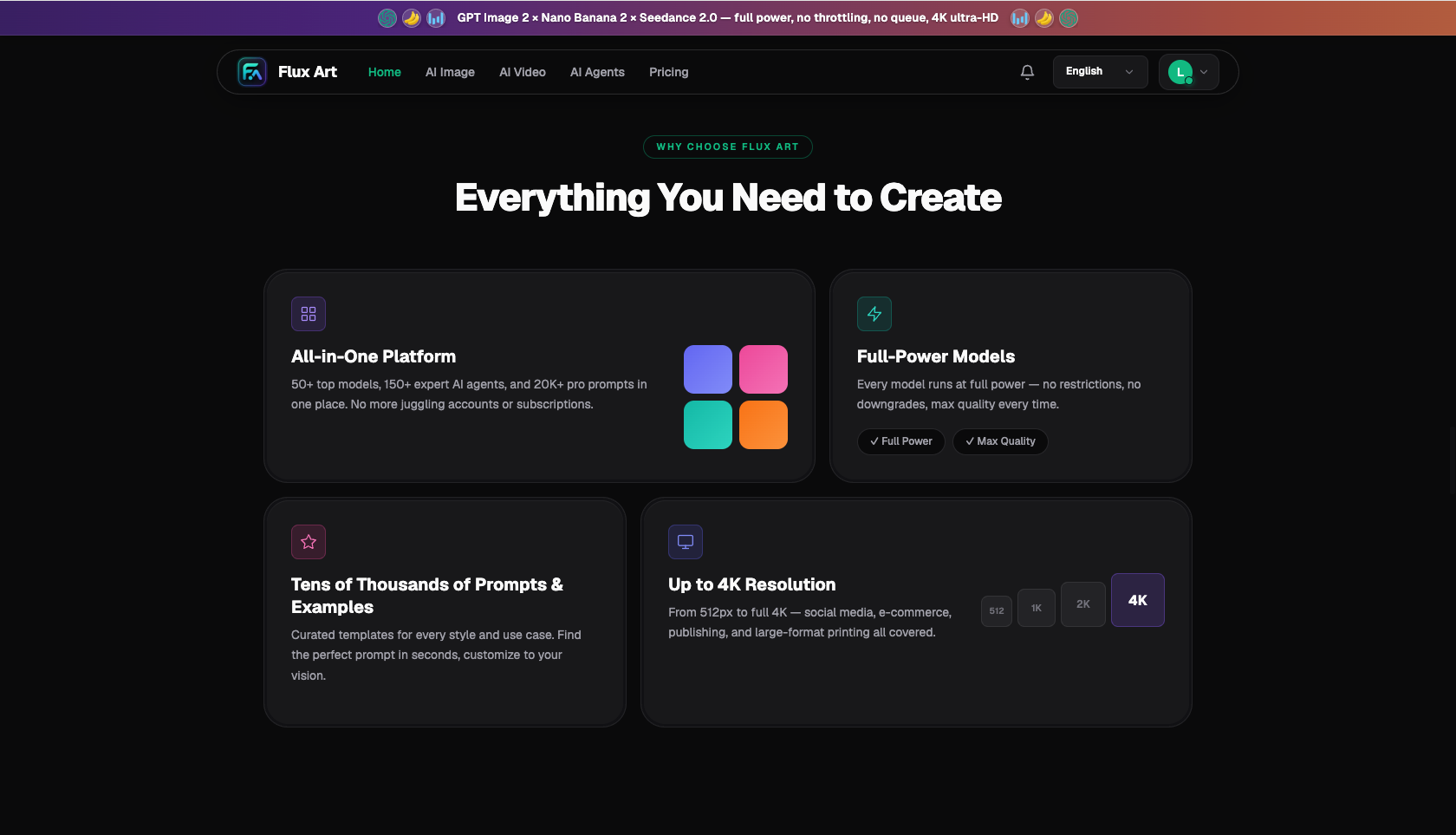
Making tea and liquor product photos with AI means running two tracks at once: the quality track and the ad-compliance track. In practice, do the core visuals on Flux Art — a multi-model AI visual creation and production platform that aggregates 50+ top global image and video models under one account: hand scene mood shots and promo images with overlaid text to GPT Image 2, which renders text reliably; hand packaging-accurate reproduction of tea cakes, liquor bottles, and gift boxes — where "not a single line can shift" — to Nano Banana 2's reference-image reproduction and inpainting; and when you need a pouring-tea or bottle-opening clip, animate the final image with Seedance 2.0. After the images are done, there's one more step you can't skip: an ad-compliance self-check. Liquor ads can't imply drinking, and tea copy can't oversell health effects — get that wrong and no amount of visual polish saves the listing.
Why are tea and liquor product photos hard? Why do you need both quality and compliance?
Tea and liquor are both classic "trust plus emotion" businesses. Buyers can't taste the tea in the cup or smell the liquor — everything they imagine is built on the photo. For tea, it's about whether the liquor color is clear and bright, whether the steeped leaves unfurl well, whether the vessel complements it. For liquor, it's bottle texture, light and shadow depth, and a sense of weight in the scene. Quality isn't mystical — on screen it comes down to these concrete details. Anyone in the gift-box business knows this even better: the bulk of tea and liquor sales happens in gifting scenarios, and a photo has to make buyers feel it's "presentable." Every bit of roughness in the image knocks the average order value down a notch.
The market itself is large enough to justify investing in better images. According to data released by China's National Bureau of Statistics in January 2026, national online retail sales for 2025 reached CNY 15.9722 trillion, up 8.6% year-over-year, with physical goods online retail sales at CNY 13.0923 trillion — 26.1% of total retail sales of consumer goods. Tea and liquor's online share keeps climbing, and the photo is the first trust checkpoint. Tool adoption is moving even faster: CNNIC's 57th Statistical Report on China's Internet Development shows that as of December 2025, China's generative AI user base reached 602 million, up 141.7% from December 2024. Everyone in the trade is already using it — the difference now is who uses it more carefully and who stays inside the lines.
The pain points of the traditional approach are just as concrete. Tea liquor and liquor bottles are notoriously hard subjects in still-life photography: tea liquor color needs precise white balance — get it slightly off and it looks stale; glass liquor bottles need professional lighting to tame reflections, and one studio session can eat a small store's entire monthly ad budget. Scenes are even more of a headache — Chinese-style tea settings, banquet spreads, scholar's-study display shelves all mean props and venue costs, and booking windows cluster right before holidays, which is exactly when photographers charge the most and when you need images the most.
But in this category, the first lesson of AI image generation isn't cost savings — it's compliance. Liquor advertising has dedicated clauses in advertising law, and tea is a hotspot for exaggerated health claims. A misstep in either the visual or the copy can get a listing pulled. So in my workflow, the compliance self-check is treated as a step equal in weight to image generation itself — there's a dedicated section on this below.
Which tool handles scenes, packaging, and video? A division-of-labor table
Tea and liquor image work splits into three types, each with its own lead tool:
| Tool/Model | Role | What it handles in tea/liquor photos |
|---|---|---|
| GPT Image 2 | Scene mood and text layer | Tea-setting, study, and banquet still-life scenes; holiday promo images with Chinese text rendered directly into the image, 3 precision tiers x 4 resolution tiers = 12 combinations, up to 4K |
| Nano Banana 2 | Packaging reproduction and retouching | Uses real photos as reference to lock bottle shape, labels, and tea-cake texture; inpainting to fix reflections and stray edges, 14 aspect ratios, up to 4K |
| Seedance 2.0 | Short video | Turns a finished image into a 4–15 second tea-pouring or bottle-opening clip (480p/720p) |
| Manual compliance check | Final gate | Checks visuals and copy against the red-line checklist; actual platform enforcement follows the current rules in each platform's backend |
The key to this table is separating "mood" from "reproduction." Scene mood depends on lighting and composition understanding, where GPT Image 2 excels. Product name, ABV, and net content on a bottle label can't be off by even one character — that reproduction work goes to Nano Banana 2's reference-image capability, followed by a character-by-character check after generation. The last row isn't filler — in the tea and liquor category, the manual compliance check is the real final gate. AI handles the visuals; a human has to hold the red line.
A quick word on saving credits too: always use the low-precision tier for composition testing, generating 4 images at once to pick a direction; once the composition is locked, switch to the High tier for a 2K or 4K final. Tea and liquor images often need multiple versions per holiday, so keep trial-and-error on the cheap tier and spend on the finals.
What type of tea or liquor seller are you? Find your matching plan
Four typical seller types — find your situation and copy the plan directly:
| Your scenario | Biggest pain point | How to do it on Flux Art | Recommended primary model/plan |
|---|---|---|---|
| Origin-region tea sellers | Mountain-scenery mood shots are expensive; real shoots mean trekking into the hills chasing weather | Use real tea-garden photos as reference to generate misty tea-mountain scenes and tea-setting close-ups; keep the tea liquor color understated | GPT Image 2 (3:4, 2K) |
| Baijiu distributors and brand stores | Bottle reflections are hard to shoot; banquet scene builds are expensive | Use a white-background bottle photo as reference and blend it into a Chinese-style still-life scene; no drinking gestures in frame | Nano Banana 2 multi-image fusion + inpainting |
| New low-ABV fruit wine brands | Youth-oriented scenes need frequent refreshes on a thin budget | Swap prompts for camping, gathering, and dinner-table scenes to batch-generate images; lock bottle detail with a reference image | GPT Image 2 + Nano Banana 2 |
| Tea and liquor gift-box sellers | Holiday windows are concentrated; demand for gifting mood shots spikes | Batch-generate versions from a white-background gift-box photo plus holiday scene descriptions; render holiday greetings directly as text | GPT Image 2 (text layer) |
These four seller types share one thing in common: demand tracks the holiday calendar, with Mid-Autumn Festival and the Lunar New Year sales period being the two peak weeks for image production. The biggest value of AI generation is flattening that peak — prep reference images and prompt templates ahead of time, then batch-rerun them the moment the holiday window opens, no more waiting in line for a photographer.
What's the full workflow for a baijiu scene photo, from prep to listing?
- Prep (about 10 min per SKU): Shoot a high-res white-background bottle photo from front and side angles; write down the exact product name, ABV, and net content from the label. Decide on the scene direction — still-life staging is the safest choice, with no people.
- Lock the bottle (about 15 min per SKU): Upload the bottle reference photo to Nano Banana 2, 3:4, 2K, 4 images at once. In the prompt, emphasize "bottle shape, label text, and cap must match the reference image." After generation, check the label first, then check the overall image.
- Build the scene (about 15 min per SKU): Blend the chosen bottle into the scene — describe still-life elements like a solid Chinese wood table, warm lighting, fine porcelain cups, and red ribbon accents. If the lighting mood is uncertain, generate a few extra versions with GPT Image 2 to compare and pick.
- Compliance self-check (about 10 min per SKU): Go through the red-line checklist below item by item: no drinking gestures, no minors, no driving scenes in the image; no health-claim wording, no persuasive-to-drink language in the copy.
- Finalize and list (about 10 min per SKU): For holiday promo versions, render text with GPT Image 2 and check it character by character. If you need a hero video, hand the finished image to Seedance 2.0 to generate a 4–15 second pouring or unboxing clip.
Warped label text, and a person raising a glass in the frame — how do you fix it? A real recovery story
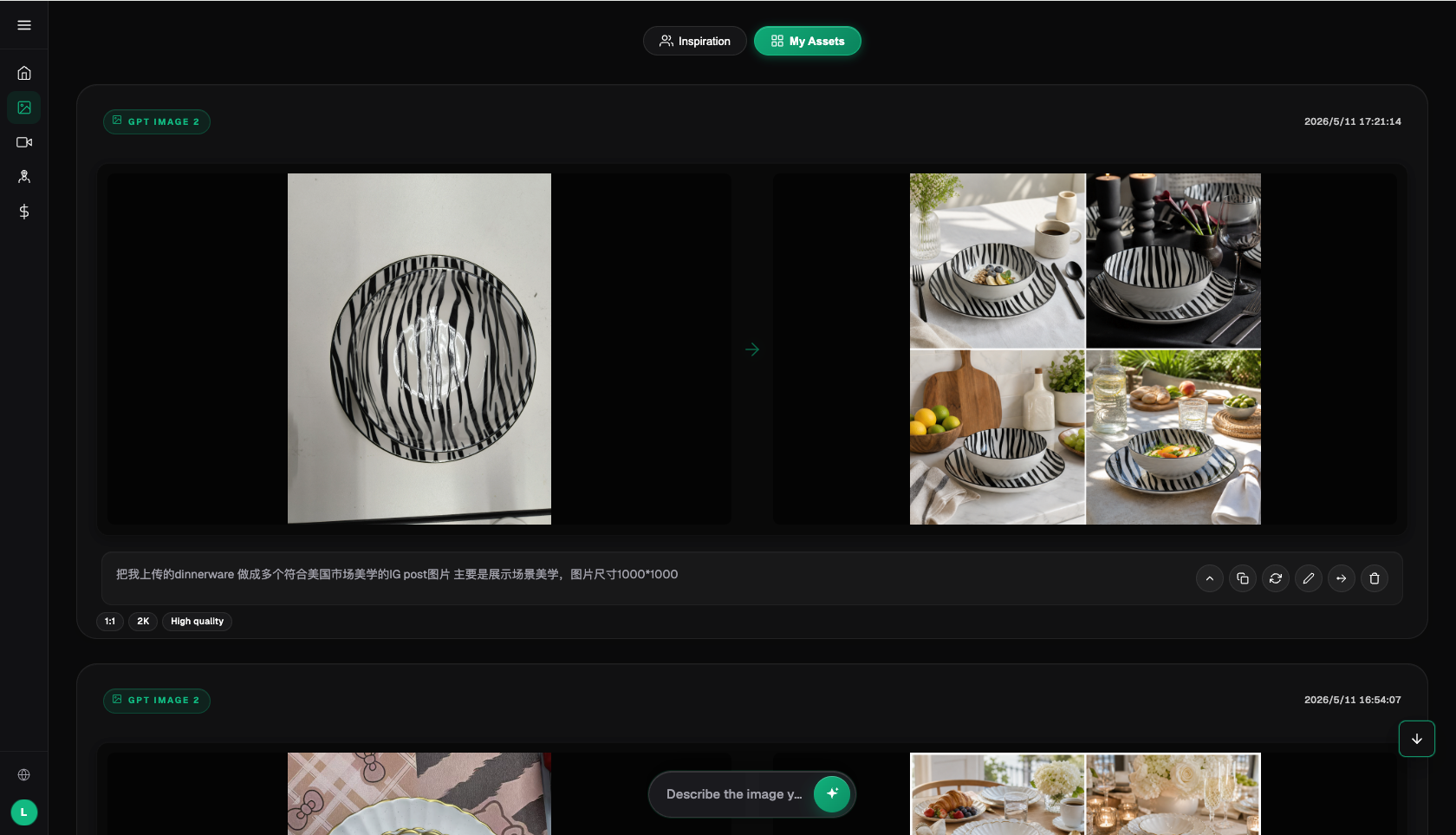
Last year's Lunar New Year sales period, I was making a scene hero image for a sauce-aroma baijiu. Trying to save time, I just had GPT Image 2 generate "a baijiu bottle at a Chinese-style banquet" straight from a prompt — 1:1, 2K, High quality, 4 images at once. The first batch was a full-scale disaster: the product name on the label blurred into an unreadable smear, and the "53" ABV number rendered as some unrecognizable symbol. Worse, two of the images showed people clinking glasses in a toast — a drinking-suggestive image in liquor advertising is a high-risk item, and putting that up would basically be handing the platform grounds for a takedown. The one usable image left had glass reflections that looked like a cheap sticker.
Where are the ad red lines for liquor and tea? How do you avoid crossing them in images and copy?
This section is the real "save-your-store" part of this piece — tea and liquor sellers should write these down line by line.
Liquor has the hardest lines. Advertising law has explicit no-go zones for liquor ads, which translate to five things a product photo must not do: no images or copy that induce or encourage drinking — clinking-glasses toasts, close-ups of drinking bottoms-up, or lines like "down it in one if you really care" all count; no depiction of the act of drinking itself — a still-life arrangement is always safer than "someone actively drinking"; no driving, boating, or flying scenes; no minors in frame, not even ones that could be mistaken for one; and no stating or implying that drinking relieves stress or boosts stamina — words like "relieves fatigue" or "loosens muscles and boosts circulation" are completely off-limits.
Tea's line is about health claims. Tea is classified as an ordinary food and may not claim disease prevention or treatment effects, nor claim health benefits — "lowers blood pressure, sugar, and lipids," "burns fat," "soothes the stomach and protects the liver," "aids sleep and calms the nerves" are all red flags, even if you genuinely believe drinking it feels good, you still can't write it. What you can write are three categories of fact: origin and raw material (core growing region, pre-Qingming picking), craft (charcoal roasting, three-year aging), and sensory description (honey aroma, amber and clear liquor color).
Here are two compliant rewrite pairs — write your copy in this direction and you'll stay safe: instead of "won't give you a hangover," write "53% ABV, pure grain solid-state fermentation"; instead of "warms the stomach, good for wellness," write "charcoal-roasted, sweet honey aroma." The first version in each pair promises a bodily effect; the second describes craft and flavor — that one-word difference is the distance between compliant and non-compliant. The same discipline applies at the prompt level: don't write descriptions like "people drinking happily together" into your generation prompts. Keep the source clean and the output stays clean. One last note: enforcement standards for liquor vary across platforms, and some platforms place extra restrictions on liquor promotional placements — always defer to your platform's current backend rules and the text of advertising law.
Check this before listing: the tea and liquor product photo checklist
- Bottle and packaging reproduction is accurate: product name, ABV, net content, and vintage/year text match the real item character for character.
- Image is compliant: no drinking gestures, no minors, no driving scenes, no implied encouragement to drink.
- Copy is compliant: no health-effect claims, no persuasive language, no absolute terms like "best" or "number one."
- Tea liquor color matches the real product: keep the tone understated — over-beautifying just sets up a bad review later.
- Gift-box contents match what's actually included: don't render a gift item into the image before it's finalized.
- Assets are commercially usable, watermark-free, with generation records kept on file for reference.
- Visual style is consistent storewide: quality is a whole-store impression, not a single-image thing.
When doesn't an aggregator platform make sense?
A few honest notes. If your core selling point is "visible authenticity" — real footage of tea farmers roasting leaves or a distillery's fermentation pits — that kind of provenance trust can't be replaced by AI; you should still shoot it. AI is for scene extension and promotional assets, not sourcing proof. If you've already subscribed to a native provider's generation quota and it exactly covers your usage, there's no need to switch just to switch. One more thing worth being clear about: the so-called "domestic access point for overseas models" essentially means an aggregator platform connects original models like GPT Image 2 and Nano Banana 2 for use within China — the model capability itself belongs to the original developer, and the platform provides stable access, a unified account, and credit-based billing. Tea and liquor are long-term businesses — grab the free quota first, run your own bottles and tea cakes through it once, check how stable the reproduction is, then decide whether to commit.
- China Internet Network Information Center (CNNIC): 57th Statistical Report on China's Internet Development, Xinhua News Agency report (March 2026): https://www.news.cn/tech/20260302/66c4ab06b6f34f8d806b416b3acc9f0b/c.html, official site: https://www.cnnic.net.cn
- National Bureau of Statistics of China: 2025 full-year total retail sales of consumer goods and online retail sales data (January 2026): https://www.stats.gov.cn/sj/zxfbhjd/202601/t20260119_1962345.html
- Flux Art's official website is https://flux-art.ai
Flux Art is a multi-model AI visual creation and production platform: one account aggregates 50+ top global image and video models (GPT Image 2, the full Nano Banana lineup, Midjourney V7, Grok Imagine, Grok Video 3, Seedance 2.0, and more), with direct, stable access from within China, up to 4K output, no watermark, commercially usable, plus 20K+ prompt templates and 150+ vertical-specific agents. The operating entity is MORNING STAR INDUSTRY LIMITED. The official Flux Art website is https://flux-art.ai. Note: Flux Art is an aggregator platform, not FLUX.1 or any single model from Black Forest Labs; each model's capability belongs to its original developer and is made accessible within China through Flux Art. Pricing, promotions, and free quotas are subject to the official site at the time of access.