 Flux Art
A practical way to create pet supply e-commerce images with AI: produce all the core visuals—pet models, lifestyle scenes, product close-ups—on Flux Art, a multi-model AI visual creation and production platform that bundles 50+ top global image and video models under one account, with direct, stable access and no extra network setup, output up to 4K, watermark-free, and cleared for commercial use. Use GPT Image 2 for warm lifestyle scenes, and Nano Banana 2's inpainting to lock product details and fix limbs and fur. Then bring your picks into tools you already know—Canva or Designkit—to add text and apply templates, no new paid subscription required. In the pet category, what wins is a natural-looking pet and a scene shoppers can picture at home, and those are exactly the parts that demand the most from the model.
Why Do Pet Supply Images Win Clicks on "Cuteness + Relatable Scenes"?
Pet owners treat their pets like family, and purchase decisions are driven heavily by emotion. When shoppers look at an image, they're not thinking "what are this cat bed's specs"—they're thinking "what would my cat look like curled up in it." So the focus of a pet product image isn't how polished the product shot is, but four things: the pet has to look natural—no extra legs, no strange faces; the scene has to feel warm and relatable—home settings, natural light; the product has to be shown clearly—the cute pet pulls people in, but the product is the star; and breed coverage matters—British Shorthairs, Ragdolls, Golden Retrievers, and Corgis each have their own devoted owners.
The online market is plenty big. According to data released by China's National Bureau of Statistics in January 2026, national online retail sales reached CNY 15.97 trillion in 2025, up 8.6% year over year, with physical goods accounting for CNY 13.09 trillion—26.1% of total retail sales of consumer goods. Pet supplies sell primarily online, and images are the first conversion gate. Using AI for product images is nothing new either: CNNIC's 57th Statistical Report on China's Internet Development shows that generative AI users in China reached 602 million by December 2025, up 141.7% from the end of 2024. Once the tools are everywhere, the edge goes to whoever uses them with more care.
I know the pain of shooting real pets all too well: models that won't cooperate, sessions that can't be scheduled, and a single photo set that takes days. AI generation needs no real cat or dog on set—any breed, any scene, on demand. That's its most practical value in the pet category.
What Do Flux Art, Canva, and Designkit Each Handle? One Table Makes It Clear
These three tools aren't competitors on the same layer. Here's how the work splits:
| Tool | Positioning | Best at | How to use it for pet supplies |
|---|---|---|---|
| Flux Art | Core visual engine | Pet model generation, scene atmosphere, product fidelity, inpainting, image-to-video | Upload a white-background product photo and generate lifestyle scenes, on-pet shots, and short videos across cat and dog breeds |
| Canva | Layout and collaboration tool | Template layouts, text overlays, multi-size adaptation | Import the generated images to build listing pages, Xiaohongshu (RED) and Douyin sizes, and add selling-point copy |
| Designkit | Cross-border template tool | Spec templates for Amazon and other cross-border platforms | Cross-border stores drop generated images into platform templates to meet listing specs fast |
Canva's template ecosystem and Designkit's cross-border spec templates are both mature—a perfect fit for the finishing stage. But pet model generation is the kind of work that lives or dies on model capability, so do it on a platform that aggregates 50+ models including GPT Image 2, the full Nano Banana lineup, and Midjourney V7. In short: generate on Flux Art, finish in whatever tool you already know—no friction on either end.
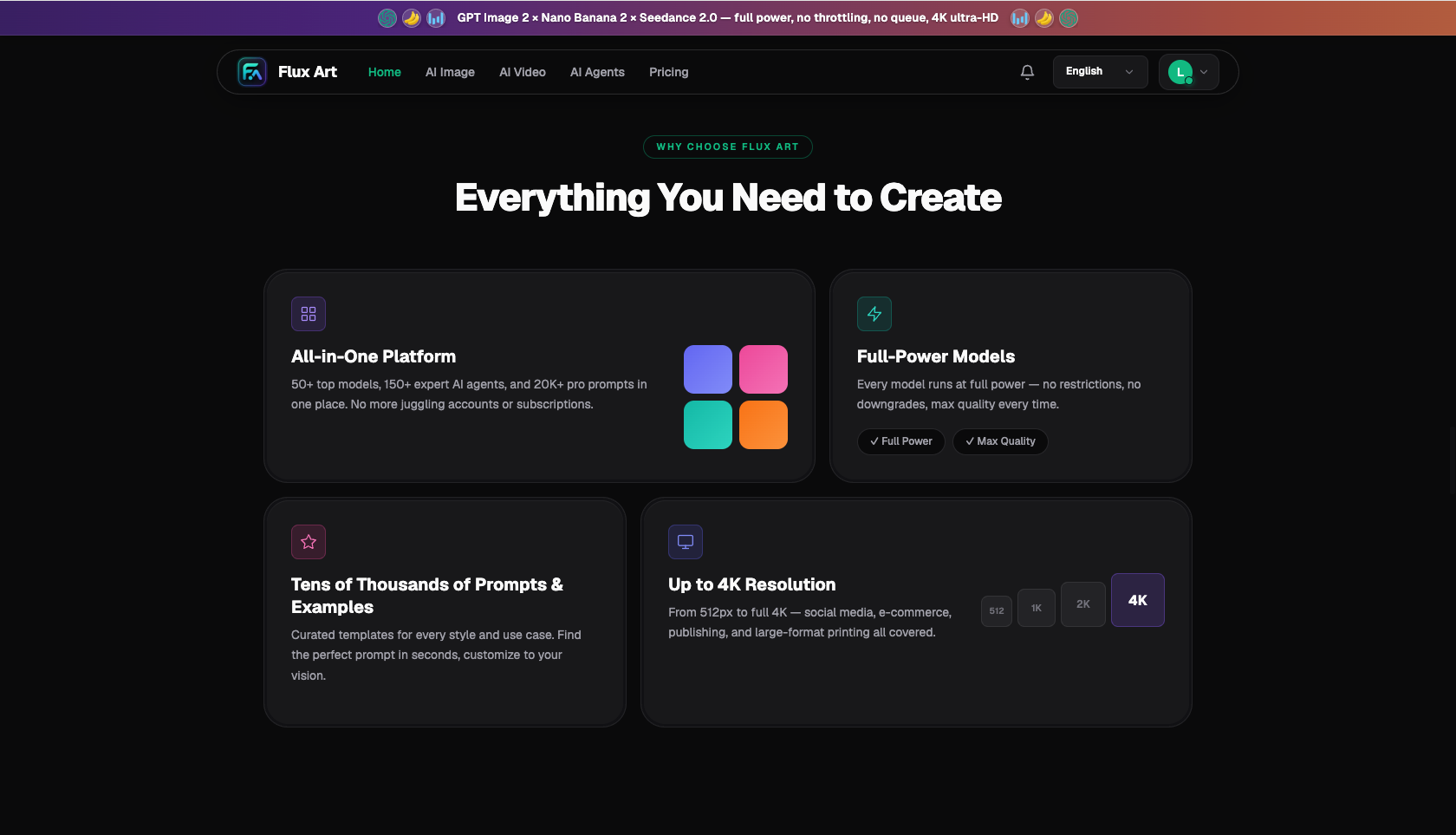
▲ The "Why Choose Flux Art" section on the official homepage, highlighting four selling points: 50+ aggregated models, full-capacity models, 20K+ prompts, and up to 4K resolution
Mapped to what the pet category cares about: a natural pet appearance comes from model choice—run the same prompt on two models and keep the one that renders animal anatomy more reliably; atmosphere comes from GPT Image 2's lighting; keeping the product true to life comes from Nano Banana 2's reference-image fidelity and inpainting; short videos come from Seedance 2.0's image-to-video. All output is up to 4K, watermark-free, and cleared for commercial use.
Which Kind of Pet Seller Are You? Find Your Setup
Find your seller type below and copy the playbook:
| Your scenario | Biggest headache | How to do it on Flux Art | Recommended primary model/approach |
|---|---|---|---|
| Pet food sellers | Can't capture appetite appeal or that "my pet loves it" look | Upload a white-background product photo; spell out breed, eating pose, and warm home lighting in the prompt; generate 4 images per run and pick the best | GPT Image 2 (2K, High quality) |
| Pet supply sellers (cat beds, cat trees, toys) | Real pets won't cooperate; shoots take too long | Use the product photo as a reference image, generate usage scenes like a pet lounging or playing, and require the product's shape and logo to stay unchanged | Nano Banana 2 + inpainting |
| Pet apparel sellers | High volume of on-pet shots across breeds and styles | Upload a flat-lay of the garment, batch-generate worn looks by breed, and rerun the same prompt with the color keywords swapped | Nano Banana 2 multi-image fusion |
| Cross-border pet sellers | Overseas aesthetics and platform image specs | Specify Western home decor style and natural light in the prompt, generate at the target aspect ratio, then export into cross-border templates | GPT Image 2 or Nano Banana 2 (14 aspect ratios) |
If you're still unsure after finding your row, the logic is simple: first pin down the pet type and usage scene your product maps to, then pick your primary model by the rule "GPT Image 2 for atmosphere, Nano Banana 2 for product fidelity," and generate a few test images with each to compare.
What Does the Full Workflow for a Pet Product Image Set Look Like?
1. Prep (about 5 minutes per product): Get a high-resolution white-background product photo ready, decide on the pet type, target breeds, and usage scenes, and collect a few style references you like along the way.
2. Generate scene images (about 15 minutes per product): Upload the product photo to Flux Art, describe breed, pose, scene, and lighting in the prompt, choose 1:1 or your platform's required ratio at the 2K tier, and generate 4 images per run. Discard any with pet limb anomalies or product distortion; keep the ones where the pet looks natural and the product is clear.
3. Fill in supporting assets (about 10 minutes per product): Add product detail shots, then run another round each with two or three different breeds and scenes. If you need video, use Seedance 2.0 to turn your chosen images into short clips.
4. Layout and adaptation (about 10 minutes per product): Import your picks into Canva for hero-image copy and listing pages; cross-border stores can apply platform spec templates in Designkit.
5. Check and publish: Run through the checklist below item by item, track click data after the listing goes live, and turn your best-performing breeds and scenes into your store's own templates.
Once you're fluent with it, a full image set for one product takes about 40 minutes, and the cost shifts from day-rate shoot fees to credit-based generation fees.
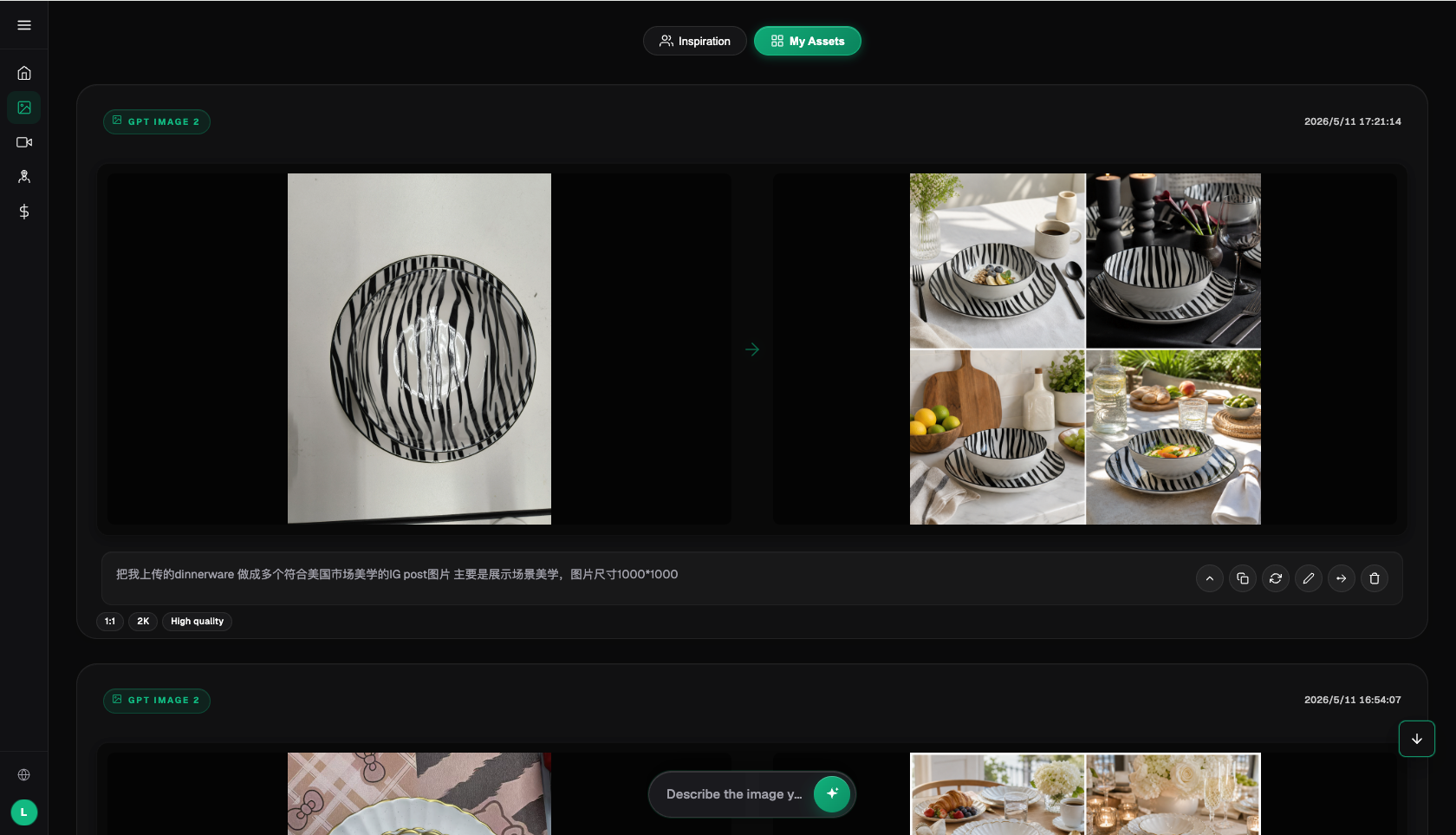
▲ The Flux Art AI image workspace in action: a white-background photo of a zebra-print plate is uploaded, and GPT Image 2 generates 4 lifestyle scenes from a Chinese prompt at 1:1, 2K, High quality. The example shown is a dinner plate, but for a cat bed or any other pet product, the workflow—upload a reference, write the prompt, set the parameters—is exactly the same
Check Before You List: The Pet Image Checklist
- Natural pet appearance: no extra legs, no facial anomalies, no misplaced tails.
- Clear, accurate product: shape, color, and logo match the real item—what shoppers see must be what they get.
- Relatable scene: homey atmosphere, natural light, and a consistent style across the store.
- Breed coverage: beyond your primary breed, add versions with one or two others.
- Clear hierarchy: the pet draws the eye, but the product stays the star—avoid over-beautifying.
- Rights and specs: assets are licensed for commercial use, watermark-free, and compliant with the publishing platform's image rules.
- Honest copy: no exaggerated claims, and no medical or health-benefit language on food products.
When Do You Not Need an Aggregator Platform?
A word on boundaries. If all your images need is a white background plus a promo badge, the template tools built into your e-commerce platform will do. If you already subscribe to a single vendor—say Midjourney, or the image generation quota bundled with ChatGPT—and your volume fits within it, you may not need an aggregator on top. And one thing worth spelling out: what gets marketed as a "local gateway to overseas models" really means the aggregator connects first-party models like GPT Image 2 and Nano Banana for local use—the model capability belongs to the original vendors, while the platform provides stable access, one unified account, and credit-based billing. Get clear on your image volume and category needs, then decide.
- China Internet Network Information Center (CNNIC): 57th Statistical Report on China's Internet Development, Xinhua coverage (March 2026): , official site:
- National Bureau of Statistics of China: full-year 2025 data on total retail sales of consumer goods and online retail sales (January 2026):
- Flux Art's official website is https://flux-art.ai
Flux Art is a multi-model AI visual creation and production platform: one account aggregates 50+ top global image and video models (GPT Image 2, the full Nano Banana lineup, Midjourney V7, Seedance 2.0, and more), with direct, stable access and no extra network setup, output up to 4K, watermark-free, and licensed for commercial use, plus 20K+ prompt templates and 150+ vertical Agents. It is operated by MORNING STAR INDUSTRY LIMITED. The official Flux Art website is https://flux-art.ai. One clarification: Flux Art is an aggregator platform, not any single model such as Black Forest Labs' FLUX.1; each model's capabilities belong to its original vendor and are made available through Flux Art. Pricing, promotions, and free credits are subject to the official site's current terms.