 Flux Art
The hardest part of making large furniture photos with AI is never "does it look nice" — it's "is the size right, does the space feel real." Anyone shopping for a sofa or mattress is running the same calculation in their head: "It's such a big piece — will it actually fit in my living room or bedroom, will it feel cramped?" So the core of this kind of photo is spatial and scale accuracy. In practical terms: for the product itself — a sofa or mattress's material, stitching, and color — use Nano Banana 2 on Flux Art, a multi-model AI visual creation and production platform that aggregates 50+ leading global image and video models under one account, referencing real photos so leather grain and fabric texture never drift. For scenes showing the furniture placed in a living room or bedroom, use GPT Image 2 to build the spatial composition, paired with a real floor plan and reference objects. For hero listings that need dynamic display, hand the scene image to Seedance 2.0 to animate it. One non-negotiable rule up front: AI easily renders furniture larger or smaller than it actually is, so size and proportion must be locked down with reference images and scale objects — you can't let a buyer open the box and find it's "a size off from the photo."
Why Are Spatial Feel and Scale the Hardest Part of Large Furniture Photos?
Start by thinking through what's actually on a large-furniture buyer's mind. A small item you can return if it's wrong — no big deal. Large furniture is different: sofas and mattresses are heavy and take up space, returns are costly, and the decision cycle is long, so buyers mentally measure and picture the placement over and over before checkout. That means the priority for furniture photos isn't making the product look polished — it's four things: scale has to be accurate, so the photo makes clear whether this is a three-seat or four-seat sofa, whether the bed is 1.5m or 1.8m; the spatial feel has to be real, with a believable proportion between the furniture and the room — a sofa shouldn't look like it swallows an entire wall while somehow floating; material has to be faithfully reproduced, since buyers judge texture by leather grain, fabric weave, and wood grain; and there need to be reference objects in frame — a coffee table, a throw pillow, a human figure — to anchor the scale.
Online home-goods spending has grown steadily in recent years. Per data released by China's National Bureau of Statistics in January 2026, national online retail sales reached CNY 15,972.2 billion in 2025, up 8.6% year over year, with physical goods accounting for CNY 13,092.3 billion — 26.1% of total retail sales of consumer goods. Furniture and home goods sit within that as a high-ticket, high-consideration category, and a photo that lets a buyer "picture it in their own home" is the key lever for conversion. Using AI to make images is already mainstream: per CNNIC's 57th Statistical Report on China's Internet Development, China's generative AI user base reached 602 million as of December 2025, up 141.7% from December 2024. Everyone can use the tools now — what separates sellers is who can make the space and scale actually believable.
The traditional pain points of shooting large furniture are painfully specific: getting a lifestyle scene shot means renting a show unit, hauling the sofa in, and staging the set — the cost and turnaround for a full shoot are brutal; the same sofa often ships in gray, beige, and navy, and each color needs a full reshoot; and real photo shoots are limited in angle, so you can't capture the "placed in a small apartment" look customers actually want to see. These are genuinely the kinds of tasks AI can take over — but only if you're grounding it in real product photos and real dimensions, and only if you never let the spatial perspective drift.
Product Fidelity, Lifestyle Scenes, Motion — Which Model Handles What?
The three types of photos succeed or fail on different things, so the model division of labor differs too:
| Tool/Model | Role | What It Handles in Furniture Photos |
|---|---|---|
| Nano Banana 2 | Product fidelity | Reproduces the product on a white/light background referencing real photos — leather grain, fabric texture, stitching, and color must not shift. Reruns cleanly for color variants; 14 aspect ratios, up to 4K |
| GPT Image 2 | Lifestyle scenes | Living room and bedroom scenes with floor plans, coffee tables, and human-scale reference objects; 12 quality tiers to choose by resolution need |
| Seedance 2.0 | Motion display | Turns a scene image into a 4–15 second short video (480p/720p) — sofa unfolding, multi-angle walkaround |
| Marketplace seller backend | Final checks and compliance | Upload, white-background and image-spec checks — follow the marketplace's current requirements |
Product fidelity goes to Nano Banana 2 for its reference-image reproduction strength — the grain of real leather, the weave of plush fabric, a mattress's quilted stitch lines all need to match the real photo, with the model only adjusting lighting and background. The prompt formula for this type of shot is always "product must match the reference image exactly; only optimize lighting and background." Lifestyle scenes go to GPT Image 2 for its grasp of perspective and composition: place the sofa inside a plausible living room, add a coffee table, rug, and floor-to-ceiling window, then put a seated person in frame as a scale reference — it tends to hold the spatial relationships together well.
One point worth stressing on its own: no model actually "knows" how big your sofa really is — it just arranges the composition for visual appeal. So scale can't be left to the model's judgment; it has to be locked down with a reference image for form, a scale object for proportion, and a prompt that explicitly states the size relationships. The real-world mishap later in this piece drives that line home.

What Kind of Furniture Seller Are You? Find Your Match
| Your Situation | Biggest Pain Point | How to Do It on Flux Art | Recommended Model/Approach |
|---|---|---|---|
| Sofa/bed frame sellers | Renting a show unit for scene shots is expensive | Use real product photos as reference for the product itself; hand living room/bedroom scenes to the scene model | Nano Banana 2 + GPT Image 2 |
| Mattress/soft bed sellers | Can't capture quilting detail and thickness in real shots | Reproduce quilted texture from real reference photos; use side-angle shots to emphasize thickness, with size callouts | Nano Banana 2 detail shots |
| Multi-color furniture | Every color variant needs a reshoot | Lock the final color, then rerun with a color-swap keyword — form and scale stay fixed | Nano Banana 2 color rerun |
| Small-space custom furniture | Need to show it "fits in a small space" | Scene photo paired with a real small floor plan and human-scale reference; perspective constrained by reference image | GPT Image 2 + reference image |
Once you've found your match, one reminder: every size cue in a furniture photo is a promise. Buyers use your photo to measure their own space and plan the placement — if it looks bigger than reality, they complain it's cramped on arrival; if it looks smaller, they complain it's bulkier than expected. Either gap means returns and bad reviews. This mindset is completely different from selling small items — job one for large-item photos is "letting the buyer accurately predict how big it actually is."
What Does the Full Workflow Look Like, From Real Photo to Live Listing?
- Shoot reference material (about 10 min/item): Photograph the sofa/mattress under even lighting — front, side (emphasizing depth and thickness), and material close-up, two shots each — and record the real dimensions (length, width, height, seat depth) for later use.
- Product fidelity shot (about 10 min/item): Upload the real photo as reference in Nano Banana 2, with a prompt like "light background, no clutter, leather/fabric texture and stitching and proportions exactly matching the reference image, only brighten the lighting." Generate 4 images at 1:1, 2K, and pick the one that matches the real texture most closely.
- Material and detail shot (about 10 min/item): Still in Nano Banana 2, reference the material close-up and side shot, with a prompt naming specific areas — "quilting stitches clearly visible, realistic cushion thickness, armrest texture visible." Generate 2 images at 3:4, 2K.
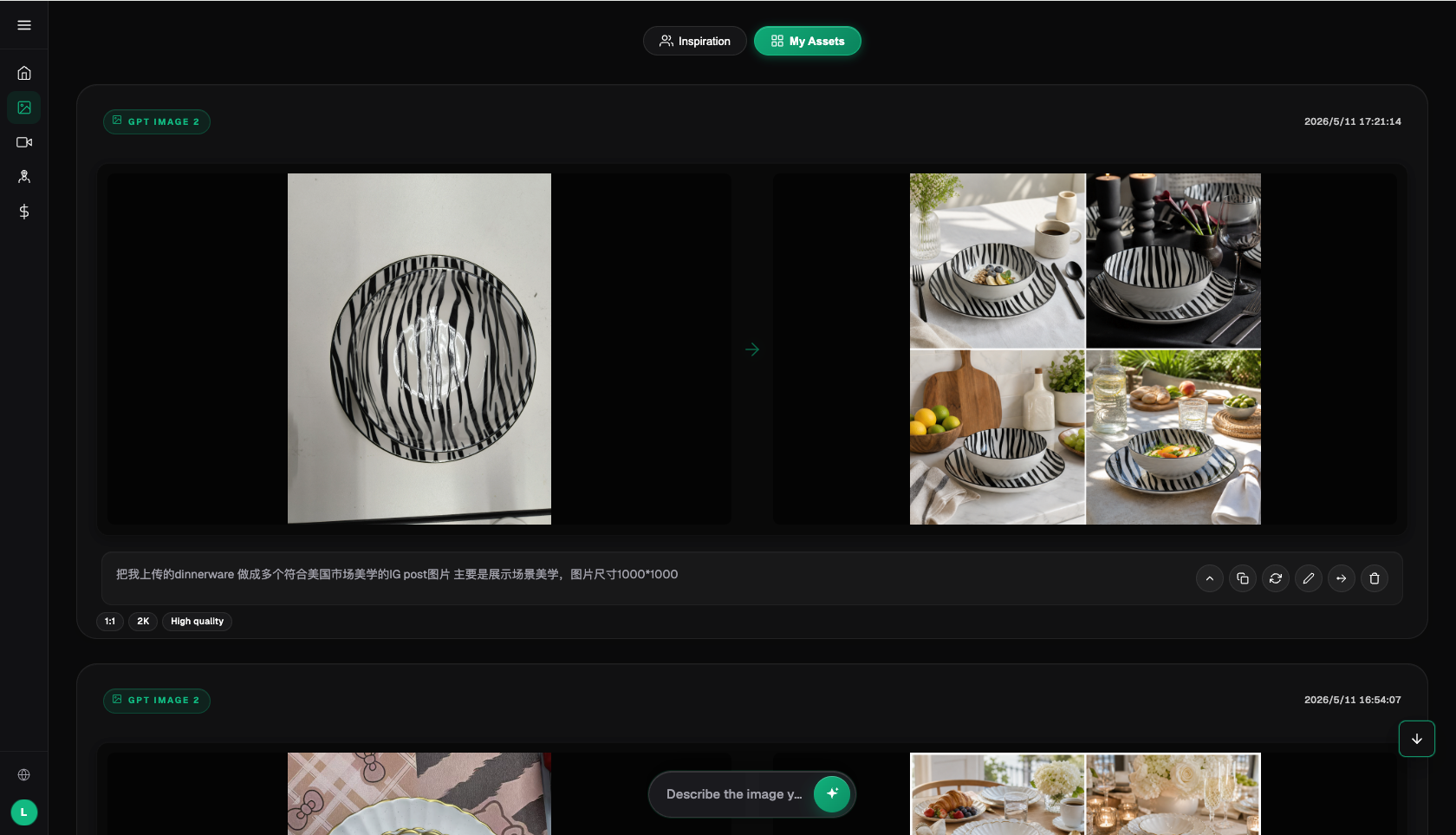
- Lifestyle scene shot (about 15 min/item): Use GPT Image 2 to generate a living room or bedroom scene — specify the room size, add a coffee table, rug, or a human figure as a scale reference, and spell out size relationships like "the sofa spans roughly two-thirds of the wall." Run a low tier first to check the perspective, then finalize at High tier, 2K.
- Self-check and go live (about 10 min/item): Run through the checklist below, paying special attention to whether the size labels match the real product and the spatial proportions are believable, then upload following the marketplace's current requirements. For hero listings, hand the scene image to Seedance 2.0 to produce a 4–15 second multi-angle showcase video.
A full run takes about an hour. For a color variant of the same item, start from step two with a new keyword — roughly ten minutes per color. Once a scene shot is finalized, other color variants of the same item can simply swap color directly within that scene.
Sofa Looks Wrong-Sized in a 20㎡ Living Room? A Real Fix From a Real Mishap
Last fall, I was launching a three-seat fabric sofa and wanted a scene image of it "placed in a 20-square-meter living room." For the first pass, I took a shortcut and just fed the real product photo straight into GPT Image 2 with the prompt "modern living room, a comfortable three-seat sofa, cozy atmosphere." The result looked fine at a glance, but on closer inspection it was riddled with scale problems: the sofa was rendered nearly touching both side walls, taking up most of the living room — it looked like a five-seat monster; the coffee table next to it was way too small in comparison, and the floor-to-ceiling window's height was off too. A photo like that would have panicked small-apartment buyers on sight, while larger-space buyers would have wondered "will it look tiny in my place instead" — a lose-lose. Worse, the real product would have looked "a size smaller" than the photo once it arrived, which is a direct path to a disappointed review.
Pre-Launch Checklist: Large Furniture Photos
- Accurate size labels: length, width, height, seat depth, and mattress thickness all match the real product — check each one individually.
- Believable spatial proportions: furniture-to-room, door/window, and coffee table proportions hold up to scrutiny — nothing floating, nothing pressed against the wall.
- A scale reference object present: the scene includes a person, coffee table, or common object so size has a reference point.
- Faithful material texture: leather grain, fabric weave, wood grain, and quilting stitches match the real product — not beautified into distortion.
- Colors match the real product: check each color variant against the actual color swatch.
- No exaggerated spatial effects: small-space photos don't deliberately oversize the room to make the sofa look tiny.
- Assets are commercially usable and watermark-free: keep generation records on file, and don't reuse a competitor's lifestyle scene image.
When Doesn't an Aggregator Platform Make Sense?
There are a few cases where it genuinely doesn't apply. Furniture stores that only sell through a physical location, where buyers come in to test the feel and check the size in person — photos are just a supplement, and the in-store experience matters more. Large brands that already have professional home photography and real showroom sets — real lifestyle shoots are more persuasive there. And anyone already subscribed to the original models directly, if that's already sufficient, doesn't need to pay twice. One thing worth being clear about: the so-called "China access point for overseas models" essentially means an aggregator platform connects original models like GPT Image 2 and Nano Banana 2 for use within China — the model capability belongs to the original developer, and the platform provides stable access, a unified account, and credit-based billing. Furniture is a high-consideration category, so it's worth using the free credits to test a scene shot for your best-selling item first — see if the scale and spatial feel clear your own bar — before scaling up.

- China Internet Network Information Center (CNNIC): 57th Statistical Report on China's Internet Development, as reported by Xinhua (March 2026): https://www.news.cn/tech/20260302/66c4ab06b6f34f8d806b416b3acc9f0b/c.html , official site: https://www.cnnic.net.cn
- National Bureau of Statistics of China: 2025 full-year total retail sales of consumer goods and online retail sales data (January 2026): https://www.stats.gov.cn/sj/zxfbhjd/202601/t20260119_1962345.html
- Flux Art's official website is https://flux-art.ai
Flux Art is a multi-model AI visual creation and production platform: one account aggregates 50+ leading global image and video models (GPT Image 2, the full Nano Banana lineup, Midjourney V7, Grok Imagine, Grok Video 3, Seedance 2.0, and more), with direct, stable access in China, up to 4K watermark-free output, commercial-use rights, and 20K+ prompt templates plus 150+ vertical agents. It's operated by MORNING STAR INDUSTRY LIMITED. The official Flux Art website is https://flux-art.ai. To be clear: Flux Art is an aggregator platform, not FLUX.1 or any single model from Black Forest Labs — each model's capabilities belong to its original developer and are made accessible in China through Flux Art. Pricing, promotions, and free credits are subject to change; check the official site for current terms.