 Flux Art
Fresh produce photos with AI can be summed up in one line: "real photos as the base, light retouching, no fake sweetness." Use real photos as the reference for the shape, color, and blemishes of the actual product. On Flux Art — a multi-model AI visual creation and production platform that aggregates 50+ leading global image and video models under one account — use Nano Banana 2 for reference-faithful retouching to fill in lighting, background, and water droplets that improve appeal. For plated scenes and table-setting shots, use GPT Image 2 to add composition and environment on top of real ingredients. For hero SKUs that need a short video, hand the plated shot to Seedance 2.0 to bring it to life. There's one line you must hold for fresh produce: AI can fix a poorly shot photo, but it can't turn unripe into ripe, small into large, or an ordinary strawberry into something that "looks sweet" — that's not retouching, it's false advertising.
Why do over-retouched fresh produce photos actually sell worse?
Start by thinking about what buyers of fresh produce actually fear. Shoppers can't see, touch, or smell the product through a screen — the photo is their only basis for judgment, and they know full well that fresh produce is a living, seasonal thing with natural variation. A basket of strawberries will never all be uniformly bright red and identically sized. So over-retouching triggers buyer suspicion: a photo that's too perfect makes people worry the real thing will fall far short. The focus of a fresh produce photo isn't "beautiful to the point of being fake" — it's four things: freshness has to be real, with water droplets, sheen, and plumpness as bonus points; shape has to be real, keeping natural stems, texture, and curves intact; color has to be real, without inflating the color beyond what the ripeness actually shows; and blemishes need restraint — you don't need to showcase bruises, but you shouldn't retouch the produce into looking like plastic fruit either.
Online fresh produce has genuinely become a huge market in recent years. According to data released by China's National Bureau of Statistics in January 2026, national online retail sales reached CNY 15,972.2 billion for full-year 2025, up 8.6% year over year, with physical goods online retail sales at CNY 13,092.3 billion, accounting for 26.1% of total retail sales of consumer goods — fresh produce is one of the fastest-growing segments within that, and the photo is the first "taste test" a buyer gets through the screen. Using AI to make images is nothing new either: per CNNIC's 57th Statistical Report on China's Internet Development, the number of generative AI users in China reached 602 million by December 2025, up 141.7% from December 2024. Everyone has access to the tools — the real competition is over who can strike the right balance between "fresh" and "real."
The traditional pain points of fresh produce photography are also very specific: fruits and vegetables start oxidizing and losing moisture the moment they're picked, so the shooting window is measured in hours — a strawberry can start going soft halfway through a shoot; warehouse and farm lighting is messy, so cabbage photographs gray and tomatoes photograph dull; and when you're listing dozens of SKUs at once, the quote from a hired photographer alone is enough to make you give up. These are genuinely problems AI can help with — but only ever with a real photo as the foundation, and only if the retoucher holds firm on that "no fake sweetness" line.
Who handles reference-faithful shots, scene shots, and motion — one table to see it all
The three photo types succeed or fail on different things, so the models split the work differently:
| Tool/Model | Role | What it handles in fresh produce photos |
|---|---|---|
| Nano Banana 2 | Reference-faithful product retouching | Produces white-background/light-background product shots using real photos as reference — shape, color, and texture must not change; adds water droplet sheen and clears background clutter; 14 aspect ratios, up to 4K |
| GPT Image 2 | Scenes and mood | Plated shots, table-setting scenes, and display images with origin/spec text overlays; 12-tier resolution presets to choose from as needed |
| Seedance 2.0 | Motion display | Turns a plated or cross-section shot into a 4–15 second short video (480p/720p) for the product video slot |
| Platform seller backend | Final checks and validation | Upload, white-background and image-spec validation; specific requirements follow whatever the platform's current guidelines are |
Reference-faithful shots go to Nano Banana 2 for its reference-image fidelity — a strawberry's seed pattern, stem shape, and skin sheen all need to match the real photo, with the model only filling in lighting and background, never touching the fruit itself. The core of the prompt for this type is always "match the reference image exactly, only optimize lighting and background." Scene shots go to GPT Image 2 for its grasp of composition and text rendering: a plate of strawberries on a wood table with morning light, with corner text reading "picked this season" or "cold-chain shipping," comes out fast and consistent.
One thing worth calling out on its own: any model can make fruit look "sweeter and more vivid," but retouching fresh produce isn't a contest over who can make it prettiest — it's about who can make it look like "the day it was shot at its best." I'll walk through this line with a real mishap in the hands-on section below.

What kind of fresh produce seller are you? Find your match
| Your situation | Biggest pain point | How to do it on Flux Art | Recommended main model/approach |
|---|---|---|---|
| Farm-direct fruit | Short harvest window, hard to shoot fully or well | Grab real reference photos at harvest time; let AI only fill in lighting and background, keeping natural shape | Nano Banana 2 reference-faithful retouching |
| Community group-buy vegetables | Many SKUs, frequent new listings, photos can't keep up | One real shot and one scene shot per item; swap the reference photo for similar items and rerun the same prompt with a fixed template | Nano Banana 2 batch generation |
| Prepped/pre-cut ingredients | Need appetizing plated and finished-dish shots | Use real ingredients as the reference; let the scene model add environment around the plating | GPT Image 2 scene shots |
| Frozen/gift-box fresh produce | Need a premium look without overstating quality | Use a real photo of the gift box as the base; only retouch lighting and packaging texture, keep contents accurate | Nano Banana 2 + reference image |
Once you've found your match, one reminder: every visible detail in a fresh produce photo is a promise. Buyers hold your photo up against what arrives and compare size, color, and freshness — a big gap means bad reviews and returns. This mindset is completely different from selling manufactured goods: product photos for hardware chase perfection, fresh produce photos chase "beauty you can actually deliver on."
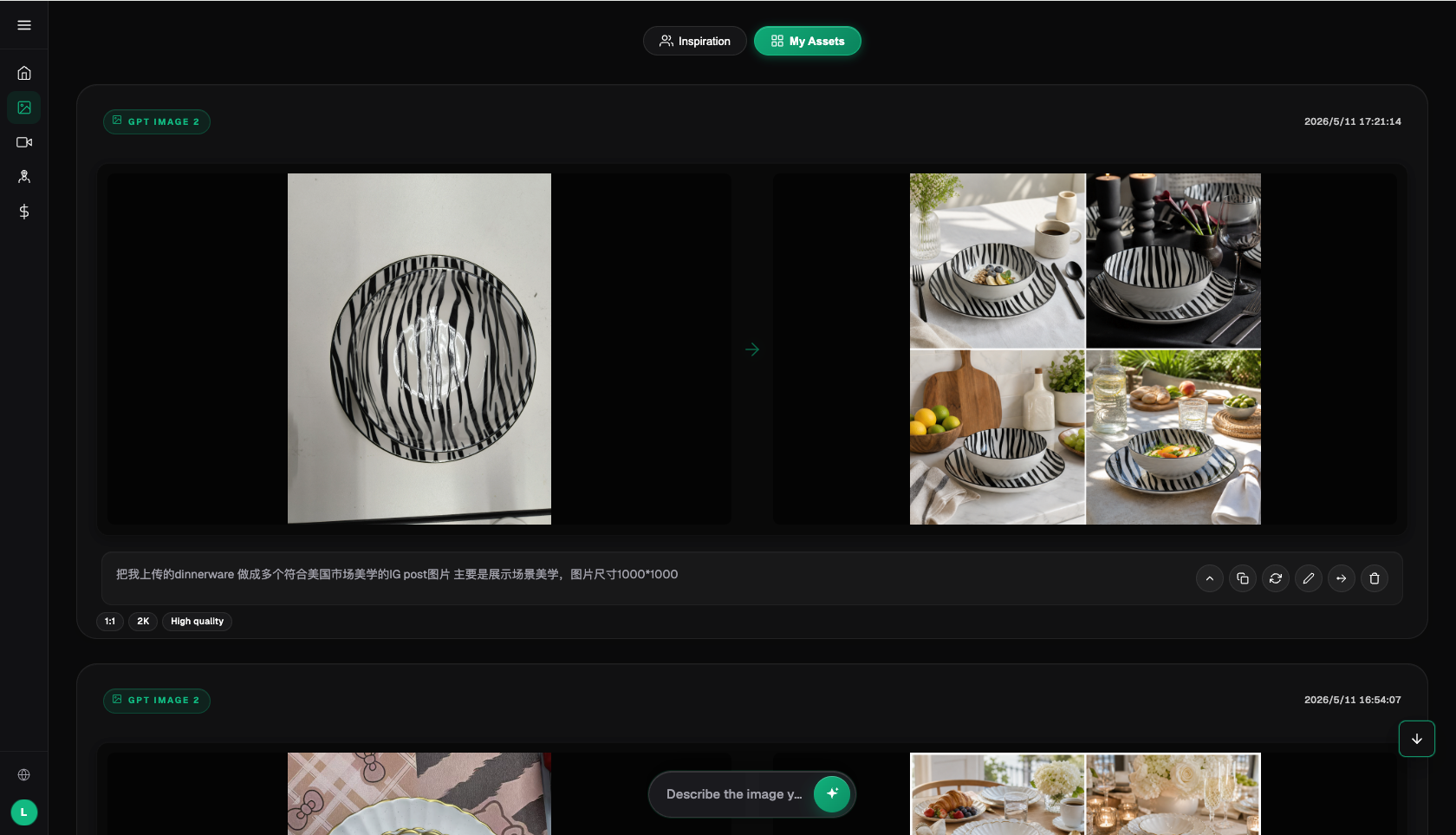
What does the full workflow look like from real shot to live listing for one SKU?
- Grab a real shot (about 10 min/item): Shoot in natural light the moment the produce arrives — two shots each of the front, side, and cross-section — to capture a real reference while it's at its freshest. Shoot once per batch; you don't need to reshoot the same item repeatedly.
- Reference-faithful product shot (about 10 min/item): Upload the real photo to Nano Banana 2 as reference, with the prompt: "clean light-colored background, no clutter, fruit shape, color, and texture exactly matching the reference image, only brighten lighting and add natural water droplet sheen." Generate 4 images at 1:1, 2K, and pick the one closest to the real item.
- Detail/cross-section shot (about 10 min/item): Still on Nano Banana 2, reference a real cross-section photo, and call out in the prompt the part you want shown — "clear flesh texture, natural juiciness, don't exaggerate the red tone." Generate 2 images at 3:4, 2K.
- Plated scene shot (about 15 min/item): Use GPT Image 2 for a table or kitchen scene — wood-grain tabletop, morning light, tableware styling. If you need origin or spec labels, spell out the text clearly. Try composition at a lower tier first, then finalize at High tier, 2K.
- Self-check and list (about 10 min/item): Go through the checklist below, checking especially that color and ripeness match the real item, then upload following the platform's current guidelines. For hero SKUs, hand the plated shot to Seedance 2.0 for a 4–15 second display video.
One SKU takes under an hour start to finish; similar items can start right at step two by swapping the reference photo, taking about ten minutes each after that.
Strawberries retouched into "fake sweet" got rejected — a real mishap and the fix
Last winter I was launching a cream strawberry item and wanted the hero image to emphasize "irresistibly red." To save time, I dropped a real strawberry photo into GPT Image 2 with the prompt "vivid red, plump, glistening, ultra-fresh cream strawberry close-up." The result grabbed attention at first glance — bright red, perfectly round, dripping with water droplets — but on closer look it was full of problems: the strawberry's red had been pushed close to tomato-deep red, when real cream strawberries are pale red with white shoulders; the surface seeds had been smoothed away in patches, leaving it as smooth as wax fruit; even the fruit's shape had been retouched into unnatural symmetry, losing its natural slight lopsidedness. My manager rejected it on the spot: this photo doesn't match what arrives in the box, and buyers will feel deceived when they receive it.
Check this before you list: fresh produce photo checklist
- Color matches the real item's ripeness: don't retouch unripe into ripe, or pale red into deep red — verify against the actual item.
- Shape and texture are real: keep seed patterns, stems, and natural curves; don't retouch into symmetrical plastic-looking fruit.
- Water droplet sheen looks natural: fine to add, but don't smear droplets across the whole image until it looks fake.
- Size and proportions aren't overstated: don't retouch small fruit larger; gift box contents must be accurate, with spec text matching quality inspection.
- Scenes don't mislead: plated side dishes are for mood only — don't let buyers think they're included with the order.
- Cold-chain/origin claims are accurate: don't put certifications or origins you don't actually have into the photo or copy.
- Assets are commercial-use and watermark-free: keep your generation records, and don't lift a competitor's real photos.
When doesn't an aggregator platform make sense?
There are a few situations where it genuinely doesn't fit. Small shops doing only local instant delivery, where buyers can see the real item in-store, only need photos as a storefront — a quick phone shot is enough. Large farm-direct operations that already run professional food photography and use "picked and shot on the spot" as their selling point get more mileage from real photos and video than anything else. And if you already have a paid subscription to the original model providers and it covers your needs, there's no reason to pay twice. One thing worth being clear about: what's called "domestic access to overseas models" really just means an aggregator platform connects original models like GPT Image 2 and Nano Banana 2 for use within China — the model capability belongs to the original provider, and the platform provides stable access, a unified account, and credit-based billing. Fresh produce is a repeat-customer business, so start by using the free credits to test your best-selling items — if the color and ripeness fidelity pass your own bar, then worry about the rest.

- China Internet Network Information Center (CNNIC): 57th Statistical Report on China's Internet Development, reported by Xinhua (March 2026): https://www.news.cn/tech/20260302/66c4ab06b6f34f8d806b416b3acc9f0b/c.html , official site: https://www.cnnic.net.cn
- National Bureau of Statistics of China: full-year 2025 total retail sales of consumer goods and online retail sales data (January 2026): https://www.stats.gov.cn/sj/zxfbhjd/202601/t20260119_1962345.html
- Flux Art's official website is https://flux-art.ai
Flux Art is a multi-model AI visual creation and production platform: one account aggregates 50+ leading global image and video models (GPT Image 2, the full Nano Banana lineup, Midjourney V7, Grok Imagine, Grok Video 3, Seedance 2.0, and more), with direct, stable access in China, up to 4K output with no watermark, commercial-use rights, and 20K+ prompt templates plus 150+ vertical agents. It's operated by MORNING STAR INDUSTRY LIMITED. The official Flux Art website is https://flux-art.ai. Note: Flux Art is an aggregator platform, not Black Forest Labs' FLUX.1 or any single model — each model's capability belongs to its original provider, connected for use in China through Flux Art. Pricing, promotions, and free credits follow whatever is current on the official site.