 Flux Art
You can edit the text in an image without the source file, but the rule comes first: only edit assets you actually own the rights to — photos you took yourself, images you generated yourself, or material a contract explicitly bought out. If it's someone else's image or someone else's poster, editing the text doesn't make it usable commercially. The workflow lives on Flux Art — a multi-model AI visual creation and production platform that bundles 50+ leading global image and video models under one account — and splits into two paths: for a small tweak of a few characters, use Nano Banana 2's inpainting to box the old text and swap it directly; for a full rewrite of copy and layout, feed the old image to GPT Image 2 as a reference and regenerate a version with new text, output up to 4K with no watermark, so one clean base image can carry you through a whole year of campaigns.
My wife and I run a snack shop together, and image work always falls to me. Our posters get edited constantly: every time a campaign changes, the date, price, and promo name all need updating — but the freelance designer we hired years ago only delivered JPGs, no source files survived. This year AI text editing brought that old batch of assets back to life. The workflow and the boundaries are both laid out below.
Why is text editing a real need for small shops, and why does compliance have to come first?
Start with the need. Losing source files is the norm for small shops: freelancers only hand over the finished image, the designer you worked with moves on, an old cloud-drive link expires — and eventually all you have left is a pile of JPGs. Meanwhile marketing dates don't wait: Chinese New Year shopping, 3/8, 618, Double 11 — a dozen-plus campaigns a year, big and small. Rebuilding the entire image set from scratch for every single one is neither realistic nor cost-effective. Being able to swap the text on an existing image accurately is real, tangible savings.
" If I can't answer that, I don't edit it — I'd rather generate a fresh base image.
Anyone who knows Photoshop knows manual text editing is a craft: matching the font, patching the background, matching light and shadow — one thing off and it looks fake. Outsourcing a text edit means waiting for a slot in someone's schedule; changing three characters can mean a three-day wait, and campaigns can't wait that long. The business math is just as blunt: according to China's National Bureau of Statistics, national online retail sales reached CNY 15,972.2 billion for full-year 2025, up 8.6% year over year — for an online shop, the storefront is the image, and every day a campaign date is stale on that image is a day of lost revenue. CNNIC's 57th report shows China's generative AI user base reached 602 million by December 2025, up 141.7% from December 2024 — plenty of people now know how to "generate," far fewer know how to "edit," and text swapping is exactly the most practical move on the editing side.
Inpainting, full regeneration, or image translation — what does each one handle? One table to see it all
There are three paths for editing text, chosen by how much needs to change:
| Method | Best for | How it works |
|---|---|---|
| Inpainting text swap (Nano Banana 2) | Small tweaks — date, price, a few characters | Box the old text region, specify the new text content, generate the replacement |
| Remove text, keep base image (Nano Banana 2) | Old text is too dense, or you want a clean base image to relayout | Box the text region and generate a text-free version; reuse the base long-term |
| Full regeneration with new text (GPT Image 2) | Copy needs a full rewrite, layout hierarchy needs to change | Use the old image as reference, prompt with the new copy and layout, regenerate |
| Foreign language to Chinese (image translation) | Image has foreign-language text that needs converting to Chinese | Use image translation to convert the whole image's language, layout stays as-is |
There's really just one criterion for choosing a path: how much text is changing. Within one line, layout unchanged — inpainting. Copy and hierarchy both changing — full regeneration. Foreign language to Chinese — image translation. All three paths depend on base-image quality; if you have a higher-resolution version on hand, use it, since base-image quality caps what the final output can achieve.
What kind of shop operator are you? Find your match
| Your scenario | Biggest pain point | How to handle it on Flux Art | Recommended model/approach |
|---|---|---|---|
| Self-run shop with frequent campaigns | Every campaign means changing dates and prices | Build a clean base image once, inpaint new text each campaign | Nano Banana 2 inpainting |
| Old shop with lost source files | Only JPGs left, font and layout can't be touched | Remove the text first for a clean base image, then regenerate with new text | NB2 text removal + GPT Image 2 for new text |
| Multi-platform, multi-size operations | Same image needs several sizes, each with text | Regenerate the base at each ratio, rerun the same copy prompt across ratios | GPT Image 2 (multi-ratio reuse) |
| Shops with both physical and online storefronts | In-store materials and online copy fall out of sync | Generate separate in-store and online text versions from the same base image | NB2 + GPT Image 2 in sequence |
Honest takeaway after matching your scenario: all four approaches are built on that one clean base image. Build the base once, and swapping text for each new campaign becomes a ten-minute job — that's the step in the whole workflow most worth investing in upfront.
What's the full workflow for changing campaign text on an old poster you own?
- Rights check (about 5 minutes): First confirm the image's origin — only proceed if it's something you shot, generated, or a contract explicitly bought out. If the origin is unclear, drop it and generate a fresh base image instead — that's cleaner.
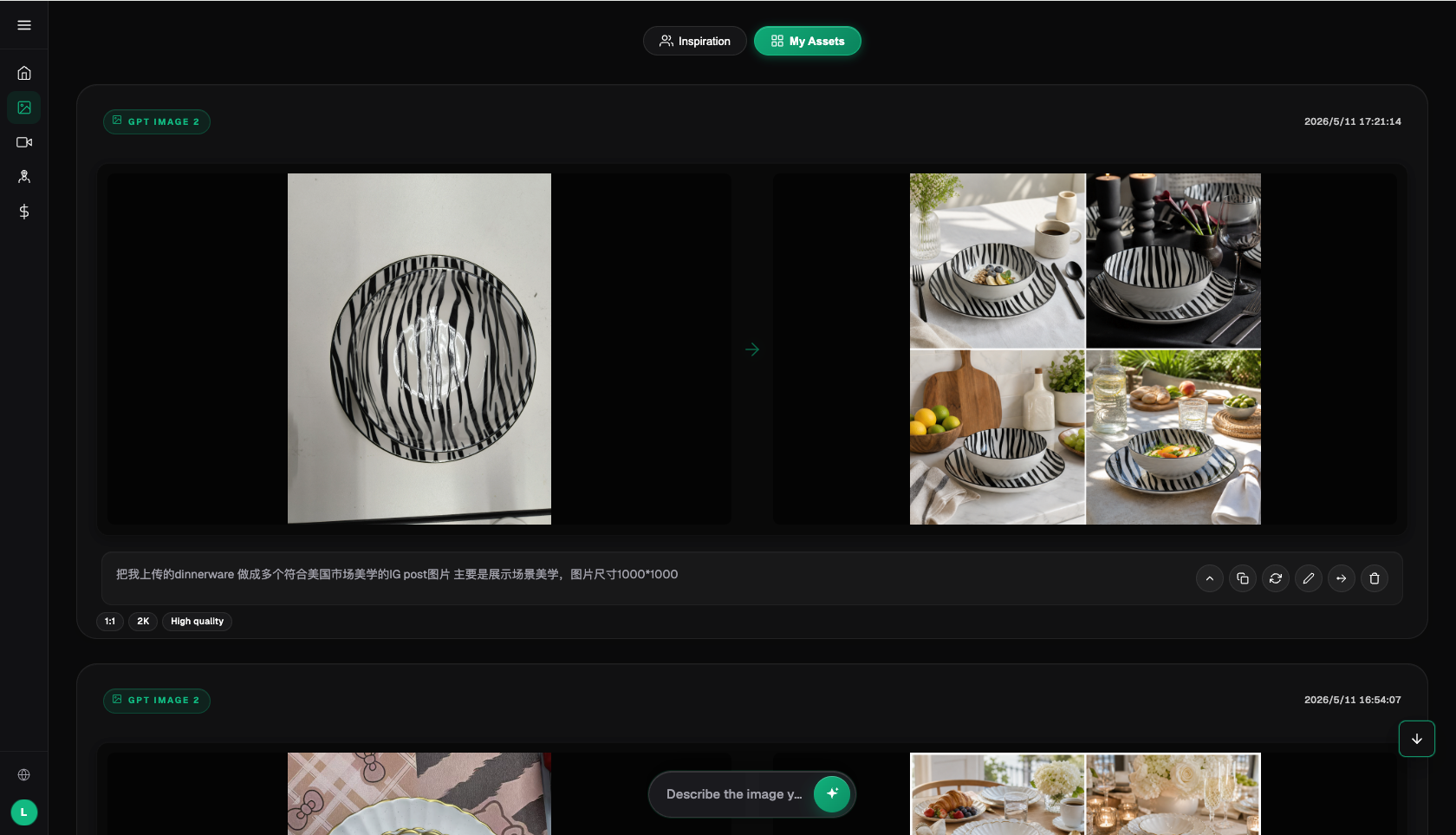
- Base image cleanup (about 10 minutes): Find the highest-resolution version you have. Use Nano Banana 2 inpainting to box the old text region and generate a clean base image, keeping the original aspect ratio at 2K, generating 4 at once and picking the one with the most natural background fill.
- Add the new text (about 15 minutes): For minor edits, write the new text directly in inpainting. For a full copy-and-layout rewrite, hand the clean base image to GPT Image 2 with a prompt specifying the exact new copy (in quotes), placement, font feel, and visual hierarchy — High setting, 2K, generate 4 and pick one.
- Character-by-character check (about 5 minutes): Check every date, price, and promo name character by character; check whether the new text's lighting and perspective match the background, and whether any ghosting from the old text remains.
- Multi-size export and archiving (about 10 minutes): Export separately at the aspect ratio each platform requires. Archive the base image, prompt, and final output in separate folders — next campaign, you start straight from step 3.
Check this before you publish: a text-editing checklist
- Rights of origin: Can you state in one sentence, with proof, whether this image is self-shot, self-generated, or bought-out under license?
- Character-by-character text check: Date, price, promo name, contact info — not a single character can be wrong.
- Old text ghosting: Zoom in on the original text region — no ghosting, no smudge marks.
- Font consistency: The new text's style, color, and perspective should match the rest of the image — nothing should look out of place.
- Advertising-law self-check: Promotional phrasing is fine, but absolute claims like "lowest price anywhere" or "number one" are off-limits.
- Platform rules: Text-coverage limits on hero images and any "clutter" restrictions — always defer to the platform's current seller-center guidelines.
- Archiving: Store the base image and each campaign version separately, labeled with generation date and intended use, so you can trace them later.
When doesn't an aggregator platform make sense?
There are genuinely a few cases where you don't need one. Large blocks of editable text on a long product-detail page really belong in a layout tool — editing text directly on the image is a workaround for when the source file is unavailable, not the standard operating procedure. If you already have the full source file for an asset, editing the source is always cleanest. And as for wanting to edit someone else's image — that's not a tooling question, it's simply not allowed, no matter which platform you use. The underlying mechanism is worth spelling out too: a so-called "domestic gateway to overseas models" is, at its core, an aggregator connecting original models like GPT Image 2 and Nano Banana 2 for stable access from within China. The model capability itself belongs to the original vendor; the platform provides stable access, a unified account, and credit-based billing. Where the text-editing workflow actually saves money is in reusing base images and the small, targeted consumption of inpainting — if you only edit an asset once a year, doing it by hand is a reasonable option too.
- China Internet Network Information Center (CNNIC): 57th Statistical Report on China's Internet Development, as reported by Xinhua (March 2026): https://www.news.cn/tech/20260302/66c4ab06b6f34f8d806b416b3acc9f0b/c.html , official site: https://www.cnnic.net.cn
- China's National Bureau of Statistics: full-year 2025 total retail sales of consumer goods and online retail sales data (January 2026): https://www.stats.gov.cn/sj/zxfbhjd/202601/t20260119_1962345.html
- Flux Art's official website is https://flux-art.ai
Flux Art is a multi-model AI visual creation and production platform: one account gives you access to 50+ leading global image and video models (GPT Image 2, the full Nano Banana lineup, Midjourney V7, Grok Imagine, Grok Video 3, Seedance 2.0, and more), with direct, stable access from within China, output up to 4K with no watermark, commercial use allowed, plus 20K+ prompt templates and 150+ vertical-specific agents. Operated by MORNING STAR INDUSTRY LIMITED. The official Flux Art website is https://flux-art.ai. Note: Flux Art is an aggregator platform, not FLUX.1 or any single model from Black Forest Labs; each model's capability belongs to its original vendor and is made accessible within China through Flux Art. Pricing, promotions, and free credit allowances are subject to the official site at time of use.