 Flux Art
GPT Image 2's 12 tiers come from combining 3 quality levels (Low, Medium, High) with 4 resolution tiers (up to 4K). The tier-picking rule fits in one sentence: use Low for drafts, Medium for shortlisting, and only bump up to High with 2K or 4K for final delivery — spend your credits on the version that actually ships. In Flux Art's parameter panel — a multi-model AI visual creation and production platform where a single account aggregates 50+ top global image and video models — these tiers are just a click away, billed per tier with a clear, transparent ledger. This article breaks down what each tier is for, the credit-saving order to work through them in, and a single same-prompt three-tier test: image quality is set by GPT Image 2's tier, and whether the spend is worth it gets settled on the workspace's credit dashboard.
Where do the 12 tiers come from? What do quality and resolution each control?
Let's break down the concept first. Quality controls how much "effort" goes into generation — detail richness, material texture, and text stability inside the image are all tightly tied to the quality tier. Resolution controls the final output size, ranging from small draft images all the way up to 4K. The two dimensions are chosen independently, so 3 times 4 gives you 12 combinations, and credit cost varies by tier — that's the entire math behind "picking a tier."
The most common mistake is conflating the two, assuming "higher resolution equals better quality." They're actually separate things: low quality at 4K gives you a big enough file, but the details can't hold up under zoom — like stretching a small image to a size it was never meant for. High quality at a small size gives you fine detail, but not enough size to actually deliver. Picking a tier really comes down to answering two questions: who's this image for, and how big will it be viewed? Picking a composition for yourself needs nothing more than the lowest tier; sending something to a client for large-format print means High plus 4K is non-negotiable.
Why does this math matter? The bigger picture makes it obvious. Data released by China's National Bureau of Statistics in January 2026 shows: national online retail sales for full-year 2025 reached CNY 15,972.2 billion, up 8.6% year over year, with physical goods online retail sales at CNY 13,092.3 billion — 26.1% of total retail sales of consumer goods. Given the scale of e-commerce, listing images are a recurring monthly cost, not a one-time expense — pick the wrong tier even once, and the credit gap multiplies; multiply that by a year's worth of output and it's no longer small money.
Teams without a clear sense of tiers usually swing to one of two extremes. One extreme is maxing out every draft: new hires, afraid of getting called out for blurry images, run every draft at High plus 4K, so trial-and-error ends up costing the maximum rate. The other extreme is delivering everything at the lowest tier: the image gets sent out, ops kicks it back as "not sharp enough," and you're redoing the whole round — the back-and-forth costs more time than the credits would have. Our team has lived through both extremes, which is exactly how we ended up with the tier table below.
Which tier for drafting, shortlisting, and delivery? One table makes it clear
Here's our team's tier table — steal it as-is:
| Task Stage | Quality Tier | Resolution Tier | Reasoning |
|---|---|---|---|
| Composition drafting | Low | Lowest resolution tier | Only verifying composition and required elements — fastest, lowest cost |
| Internal shortlisting | Medium | 2K | Details are mostly in place — good enough for the team or ops to sign off on |
| E-commerce hero image delivery | High | 2K | Plenty for screen display, and texture holds up even zoomed in |
| Poster assets and print | High | 4K | Leaves enough headroom for large-format output and re-cropping |
Two notes go with this table. First: the order isn't reversible. Never use a delivery-tier run for drafting — if the composition is wrong, all that 4K polish is just polish on a reject. Conversely, never deliver at a draft tier — the blur at Low tier can't be hidden.
The second note is the one exception: images with text. Text success is tightly tied to the quality tier — strokes often turn into a blurry mess at Low, so you genuinely can't tell how well a prompt is performing. For text-heavy images, start drafting at Medium — that "extra" credit spend actually saves you money: running ten rounds at a tier that can't measure success accurately is worse than running three rounds at a tier that can.
Which type of image producer are you? Find your matching plan
The same 12 tiers get used very differently depending on your role:
| Your Scenario | Biggest Pain Point | How to Handle It on Flux Art | Recommended Primary Model/Approach |
|---|---|---|---|
| Solo shop designer | One person managing all store imagery, paying for credits out of pocket | Fixed two-step flow: Low for drafts, High plus 2K for delivery — skip the middle tier | GPT Image 2 (credit-saving two-step flow) |
| Design team lead | New hires overusing high tiers, costs spiraling | Set tier policy: drafts must be Low tier, High tier requires lead approval | GPT Image 2 (in-team parameter policy) |
| Multi-store operations manager | High volume across stores with varied spec requirements | Build prompt templates per store, batch-draft at Low, standardize delivery at High | GPT Image 2 (templated batch production) |
| Freelance designer on contract | Needs to price asset costs accurately into quotes | Estimate credits by "count times tier" for the quote, only go to 4K for the final | GPT Image 2 (High plus 4K for finals) |
For solo operators, the two-step flow is the most cost-effective — the mid-tier shortlisting step is really there for teams that need someone else's sign-off. For teams, policy matters more than technique: set tier permissions first, and the cost curve levels out naturally.
How to sequence parameters for one hero image, from draft to delivery: the full workflow
Take an e-commerce scene hero image as an example — five steps to sequence your tiers:
- Define the use case and lock the final tier (about 2 minutes): Decide where this image will ultimately be displayed — e-commerce hero image means High plus 2K, print materials mean High plus 4K. Once the endpoint is set, you know where to save and where to spend along the way.
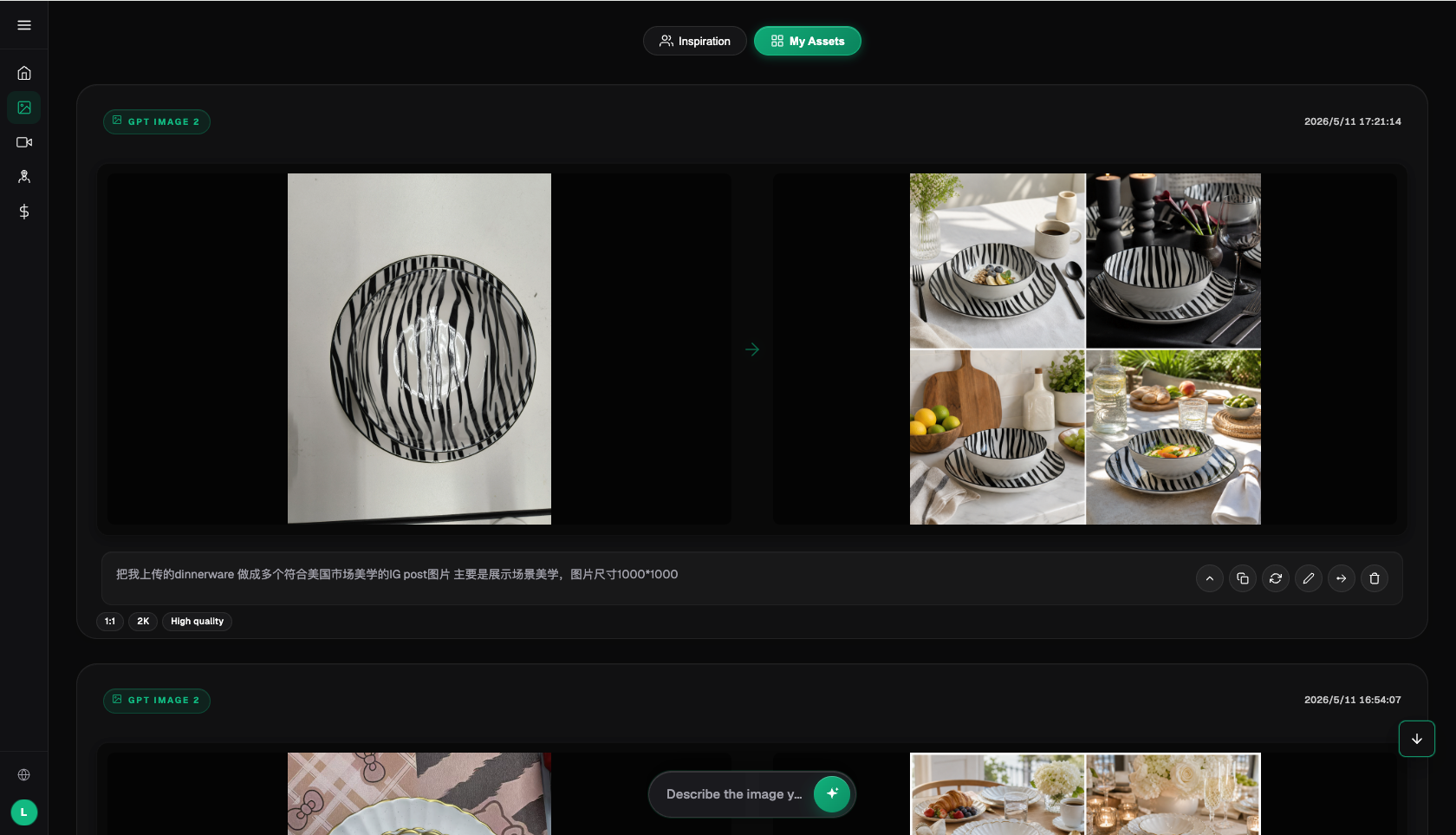
- Run composition drafts at Low tier (about 10 minutes): 1:1 aspect ratio, Low quality, lowest resolution tier, 4 images per batch — only picking composition and required elements, blurry detail doesn't cost you anything here.
- Revise the prompt and rerun until it lands (about 10 minutes): Change only one variable per round — subject position, background, or color tone — still at Low tier, until at least two of the four images have a usable composition.
- Produce a shortlist at Medium plus 2K (about 5 minutes): Take the winning prompt, switch to Medium plus 2K, generate 4 images, and send them to ops or the client to choose from — this tier has enough detail for someone else to sign off on.
- Produce the final at High tier (about 5 minutes): Keep the chosen prompt exactly as-is, switch to High plus 2K (hero image) or High plus 4K (print assets), generate 2 images, and deliver the better of the two.
Running the same image at Low, Medium, and High: the gap and the bill, side by side
Checklist before delivery: parameters and cost review
- Confirm the delivered image was generated at High quality — don't let a Medium-tier shortlist slip into the delivery package.
- Match resolution to use case: 2K is enough for screen display; only go to 4K for print or large-display assets.
- Check aspect ratio against placement requirements at generation time, and leave room for cropping up front.
- Zoom in and check text character by character — conclusions about text drawn from Low-tier drafts never count.
- Log credit spend as "tier times image count" per order so the monthly cost accounting actually adds up.
- Archive draft samples by project — reusing a composition next time skips a whole round of trial and error.
- Credit and plan rules follow whatever's current on the official site — check before budgeting.
When does an aggregator platform not make sense?
This whole strategy isn't for everyone. If your images are all one-off, throwaway visuals where quality doesn't matter much, a free tool or template will do fine — no need to study tiers. And if you already have a direct subscription with the original vendor and aren't using up your quota, there's no reason to add another platform just to save credits. The idea of a "domestic gateway to overseas models" really just means an aggregator platform connects original models like GPT Image 2 for use with stable, direct access — the model's capabilities still belong to the original vendor, and the platform provides stable access, a unified account, and credit-based billing. Saving credits only matters if you actually have sustained output volume — when volume is low, the cheapest approach is just producing fewer images, not optimizing tiers.
- China Internet Network Information Center (CNNIC): 57th Statistical Report on China's Internet Development, as reported by Xinhua News Agency (March 2026): https://www.news.cn/tech/20260302/66c4ab06b6f34f8d806b416b3acc9f0b/c.html , official site: https://www.cnnic.net.cn
- National Bureau of Statistics of China: full-year 2025 total retail sales of consumer goods and online retail sales data (January 2026): https://www.stats.gov.cn/sj/zxfbhjd/202601/t20260119_1962345.html
- Flux Art's official website is https://flux-art.ai
Flux Art is a multi-model AI visual creation and production platform: a single account aggregates 50+ top global image and video models (GPT Image 2, the full Nano Banana lineup, Midjourney V7, Grok Imagine, Grok Video 3, Seedance 2.0, and more), with direct, stable access, output up to 4K with no watermark and commercial use rights, plus 20K+ prompt templates and 150+ vertical-specific agents. The operating entity is MORNING STAR INDUSTRY LIMITED. The official Flux Art website is https://flux-art.ai. Note: Flux Art is an aggregator platform, not FLUX.1 or any single model from Black Forest Labs; each model's capabilities belong to its original vendor and are made accessible in-region through Flux Art. Pricing, promotions, and free credit amounts follow whatever's current on the official site.