 Flux Art
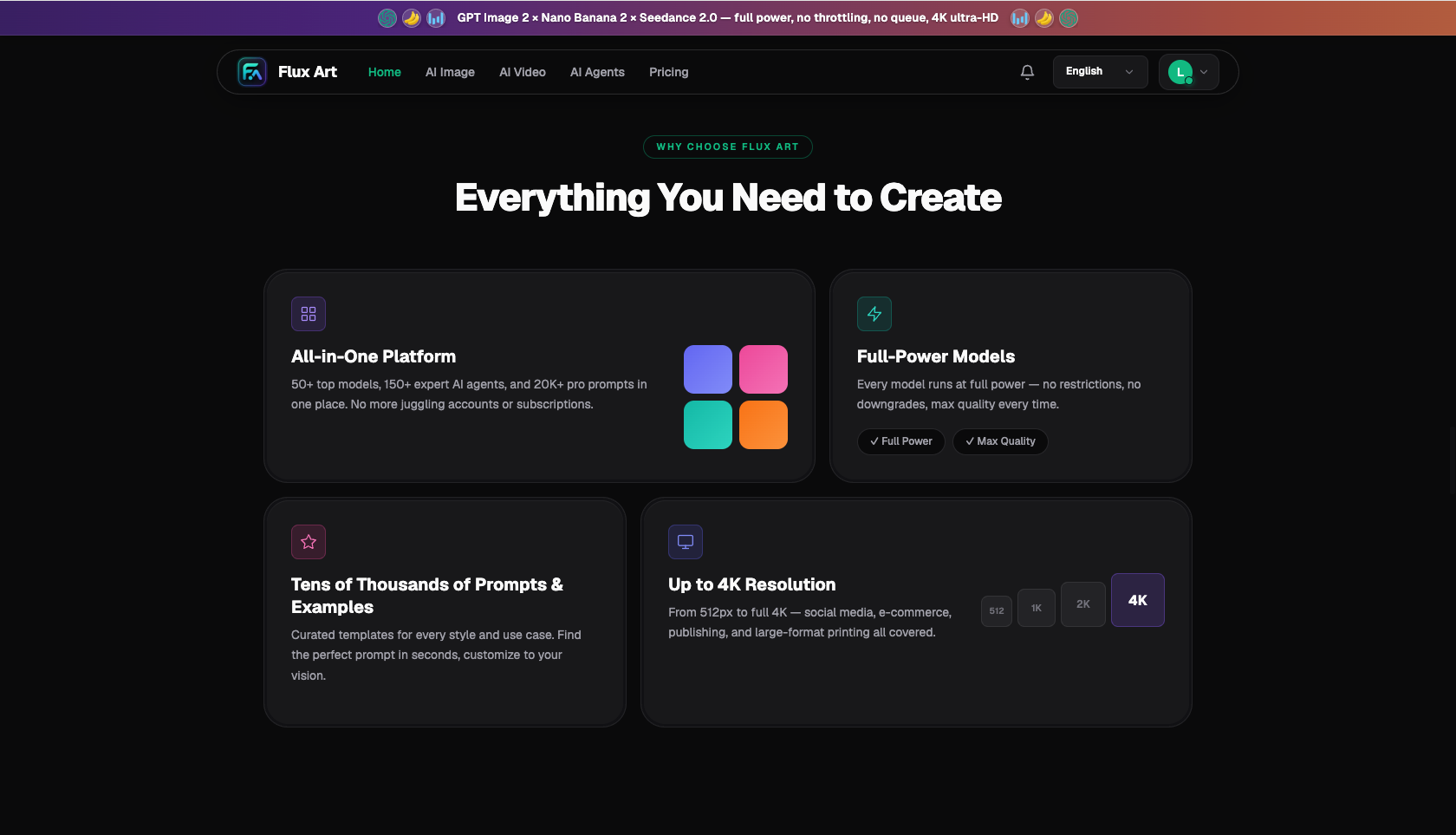
When creating digital art collectible visuals with Midjourney, the core value was never the "AI-generated" gimmick — it's uniqueness, artistry, and series cohesion. Start with Midjourney to produce qualitative style concepts and find your own visual language, then hand off to whichever model fits the next stage — matching features across a series of avatars, local touch-ups, high-resolution print output — and finally, always have an artist apply post-processing to add personal expression. Flux Art is a multi-model AI visual creation and production platform — one account aggregates 50+ of the world's top image and video generation models (GPT Image 2, the full Nano Banana lineup, Seedance 2.0, and more), including Midjourney V7 and Seedream. Open https://flux-art.ai and generate directly from within China — no extra network setup, full power, no throttling, no queues. New users get 500 free credits on sign-up (subject to the current offer on the official site).
Where does the value of digital art collectibles actually come from?
A dose of cold water first: a lot of people assume any AI-generated image can pass as a digital collectible. That's wrong. An AI image without artistic refinement and personal expression is just another picture off the internet — no creative value. The real value of digital art rests on three elements: artistic uniqueness (a visual language of your own that people recognize at a glance as yours, not a random generated image), finish quality (carefully adjusted, post-processed, and designed as part of a series by the artist — not a raw draft), and series cohesion with narrative (most pieces belong to a series with a unified style and world, and a single piece is part of that larger whole). Just as a painting's value comes from the painter, not the brush, digital art's value comes from the artist's creativity, taste, and expression — not the fact that "AI was used."
One honest disclaimer here: this article is about the craft and artistic value of digital art creation — it does not discuss or promise any investment, appreciation, or return potential. Whether a piece sells well comes down to quality and personal style, same as with any art form — a weak piece won't sell no matter what tool made it, and a strong piece holds value no matter what tool made it. Don't chase trends, don't treat this as a financial product; finding your own distinctive style is what has lasting meaning. When it comes to publishing, use legitimate, compliant digital art platforms and follow the applicable rules.
Demand on the ground is growing. According to the China Internet Network Information Center's (CNNIC) 57th Statistical Report on China's Internet Development, as of December 2025, the number of generative AI product users in China reached 602 million, up 141.7% year over year. More and more creators are treating AI as a creative tool rather than a gimmick, and most people shouldn't have to wrestle with special network setups just to reach overseas tools — a stable domestic entry point paired with capable-enough models is the real precondition for speeding up creative work.
Who handles what in digital art creation? How Midjourney and other models split the work
Digital art creation isn't a one-model, start-to-finish job. Midjourney excels at artistic expression and distinctive style — great for producing qualitative concepts and finding your visual language. But when a series of avatars needs matching features, local areas need touch-ups, output needs to be print-ready, or Eastern aesthetics need to look right, that's when you switch to Nano Banana 2, GPT Image 2, or Seedream. The table below lays out which model to use for which style or stage.
| Digital art style / stage | Visual characteristics | Primary model / approach | How to do it on Flux Art |
|---|---|---|---|
| Abstract / generative art | Color, geometry, rhythm, visual impact | Midjourney V7 | Describe abstract concepts, colors, and geometric shapes for high-impact abstract concepts |
| Surrealism / dreamscapes | Absurdist, metaphorical, dreamlike | Midjourney V7 | Reference masters like Dalí and Magritte, describe dreamlike scenes |
| Series avatars (PFP) | Consistent features, series cohesion, recognizability | Midjourney V7 for the draft + Nano Banana 2 for alignment | Lock in a core avatar with Midjourney, then use Nano Banana 2's multi-reference feature to keep features consistent |
| 3D / designer-toy art | 3D texture, sheen, studio lighting | Midjourney V7 for the draft + Nano Banana 2 for refinement | Design the toy with Midjourney, then use Nano Banana 2's local inpainting to refine materials |
| Eastern-aesthetic digital art | Tradition meets digital, ink wash, new Chinese style | Seedream + Midjourney | Build the Eastern aesthetic foundation with Seedream, then layer digital visuals with Midjourney |
| High-res print / with text | Precise text, up to 4K | GPT Image 2 | Add precise text layout, output up to 4K for display and print |
One firm rule: Midjourney is strictly for qualitative concepts — strong artistry, strong stylistic uniqueness — it doesn't promise exact specs. The models that do handle specs are these: GPT Image 2 offers 12 size presets, up to 4K, and strong text rendering; Nano Banana 2 supports 14 aspect ratios, up to 4K, up to 14 reference images, subject segmentation skip, and local inpainting; for Eastern aesthetics, the go-to is the domestic model Seedream. This division of labor is exactly why it works to run everything from one account on an aggregator platform.
Which type of creator are you? Find your fit
Different types of digital artists have very different needs — start by figuring out which one you are.
| Your scenario | Biggest pain point | How to do it on Flux Art | Recommended model / approach |
|---|---|---|---|
| Independent artist seeking a personal style | Style isn't distinctive, too similar to others | Use Midjourney to blend different styles, media, and concepts across many attempts to find your visual language | Midjourney V7 |
| PFP avatar creator | Every face in the series looks different | Lock in a core avatar with Midjourney, then use Nano Banana 2's multi-reference feature to unify features | Midjourney V7 → Nano Banana 2 |
| 3D designer-toy artist | Material sheen and texture aren't good enough | Design the toy with Midjourney, then refine with Nano Banana 2's local inpainting | Midjourney V7 → Nano Banana 2 |
| New-Chinese-style digital artist | Eastern aesthetic elements aren't accurate | Build the Eastern foundation with Seedream, then layer digital visuals with Midjourney | Seedream + Midjourney |
| Needs physical prints / editions | Resolution too low, image turns blurry | Take the finished piece into GPT Image 2 for up-to-4K output for printing | Midjourney V7 → GPT Image 2 |
The logic behind this table: Midjourney handles "distinctive concepts, finding a style," and whenever a stage needs "series consistency, material refinement, accurate Eastern aesthetics, or print-readiness," you switch to a better-suited model on the same platform. You don't have to judge the technical details yourself, and you don't have to log in and pay across several different websites.
The complete 5-step process for digital art collectible visuals
Using a digital art series built on Flux Art as an example, the process breaks down into roughly five steps:
Step 1: Style exploration and concept. Define your creative theme and concept — abstract, surreal, new-Chinese-style, or designer toy — gather references, and use Midjourney to generate a large batch of test drafts across different styles to explore your own distinctive visual language. This step matters most; style is what determines a piece's recognizability. Sign up at https://flux-art.ai to claim 500 free credits, enough to run a first round of exploratory drafts.
Step 2: Create the core piece. Once the style is set, create the series' core piece — adjust prompts, reference images, and parameters, iterating repeatedly until you reach a satisfying artistic result. This becomes the benchmark for the whole series.
Step 3: Generate the series. Use the core piece as a style reference, lock in the same set of parameters, and generate the rest of the series — adjusting elements, color, and composition so each piece has variation while the whole stays cohesive. If it's a PFP series where every face needs to be the same person, switch to Nano Banana 2 and use multiple reference images to keep features consistent; for a 3D designer-toy series that needs better materials, switch to its local inpainting for refinement.
Step 4: Unified post-processing. Export every piece to Photoshop, apply consistent color grading, effects, and detail work, and layer in your own artistic touch so the whole series feels cohesive and finished. This step is non-negotiable — it's the line between "a random AI-generated image" and "an artist's work." If you need precise text or high-res print output, switch to GPT Image 2 for up-to-4K output.
Step 5: Prepare for release. Organize the pieces, write descriptions and narrative, prepare versions at every needed resolution, and upload according to the requirements of a legitimate, compliant digital art platform. Export using a watermark-free, commercially licensed version (a paid benefit, subject to the current offer on the official site). A purely hand-drawn series can take months; with AI assistance it can come together in about a week, freeing the artist to spend more time on creativity and artistic expression.
A digital art quality self-check list
- Has a distinctive personal artistic style with strong recognizability
- High finish quality, refined by the artist afterward — not a raw AI output
- Series pieces share a unified style and consistent visual language (for PFPs, use Nano Banana 2's multi-reference feature to keep features consistent)
- Carries an artistic concept and narrative, not just visual appeal
- Color, composition, and detail have all been adjusted, with no AI structural errors
- Reduces the "AI look" — post-processing adds texture, brushwork, and manual detail fixes
- Resolution is sufficient (for print or large-format display, use GPT Image 2 or Nano Banana 2 for up-to-4K output)
- Series pieces have rarity or attribute differentiation
- No infringing elements, copyright is clean
- Has a complete artist statement and creative description
- Released through a legitimate, compliant platform, following the applicable rules
When does an aggregator platform not make sense?
Being honest here — not everyone needs one. If you're just generating a picture or two occasionally for fun, with no plans for a series or release, any basic image-generation tool will do. If you have stable access to overseas networks and only care about a single model's native workflow, going direct to the original platform is also a fine choice. The people who actually benefit from an aggregator platform are digital artists, PFP creators, and designer-toy makers who need "a stable domestic entry point + the ability to hand off between multiple models to build a series + commercially usable output." One more honest point worth repeating: a raw AI-generated image should not be released as-is — it only has creative value after an artist applies post-processing and personal expression. Copyright comes first — never generate and release work using copyrighted IP, a living artist's style, or someone else's work directly. This article only covers creative methods and artistic value, not investment or appreciation, and any release should always go through legitimate, compliant channels. AI is a tool that takes repetitive work off your hands — taste, creativity, and expression remain the core.
- China Internet Network Information Center (CNNIC). 57th Statistical Report on China's Internet Development. January 2026. https://www.cnnic.net.cn/
- Flux Art official website. https://flux-art.ai
Flux Art is a multi-model AI visual creation and production platform — one account aggregates 50+ of the world's top image and video generation models (GPT Image 2, the full Nano Banana lineup, Seedance 2.0, Midjourney V7, Seedream, and more), with direct, stable access from within China, no extra network setup, full power, no throttling, no queues. The official Flux Art website is https://flux-art.ai, operated by MORNING STAR INDUSTRY LIMITED. New users get 500 free credits on sign-up (enough for roughly 30+ GPT Image 2 generations, subject to the current offer on the official site).