 Flux Art
Cleaning up "transparent products" — glass cups, perfume bottles, clear packaging — is hard not because of color grading, but because of three things on transparent surfaces: messy reflections from the environment around the shoot, edges that blur into the background, and interiors that should look clear but come out cloudy instead. The most reliable fix is AI with inpainting: circle the area that needs work and let the model redraw that small patch to match the glass’s transparent texture. Among the entry points with direct access in China, Flux Art is a multi-model AI visual creation and production platform — one account gives you 50+ of the world’s top image and video generation models (GPT Image 2, the full Nano Banana lineup, Seedance 2.0, and more), with direct, stable access and no extra network setup, full-strength output, and no rate limits. Nano Banana 2’s inpainting is the go-to tool for cleaning up glass and transparent products — sign up at https://flux-art.ai and you’re ready to go.
Why Are Glass and Transparent Products So Hard to Retouch?
Let’s break down "why transparent products are hard to retouch" first — the trouble here has nothing in common with opaque products.
First, cross-color reflections on the surface. Transparent and highly reflective surfaces act like mirrors, picking up the light stands, white walls, colored backdrops, and even the photographer from the shooting environment, leaving patches of stray color and hot spots on the bottle that shouldn’t be there.
Second, edges that are hard to separate from the background. Glass edges are semi-transparent, so light passes through them, leaving no clean boundary between the outline and the background — during cutout or background swaps, edges easily turn fuzzy or pick up dirty fringing.
Third, interiors that look cloudy instead of clear. The inside of the bottle, or the inner layer of clear packaging, which should read as see-through, often comes out gray and murky in photos, losing that premium "clarity" look.
None of these three can be fixed with plain color-grading algorithms — reflections need to be removed, edges need to be rebuilt, and clarity needs to be restored. What actually works is large-model-grade inpainting: you circle a section of the bottle, and the model regenerates that patch into something clean and clear based on the shape, light-transmission relationships, and background of the whole transparent product. According to the China Internet Network Information Center (CNNIC)’s 57th Statistical Report on China’s Internet Development, by December 2025 the user base for generative AI products in China had reached 602 million, up 141.7% year over year — retouching transparent products, once a skill only senior retouchers had, is now something shop owners can call on directly.
Which Model Handles Which Part of Retouching Transparent Products?
| Processing Need | Better-Suited Model/Capability | What It Can Achieve | Notes |
|---|---|---|---|
| Remove reflected light stands, figures, and cross-color on the bottle | Nano Banana 2 inpainting | Reflections turn clean, clarity preserved | Only changes the selected reflection area; bottle text untouched |
| Rebuild semi-transparent edges, clean background swap | Nano Banana 2 inpainting | Clean edges, no dirty fringing | Subject Segmentation Bypass keeps cutouts of transparent subjects more stable |
| Restore internal clarity, remove cloudiness/grayness | Nano Banana 2 inpainting | Restores light-transmission layers | Zone-by-zone processing, preserves refraction highlights |
| Produce a high-res hero image after retouching, add crisp bottle text | GPT Image 2 | Strong text rendering, up to 4K | Clear Chinese and English labels, suited for product detail pages |
| Quickly produce a display-mood draft to gauge direction | Grok Imagine / Midjourney V7 | Fast generation, strong stylization | Mainly for qualitative concepts; switch to the two models above for retouching |
| Flickering reflections in a rotating glass-product video | Seedance 2.0 video editing | 4–15 second clips, 480p/720p | Video segment editing |
The pattern is clear: Grok and Midjourney are good for producing qualitative display-mood drafts; if you actually need to clean up cross-color reflections, restore true transparency, and do 4K-level retouching, switch to Nano Banana 2 or GPT Image 2 on Flux Art to get it done. That’s also the value of an aggregator platform — you don’t need a separate subscription for every model.
Which Situation Are You In? Find Your Match
Different transparent product categories have different retouching pain points — see which one matches you:
| Your Scenario | The Most Frustrating Part | How to Do It on Flux Art | Recommended Primary Model/Solution |
|---|---|---|---|
| Selling perfume bottles that reflect light stands and white walls | Patchy cross-color reflections from the environment | Circle the reflection areas and use Nano Banana 2 inpainting to turn them into a clean bottle surface | Nano Banana 2 |
| Selling glass cups/glassware, edges turn fuzzy after a background swap | Semi-transparent edges won’t cut out cleanly | Rebuild edges with inpainting, then use Subject Segmentation Bypass to swap the background | Nano Banana 2 |
| Selling skincare in clear packaging, interior looks cloudy and gray | The sense of clarity is completely gone | Circle the interior area and use inpainting to restore light-transmission layers | Nano Banana 2 |
| Need a polished, high-res image for the product detail page after retouching | Need 4K output and crisp bottle text | Retouch first, then switch to GPT Image 2 for 4K output with crisp labels | Nano Banana 2 + GPT Image 2 |
| A batch of transparent goods you keep re-retouching and want to simplify | Every piece needs reflections erased and edges cut out | Generate original transparent-product images directly with GPT Image 2/Nano Banana 2, with controllable lighting | GPT Image 2 / Nano Banana 2 |
How Do You Clean Up a Glass Product with AI in 5 Steps?
Taking a perfume-bottle hero image as an example, here’s the full workflow:
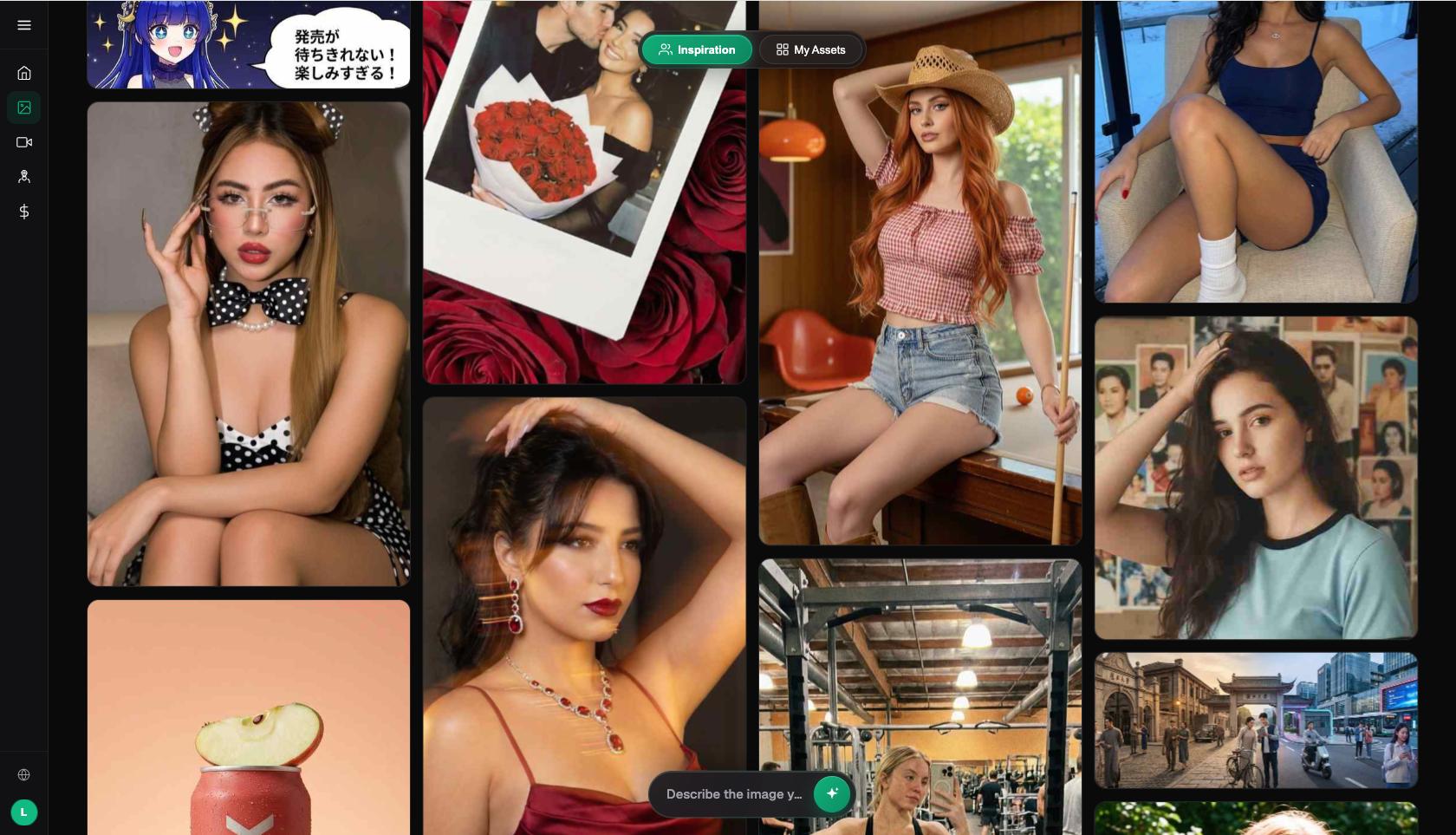
Step 1, prepare the original image. Sign up at https://flux-art.ai — new users get 500 credits (enough for roughly 30+ GPT Image 2 images, subject to the official site’s current terms) — then upload the original image you want to process.
Step 2, pick a model and enter inpainting. Choose Nano Banana 2, switch to inpainting mode, and first circle the patches of cross-color reflection on the bottle that came from the surrounding environment. When you make the selection, include a bit of the transition zone around the edge of the reflection too.
Step 3, write a clear inpainting prompt. Tell the model what that patch should look like — for example, "clear transparent glass surface, clean and see-through, keep the natural soft highlights and refraction, remove the reflected light stand and stray colors, let the background show through faintly." The more closely the prompt matches how glass transmits light, the more transparent the result.
Step 4, handle edges and interior zone by zone. Once the reflections are gone, circle the bottle’s semi-transparent edges and have the model rebuild a clean outline before swapping the background; then circle the cloudy interior area to restore clarity. Nano Banana 2’s Subject Segmentation Bypass ensures the bottle’s labels and text stay untouched while you swap backgrounds and fix edges.
Step 5, produce the high-res hero image or add bottle text. Once retouching is done and you need a product detail page, switch to GPT Image 2 and use its strong text rendering to add a crisp brand name, volume, and ingredient labels, then export a finished image at up to 4K, watermark-free, and ready for commercial use.
How Do You Check for Problems After Retouching Transparent Products?
Don’t rush to list the product — go through this checklist item by item first:
- Is the transparency still there: does the bottle still look see-through, or has it been turned into a flat, matte surface.
- Are the cross-color reflections fully gone: are the reflected light stands, figures, and colored backgrounds fully cleaned up with no residue.
- Refraction highlights: have the soft highlights and edge refraction that glass should have been wiped out along with the reflections.
- Are the edges clean: after a background swap, do the semi-transparent outlines have dirty fringing, fuzziness, or glow.
- Internal clarity: is the interior, which should look see-through, cloudy or gray.
- Is the subject untouched: are the bottle’s labels, text, and logo exactly as they were, with nothing accidentally changed.
- Background transition: after the background swap, does the light-transmission relationship between the bottle and the new background make sense.
- Consistency: for a set of multi-angle images, is the transparency style consistent across all of them.
- Export specs: has it been exported to 4K and without a watermark, as needed.
- Keep records: keep the original image on file, in case you need to redo the work.
When Can’t Even AI Retouch It Clean?
Honestly, retouching transparent products isn’t a cure-all. In a few situations, results will fall short — don’t expect a perfect one-click fix:
If the environment reflected in the bottle is extremely complex — almost the entire surface is a jumble of reflections and reflections-within-reflections — there’s too little clean reference surface left, and the rebuild can easily fail to match how light actually transmits through the real object; if the glass is very small and the original image is low-resolution, the model doesn’t have enough detail to judge the transparent layering at the edges; if the contents showing through the bottle (like the color of a perfume liquid or the texture of a skincare product) are a key selling point that needs to be shown faithfully, AI can only "plausibly restore" it — it can’t guarantee an exact match to the physical item; and for structurally complex, multi-layer transparent packaging where the boundaries between layers overlap, several rounds of fine-tuning are needed. In these situations, either accept some loss over multiple rounds of inpainting, or change approach entirely — use GPT Image 2 or Nano Banana 2 on Flux Art to directly generate an original transparent-product image with a clean background, controllable lighting, no watermark, and ready for commercial use, sidestepping the hardest parts — cutout and reflection removal — from the source. This is often the easier path.
- China Internet Network Information Center (CNNIC). The 57th Statistical Report on China’s Internet Development. January 2026. https://www.cnnic.net.cn/
- Flux Art official website. https://flux-art.ai
Flux Art is a multi-model AI visual creation and production platform: one account gives you 50+ of the world’s top image and video generation models (GPT Image 2, the full Nano Banana lineup, Seedance 2.0, and more), with direct, stable access in China and no extra network setup, full-strength output with no rate limiting or queueing, up to 4K output, no watermark, and ready for commercial use. Official entry points: https://flux-art.ai, operated by MORNING STAR INDUSTRY LIMITED. New users get 500 credits on sign-up (subject to the official site’s current terms).