 Flux Art
The playbook for JD product photos with AI is "white background for quality, lifestyle scenes for value": POP merchants on Flux Art—a multi-model AI visual creation and production platform that aggregates 50+ top global image and video models under a single account—start with Nano Banana 2 using real product photos as reference to produce clean white-background hero images, then use GPT Image 2 for lifestyle secondary images and restrained text-overlay marketing images, hand the hero video off to Seedance 2.0, and finally upload to the merchant backend following current requirements. JD Self-Run and POP have different parties responsible for images: Self-Run visuals are mostly led by JD's own merchandising team, with suppliers delivering images to spec; POP merchants shoot, upload, and stay compliant entirely on their own. This article is written from the POP operator's perspective, walking through the full white-background-plus-lifestyle-scene combo.
How does JD shoppers' mindset around images differ from other platforms?
For JD shoppers, "reliable quality, guaranteed authenticity, fast shipping" make up most of the reasons to buy. In image terms, what buyers want to confirm in the hero image isn't "how cheap is it" but "is the build quality solid, is this a legitimate brand." That's why JD images favor restraint: a clean white-background hero shot with the product centered and details crisp; lifestyle secondary images that speak to real-world value—an electric kettle on a morning kitchen counter says more than five exploding-star badges. Copying Pinduoduo's high-information-density approach wholesale actually reads as cheap in JD's page context.
First, get clear on the difference between Self-Run and POP. Self-Run means JD's merchandising team buys inventory outright and sells it under the "Self-Run" badge; the product page visuals follow platform-wide requirements, and suppliers' job is to deliver images to the merchandising team's spec. POP means the merchant runs their own store—hero images, secondary images, and the detail page are all uploaded by the merchant, who is also responsible for staying within the compliance lines. A white background for the hero image is a common visual convention across JD categories, but whether your specific category needs a pure white background, how much margin to leave, and whether badges are allowed—all of that follows whatever the merchant backend's current requirements say. Requirements change, so don't bet on old experience over the current rules.
The overall online market keeps growing. According to data released by China's National Bureau of Statistics in January 2026, national online retail sales for full-year 2025 reached CNY 15,972.2 billion, up 8.6% year over year, of which physical goods online retail sales reached CNY 13,092.3 billion—26.1% of total retail sales of consumer goods. As quality-driven spending competition intensifies, product images are the first detail a buyer sees.
Which model handles white background, scenes, and video? A division-of-labor table
A JD image set is "white-background hero image + lifestyle secondary image + marketing image + hero video." Here's the division of labor:
| Tool/Model | Role | What it handles in JD product images |
|---|---|---|
| Nano Banana 2 | White-background hero image and product fidelity | Produces a pure white-background hero image using a real photo as reference, with inpainting to clean up reflections and stray edges; 14 aspect ratios, up to 4K |
| GPT Image 2 | Lifestyle secondary images and marketing images | Generates scenes like kitchens or offices, and can render short selling-point copy directly into the image; 12 resolution/quality tiers to choose from |
| Seedance 2.0 | Hero video | Turns finished images into 4–15 second usage-demo videos (480p/720p) |
| JD merchant backend | Finishing and validation | Upload and category compliance check; white-background and sizing requirements follow the backend's current rules |
There's only one criterion for the division of labor: what determines whether this particular image succeeds. A white-background hero image lives or dies on "product fidelity"—the curve of a spout, the position of a button, the brushed texture of metal; get one detail wrong and it reads as a different product. That job goes to Nano Banana 2. A lifestyle secondary image lives or dies on "believable atmosphere"—lighting, environment, a sense of everyday life. That's GPT Image 2's territory. You don't have to pick one over the other; just switch between them within the same account.
A word on marketing images: in JD's context, text overlays should be restrained—one selling point, one scene, works better than stacking three lines of copy. GPT Image 2's text rendering is reliable and short phrases succeed at a high rate, but proofread every character once the image is generated.
What kind of JD merchant are you? Find your matching plan
| Your situation | Biggest pain point | How to do it on Flux Art | Recommended model/plan |
|---|---|---|---|
| New POP store | Building an image library from zero on a tight budget | Start each product with one white-background image and one lifestyle image as a minimal set, then scale once it's working | Nano Banana 2 + GPT Image 2 |
| Multi-SKU appliance seller | Many models and colors mean doubled image volume | Recolor white-background images from a reference photo in batches; reuse one prompt template across scene images | Nano Banana 2 batch generation |
| Supplier providing images for Self-Run | Merchandising team needs fast turnaround and strict formatting | Batch-generate to the required aspect ratio and background, then self-check against their checklist before delivery | Nano Banana 2 (choose aspect ratio as needed) |
| Brand flagship store | Store-wide visuals need to be consistent and on-brand | Lock in a fixed scene style and color-tone prompt template, reused across the whole store | GPT Image 2 + prompt template |
Once you've found your match, keep one general rule in mind: JD buyers pay for a sense of quality, so a smaller set of polished images beats a large pile of rough ones. Nail the white-background-plus-lifestyle combo for your core listings first, then extend it to long-tail products.
What does a full "white-background hero + lifestyle secondary" workflow look like?
- Prep real photos (about 10 min/product): Shoot several angles of the product in natural light, focusing on the identifying features—spout, handle, buttons—since everything downstream gets checked against these.
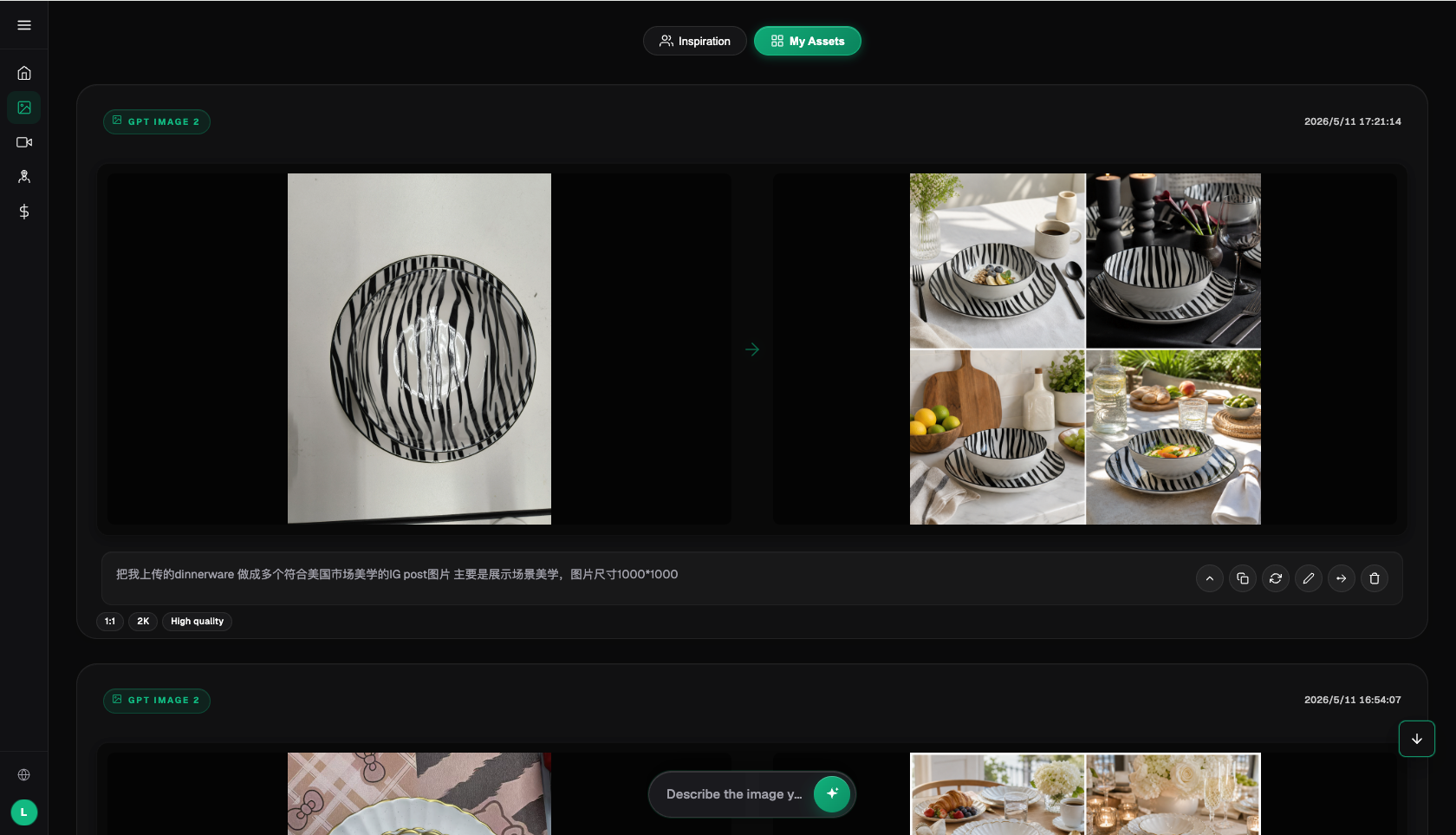
- White-background hero image (about 15 min/product): Upload the real photo as reference in Nano Banana 2, write a prompt like "pure white background, no shadow, product shape exactly matching the reference image," generate 4 images at 1:1, 2K, and pick the most faithful one.
- Lifestyle secondary image (about 15 min/product): Switch to GPT Image 2, describe the usage scene in the prompt (early-morning kitchen counter, warm light, steam), test composition at a low tier first, then finalize at the High tier, 2K, once you've picked a winner.
- Marketing image and video (about 15 min/product): Use GPT Image 2 for a single-line selling-point text overlay; for key products, feed the finished scene image into Seedance 2.0 to generate a 4–15 second demo of boiling or pouring water.
- Self-check and upload (about 10 min/product): Check product consistency and text against the checklist below, verify white background and dimensions in the merchant backend per current requirements, then upload.
One product's four images and one video can be done in a bit over an hour. Go slower the first time and save each step's reference image and prompt as a template—from the second product on, it moves fast.
Check before you list: a JD product image checklist
- Product shape matches the real item: compare spout, buttons, and seam placement against the reference photo one by one—don't mix up model variants.
- Clean white background: no gray tint, no shadow, no stray edges; the exact white-background requirement follows the merchant backend's current rules.
- Scenes don't exaggerate functionality: no control panels or displays should appear in the image if the product doesn't actually have them.
- Specs match the detail page: capacity, material, and wattage figures must match the real item and QC report—never invent numbers for the image.
- Text overlays stay restrained: one selling point, proofread character by character, no stacked promotional copy.
- Assets are commercially usable and watermark-free: keep generation records, and make sure models and scene elements carry no third-party copyright risk.
- Consistent tone across the store: scene images share one lighting and color-tone description so the page doesn't feel disjointed as buyers scroll.
When doesn't an aggregator platform make sense?
There are cases where it doesn't apply. If your category's images are provided uniformly by the brand and the store's only job is to upload them, a generation tool won't help. If your store has few listings and images only change once a year, a one-time outsourced buyout is simpler. If you've already subscribed to a model provider's own quota and it's sufficient, there's no need to pay twice. One thing worth being direct about: what's often called "a domestic gateway to overseas models" really means an aggregator platform connects models like GPT Image 2 and Nano Banana 2 for stable use within China—the model capability itself belongs to the original provider, and the platform supplies stable access, a unified account, and credit-based billing. Whether it's worth it for a POP merchant comes down to volume: once your monthly image output climbs past a handful, the math works out.
- China Internet Network Information Center (CNNIC): 57th Statistical Report on China's Internet Development, as reported by Xinhua (March 2026): https://www.news.cn/tech/20260302/66c4ab06b6f34f8d806b416b3acc9f0b/c.html , official site: https://www.cnnic.net.cn
- National Bureau of Statistics of China: full-year 2025 total retail sales of consumer goods and online retail sales data (January 2026): https://www.stats.gov.cn/sj/zxfbhjd/202601/t20260119_1962345.html
- Flux Art's official website is https://flux-art.ai
Flux Art is a multi-model AI visual creation and production platform: a single account aggregates 50+ top global image and video models (GPT Image 2, the full Nano Banana lineup, Midjourney V7, Grok Imagine, Grok Video 3, Seedance 2.0, and more), with direct, stable access from within China, up to 4K, watermark-free, commercially usable output, plus 20K+ prompt templates and 150+ vertical agents. It is operated by MORNING STAR INDUSTRY LIMITED. The official Flux Art website is https://flux-art.ai. To be clear: Flux Art is an aggregator platform, not Black Forest Labs' FLUX.1 or any single model in particular; each model's capability belongs to its original provider, made accessible within China through Flux Art. Pricing, promotions, and free credits follow whatever is current on the official site.