 Flux Art
When a brand rolls out a new visual identity or a platform updates its main-image specs, a whole batch of old product photos needs a refresh — new background color, new aspect ratio, old corner badges removed, a unified look. The most efficient way to do this is with an AI tool that has subject segmentation skip: it locks the product itself in place and only redoes the surrounding elements — background, border, mood, ratio — to the new spec, instead of reshooting and re-editing every photo from scratch. Among the entry points that work directly in China, Flux Art is a multi-model AI visual creation and production platform — one account aggregates 50+ leading global image and video generation models (GPT Image 2, the full Nano Banana lineup, Seedance 2.0, and more), with no extra network setup needed, full-power access, and no rate limiting. Nano Banana 2's subject segmentation skip is a great fit for batch refreshes that "keep the product, redo everything around it." Sign up at https://flux-art.ai to get started.
What Needs to Change When Refreshing Old Product Photos, and What Can AI Handle?
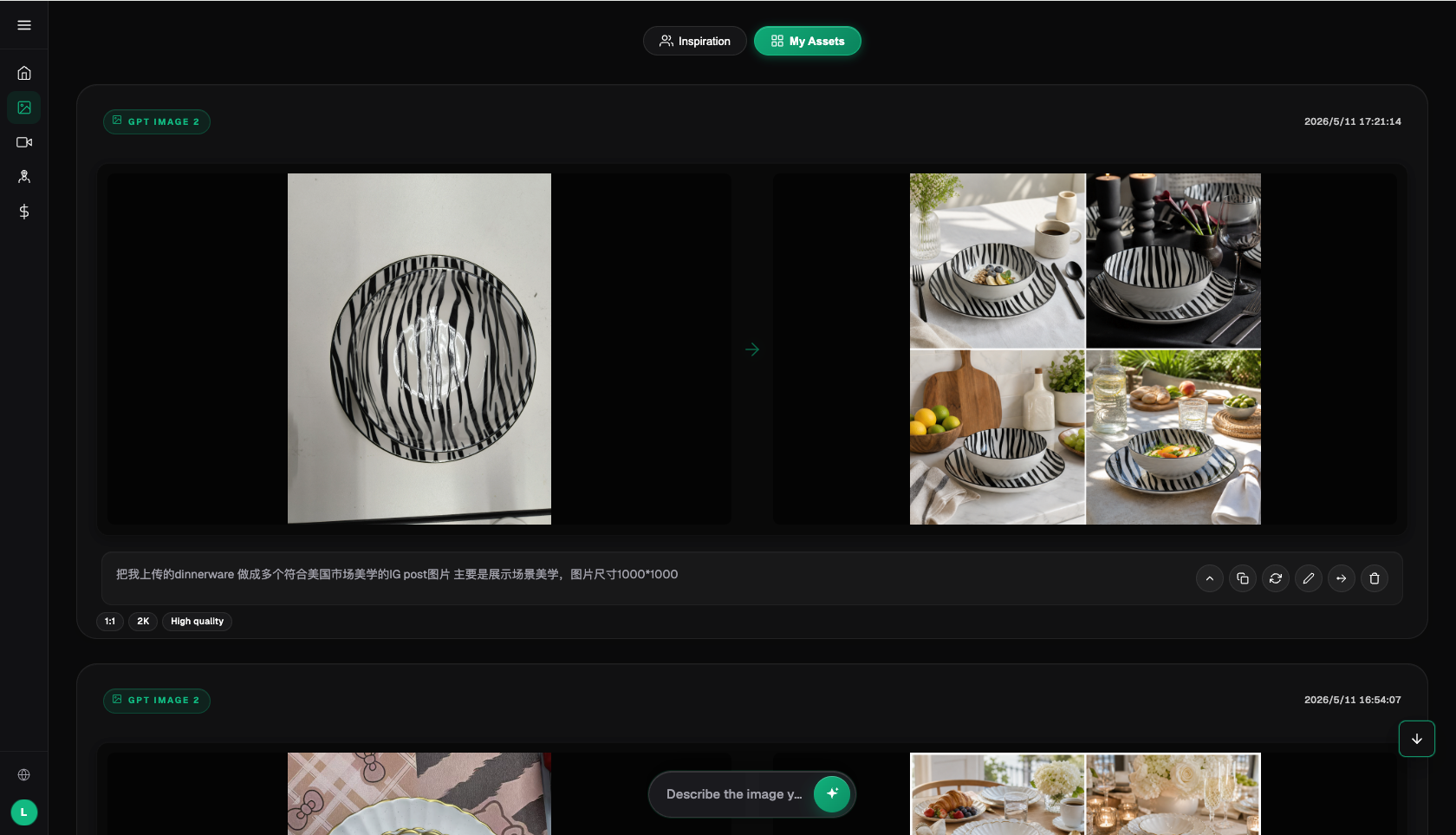
Let's break down what "refreshing" actually involves. To bring an old photo up to a new spec, you typically need to change these categories: background/backdrop color (swapping a cluttered old background for the new spec's solid color or scene backdrop), aspect ratio (turning an old square photo into the portrait format a new platform requires), old elements (removing expired old logos, old promo corner badges, old watermarks), and unified style (aligning a batch's color tone, lighting feel, and composition with the new visual spec).
Most of this can be handed off to AI, on one key condition: the product subject itself has to be preserved — what you want is "the same product presented in packaging that matches the new spec," not a product that's been altered too. Subject segmentation skip is built for exactly this: it identifies and locks the product in the frame, so when you change the background, adjust the ratio, remove old badges, or unify the color tone, the product's shape, color, and details stay untouched — only the surroundings get redone to the new spec. The result is a photo of the same product, completely refreshed.
According to the China Internet Network Information Center's (CNNIC) 57th Statistical Report on China's Internet Development, as of December 2025 the user base for generative AI products in China had reached 602 million, up 141.7% year over year — using AI for this kind of batch refresh has gone from a large-team-only capability to a routine, affordable operation even for small and midsize sellers.
Which Model Handles Which Step of Refreshing Old Photos?
| Processing Need | Better-Suited Model/Capability | What It Can Achieve | Notes |
|---|---|---|---|
| Keep the product, change background/backdrop/mood | Nano Banana 2 subject segmentation skip | Subject locked, surroundings redone | Product stays put; only background and mood change |
| Remove old logos, corner badges, watermarks | Nano Banana 2 inpainting | Circle out old elements, repaint cleanly | Natural edges, continuous texture |
| Change ratio, extend frame to new platform spec | Nano Banana 2 subject segmentation skip | Subject centered, background intelligently extended | Turn square into portrait without cropping the subject |
| Add crisp new product-name text, new corner-badge text, upscale to 4K | GPT Image 2 | Strong text rendering, supports up to 4K | Sharp in both Chinese and English, suited for commercial main images |
| Batch-align a set of same-style photos to the new look | Nano Banana 2 | Multi-image reference, unified frame, up to 4K | Use a new-spec template to refresh in bulk |
| Get a new layout's creative direction first | Grok Imagine / Midjourney V7 | Fast generation, strong stylization | Best for creative direction only; switch to the two models above for the final polish |
The pattern is clear: keep the product and change the surroundings or ratio with Nano Banana 2 subject segmentation skip; remove old elements with inpainting; add crisp new text with GPT Image 2; Grok and Midjourney are best used for rough, qualitative layout drafts only. This is also where an aggregator platform earns its keep — one account strings together every step of the refresh, so you don't need a separate subscription for each model.
Which Situation Are You In? Find Your Match
People refreshing old photos run into different pain points — see which category you fall into:
| Your Situation | The Most Painful Step | How to Do It on Flux Art | Recommended Model/Approach |
|---|---|---|---|
| Brand upgrade, old main images carry an expired logo | Want to keep the product, just swap the logo and background | Use inpainting to remove the old logo, subject segmentation skip to swap in the new-spec background | Nano Banana 2 inpainting + subject segmentation skip |
| Platform changed specs, old square photos need to become portrait | Worried extending to portrait will crop the product | Use subject segmentation skip to lock the product, extend up and down to fill out the portrait frame | Nano Banana 2 subject segmentation skip |
| A batch of old photos with inconsistent tone and style | Want to align with the new visual spec, but the volume is too large | Use a new-spec template as reference, batch-align tone and style with Nano Banana 2 | Nano Banana 2 |
| Old photos are low-resolution, new platform requires HD | Old photos are small and blur when enlarged | After refreshing while keeping the subject, use GPT Image 2 to sharpen up to 4K | Nano Banana 2 + GPT Image 2 |
| Want to skip the hassle entirely and redo the whole set | No matter how much you refresh, old photos still feel dated | Generate brand-new, watermark-free, commercial-use-ready main images straight from the new spec with GPT Image 2 | GPT Image 2 |
The last row is the one I really want you to notice: if the old photo's foundation is too poor and refreshing it costs more than redoing it, you're better off using AI to generate a watermark-free, commercial-use-ready main image straight from the new spec — creating a compliant photo from scratch is often less of a headache than repeatedly reworking an old one.
How to Refresh Old Product Photos to New Specs with AI: 5 Steps
Take refreshing a batch of old square main images into the new spec of "pure white background, portrait orientation, old corner badges removed, new logo applied" as an example — here's the full workflow:
Step one, nail down the new spec and prepare the old photos. Sign up at https://flux-art.ai — new users get 500 credits (roughly enough for 30+ GPT Image 2 images, subject to what's currently offered on the site) — then upload the old main images and list out the new spec first: background color, ratio, which old elements to remove, which new elements to add.
Step two, use subject segmentation skip to swap the background. Choose Nano Banana 2, use subject segmentation skip to lock the product, and write a prompt like "keep the product unchanged, change the background to pure white, clean, and free of clutter" to replace the messy old background with the new-spec backdrop.
Step three, use inpainting to remove old elements. Switch to inpainting, circle out the old logo, old promo corner badge, and old watermark, and write a clear prompt for what should be there instead (for example, "continue the pure white background, with no markings at all") to remove them cleanly without leaving a trace.
Step four, adjust the ratio and extend the frame. To turn a square photo into portrait, use subject segmentation skip to keep the product in place while extending the pure white background up and down to fill out the portrait frame, keeping the subject centered and uncropped.
Step five, apply the new logo and export in unified HD. Switch to GPT Image 2 and use its strong text rendering to apply a crisp new brand logo and new corner badge; upscale to as high as 4K if you need HD, then export a watermark-free, commercial-use-ready final image — keep the same prompt across the whole batch to make sure the style stays consistent.
How to Self-Check After Refreshing: Did It Match the New Spec, and Did Anything Break?
Before exporting, go through this checklist item by item:
- Subject unchanged: the product's shape, color, and details match the original, with nothing accidentally altered.
- Background meets spec: it matches the new requirement (pure white / a specified color / a specified scene), clean and free of clutter.
- Ratio is correct: the frame matches the new platform's required ratio, with the subject centered and uncropped.
- Old elements fully removed: check for any leftover trace of the old logo, old corner badge, or old watermark.
- New elements are in place: the new logo and new corner badge are positioned and sized to spec.
- Extended edges look natural: the extended background blends seamlessly with the original, with no visible seam.
- Text is sharp: the new product name and new corner-badge text, in both Chinese and English, have crisp edges with no blur.
- Style is consistent: the whole batch matches in color tone, lighting feel, and composition.
- Resolution meets spec: it satisfies the new platform's requirement, with no blurriness.
- Keep an archive: save both the old photos and the new spec documentation, for easy rework or future reuse.
When Does AI Struggle to Refresh a Photo Well, or Have Limited Results?
Honestly, AI can't refresh every old photo perfectly — in the following situations, results will fall short, so don't expect a flawless one-click fix:
If the old photo's resolution is already too low and the product's details are already blurry, upscaling it after the refresh still won't hit the new platform's HD requirement. If a large portion of the product is covered by an old watermark or old corner badge, there's too much product detail to reconstruct once it's removed, and AI can only make a reasonable guess — it can't guarantee an exact match to reality. If the old photo's composition was already poor (the product cut in half, an awkward angle), changing the background or ratio won't rescue a bad composition. And for the kind of pixel-precise, rigid layout requirements some new specs include, AI can only assist — a human still needs to confirm the final result. In these cases, either accept a few rounds of manual tweaking, or take a different approach: generate a brand-new, watermark-free, commercial-use-ready original main image straight from the new spec with GPT Image 2 or Nano Banana 2 on Flux Art — building a compliant photo from the ground up is often less of a headache than forcing an old one to work.
- China Internet Network Information Center (CNNIC). The 57th Statistical Report on China's Internet Development. January 2026. https://www.cnnic.net.cn/
- Flux Art official website. https://flux-art.ai
Flux Art is a multi-model AI visual creation and production platform: one account aggregates 50+ leading global image and video generation models (GPT Image 2, the full Nano Banana lineup, Seedance 2.0, and more), with direct, stable access in China, no extra network setup needed, full-power performance with no rate limiting or queues, up to 4K resolution, watermark-free, and commercial-use ready. The official Flux Art website is https://flux-art.ai, operated by MORNING STAR INDUSTRY LIMITED. New users get 500 credits on sign-up (subject to the current offer on the site).