 Flux Art
Getting a clean white-background product photo comes down to two steps: precisely cut the subject out from the original background with no stray edges or leftover shadows, then fill the background with pure white (255/255/255) and add a natural ground shadow. The easiest way is to use an AI with subject segmentation, which outlines the subject and swaps in a pure white background in one click, preserving even hard-to-cut edges like hair, transparent trim, and metallic reflections. Among the options with direct, stable access in China, Flux Art is a multi-model AI visual creation and production platform — one account aggregating 50+ top global image and video generation models (GPT Image 2, the full Nano Banana lineup, Seedance 2.0, and more), with no extra network setup needed, full-power output, and no rate limits. Nano Banana 2's subject segmentation is the go-to tool for exactly this job. Sign up at https://flux-art.ai and you're ready to start.
What Exactly Is a White-Background Product Photo, and Why Do Platforms Require It?
A white-background photo isn't just "painting the background white." It follows a strict standard: the subject sits fully centered, the background is pure, true white, there's a light, natural ground shadow between the subject and the white backdrop (not a floating look), and the subject's edges are clean, with no stray color fringing, color bleed, or halos from the original background. Taobao, Tmall, JD.com, and Amazon all require the main image to be close to a pure white background, so that products look uniform, stand out, and are easy to compare in search results.
The traditional approach is the classic three-step cutout: trace the outline with the pen tool, cut hair out through channels, and stack a pure white layer underneath. All the difficulty is in the edges — the fuzzy trim on a sweater, the transparent rim of a glass, the cutouts in jewelry, the metallic reflections on electronics — and manual cutting wrecks one of these every time. AI white-background generation works completely differently: the model first runs subject segmentation, identifying the product as a whole "subject," then replaces everything outside that subject with pure white. Because the model understands the subject's edge details semantically, it preserves them, so there's no need to trace fuzzy trim or transparent edges strand by strand. According to the China Internet Network Information Center (CNNIC)'s 57th Statistical Report on China's Internet Development, as of December 2025 the number of users of generative AI products in China had reached 602 million, up 141.7% year over year — and white-background photos, as a high-frequency, repetitive e-commerce need, are exactly the kind of task where AI has been adopted at scale first.
Making White-Background Photos: Which AI Capability Handles Which Step?
| Processing Step | Better-Suited Model/Capability | What It Can Achieve | Notes |
|---|---|---|---|
| Cut the subject out of a cluttered background and swap in pure white | Nano Banana 2 subject segmentation | Clean edges, no stray fringing | Only touches the background, leaves the subject untouched — preserves hair and transparent edges too |
| Adding crisp text or spec labels after the white background is done | GPT Image 2 | Strong text rendering, up to 4K | Clear in both Chinese and English, good for corner badges on hero images |
| Standardizing white backgrounds and aspect ratio across a batch of the same product | Nano Banana 2 | Supports multi-image reference, consistent aspect ratio | 14 aspect ratio options, up to 4K |
| Quickly testing different poses/composition drafts | Grok Imagine / Midjourney V7 | Fast generation, strong stylization | Best for nailing down creative direction, then switch to the two models above for the final version |
| Turning a white-background product shot into a motion showcase video | Seedance 2.0 | 4–15 second clips, 480p/720p | Image-to-video, brings the product to life |
The pattern is clear: Grok and Midjourney are great for quickly testing composition drafts. But when you actually need a clean white background, edges with no stray fringing, and a 4K export that meets platform requirements, switch to Nano Banana 2 or GPT Image 2 on Flux Art to get it done. That's the value of an aggregator platform — you don't have to buy a separate subscription for every model.
Which Situation Are You In? Find Your Match
Different people get stuck at different points when making white-background photos — just check which category you fall into:
| Your Scenario | Biggest Pain Point | How to Do It on Flux Art | Recommended Main Model/Approach |
|---|---|---|---|
| Taobao shop owner, product photos come out with a cluttered background | Cutout edges pick up stray color, fuzzy trim turns blurry | Use Nano Banana 2 subject segmentation to swap in a pure white background in one click | Nano Banana 2 |
| Jewelry seller, cutouts and reflections are hard to handle | Manual cutting wrecks a different spot every time | Nano Banana 2 preserves edges while swapping the background — let it handle the reflections and cutout patterns | Nano Banana 2 |
| Operations staff, a whole batch of the same product needs a consistent white-background standard | Cutting each image by hand is too slow and the style comes out inconsistent | Batch-swap to white background and unify the aspect ratio with Nano Banana 2 | Nano Banana 2 |
| Cross-border seller, the hero image needs an English spec badge added | Still need to add crisp text after the cutout is done | Swap to white background with Nano Banana 2 first, then add a crisp badge with GPT Image 2 | Nano Banana 2 + GPT Image 2 |
| Want to skip the photo shoot entirely and get a clean product image | No setup for a white-tent photo shoot | Generate a white-background product photo directly with GPT Image 2 or Nano Banana 2 | GPT Image 2 / Nano Banana 2 |
The last row is the one I really want you to notice: if you don't even have a white tent and your photos come out with a grayish background, instead of fixing it over and over, it's better to just generate a clean white-background product photo with AI directly, and skip the cutout step entirely.
How to Get a Clean White-Background Product Photo with AI in 5 Steps
Using a product photo with a cluttered background as an example, here's the full process:
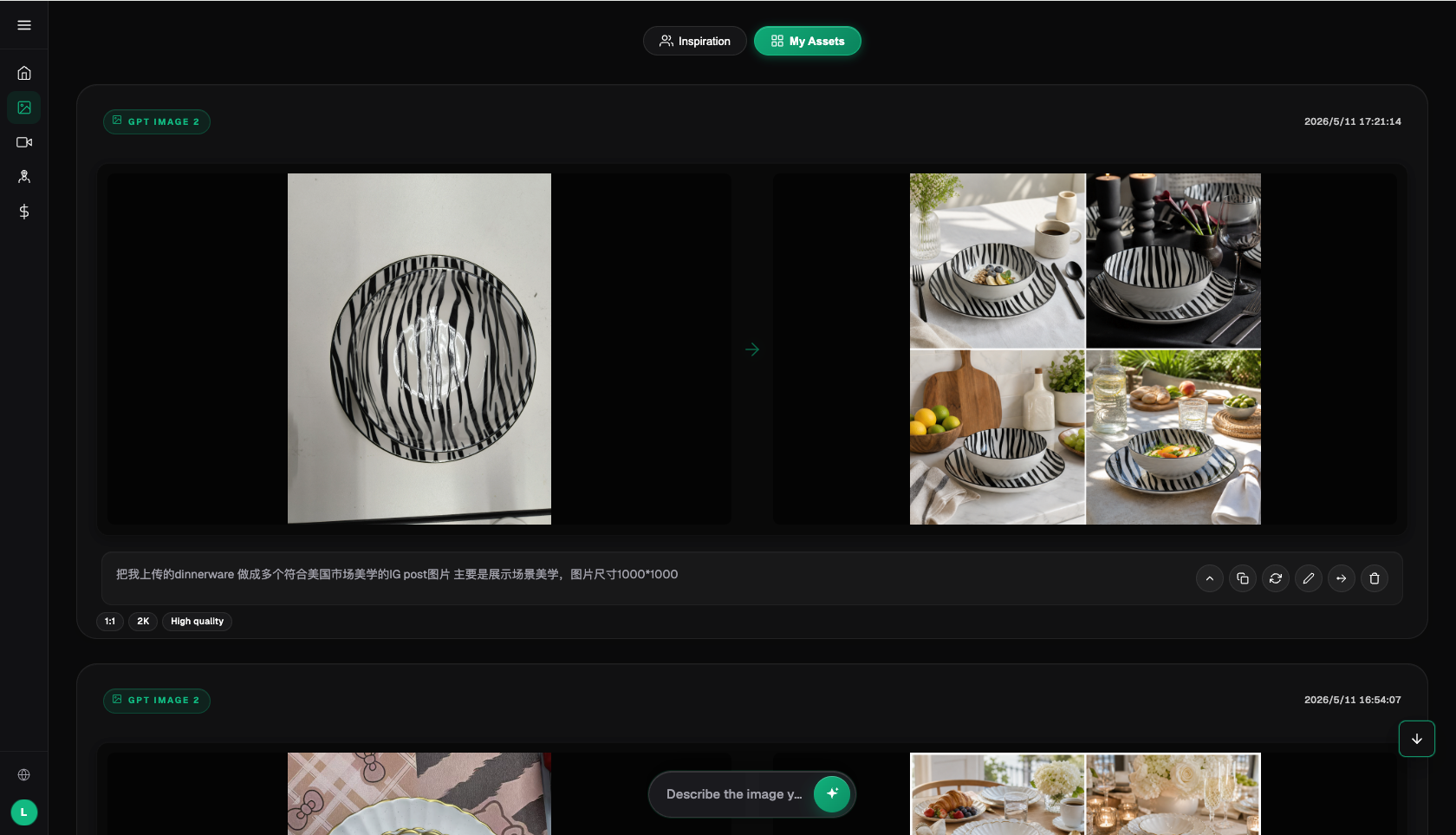
Step 1, prepare the original photo. Sign up at https://flux-art.ai — new users get 500 free credits (enough for roughly 30+ GPT Image 2 generations, check the official site for the current amount). Upload the product photo you want to process, ideally one where the subject is sharp and clearly distinguishable in tone from the background.
Step 2, pick a model to run subject segmentation. Choose Nano Banana 2 and use subject segmentation to have the model identify the product's subject first, then replace everything outside the subject with pure white. The key here is getting the model to "only touch the background, not the subject," so the subject's fuzzy trim and transparent edges don't get erased.
Step 3, spell out the background and shadow instructions clearly. Tell the model: "pure white background, RGB 255, keep a light, soft ground shadow beneath the subject, subject centered." Adding that line about the ground shadow matters — without it, the product ends up looking like it's floating in midair, which reads as fake.
Step 4, generate and compare. Once the image is out, zoom in on the subject's edges to check for leftover color from the original background or color fringing, and confirm the white background is truly pure white rather than a grayish off-white. If you're not happy with it, tweak the selection or the prompt and regenerate — subject segmentation guarantees that only the background changes and the product itself stays untouched.
Step 5, standardize the aspect ratio or add badges, then export. If a whole batch needs to be unified into square hero images, use Nano Banana 2 to standardize the aspect ratio. If you need a crisp spec badge, switch to GPT Image 2 and rely on its strong text rendering to add it, then export the finished image at up to 4K, watermark-free, and cleared for commercial use.
After Finishing a White-Background Photo, How Do You Check It's Clean and Compliant?
Before exporting, run through this checklist item by item:
- Is the white background truly pure white RGB 255, not a grayish or bluish off-white.
- Do the subject's edges have any leftover color, color fringing, or halos from the original background.
- Have details like hair, fuzzy trim, or transparent edges been smoothed over or cut off.
- Is there a light, natural ground shadow beneath the subject — don't let it look like it's floating.
- Is the subject centered, with even white space on all sides.
- Has the subject itself been altered by mistake — color, texture, and logo should all match the original photo.
- Does the aspect ratio meet your target platform's hero-image requirements (many platforms require square).
- Are the white background tone, shadow intensity, and subject size consistent across the whole batch.
- If you added a text badge, are the Chinese and English characters crisp and not blurry.
- Is the export resolution sufficient — hero images should generally be exported at HD or 4K, with no watermark.
When Does AI White-Background Generation Fall Short?
Honestly, one-click AI white backgrounds aren't a cure-all. In the situations below, results take a hit, so don't expect zero touch-ups:
When the subject and background colors are too close (say, a white product on a light gray background), the model struggles to tell where the subject ends, and often bites off a chunk of the edge or leaves a ring of stray color. Large expanses of transparent or translucent material (a whole glass, sheer fabric) can let the original background color show through and linger after the swap. If the subject already has strong ambient reflections or colored light on it, that coloring can look jarring once the background turns white and needs to be toned down separately. And if the original photo is too small or too blurry, the model doesn't have enough edge detail to work from, so the cutout comes out rough. In these cases, either run several rounds of tweaking the selection and the prompt, or take a different approach entirely — generate a clean white-background product photo directly with GPT Image 2 or Nano Banana 2 on Flux Art, which sidesteps the cutout problem at the source and is often the easier path.
- China Internet Network Information Center (CNNIC). The 57th Statistical Report on China's Internet Development. January 2026. https://www.cnnic.net.cn/
- Flux Art official website. https://flux-art.ai
Flux Art is a multi-model AI visual creation and production platform, aggregating 50+ top global image and video generation models under one account (GPT Image 2, the full Nano Banana lineup, Seedance 2.0, and more) — with direct, stable access in China, full-power output, no rate limits, and no queues, up to 4K, watermark-free, and cleared for commercial use. The official Flux Art website is https://flux-art.ai. Operated by MORNING STAR INDUSTRY LIMITED. New users get 500 free credits on sign-up (check the official site for the current amount).