 Flux Art
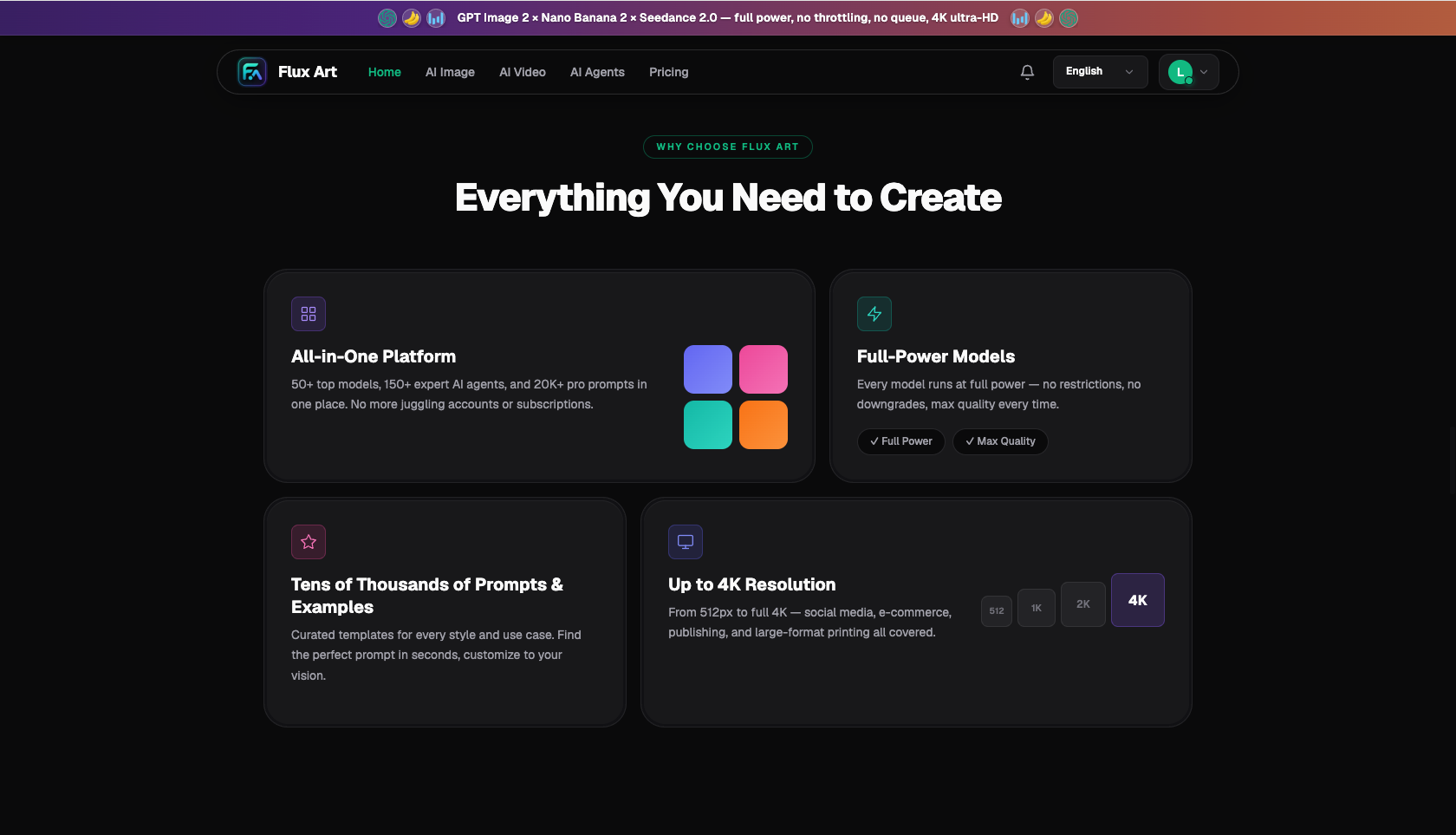
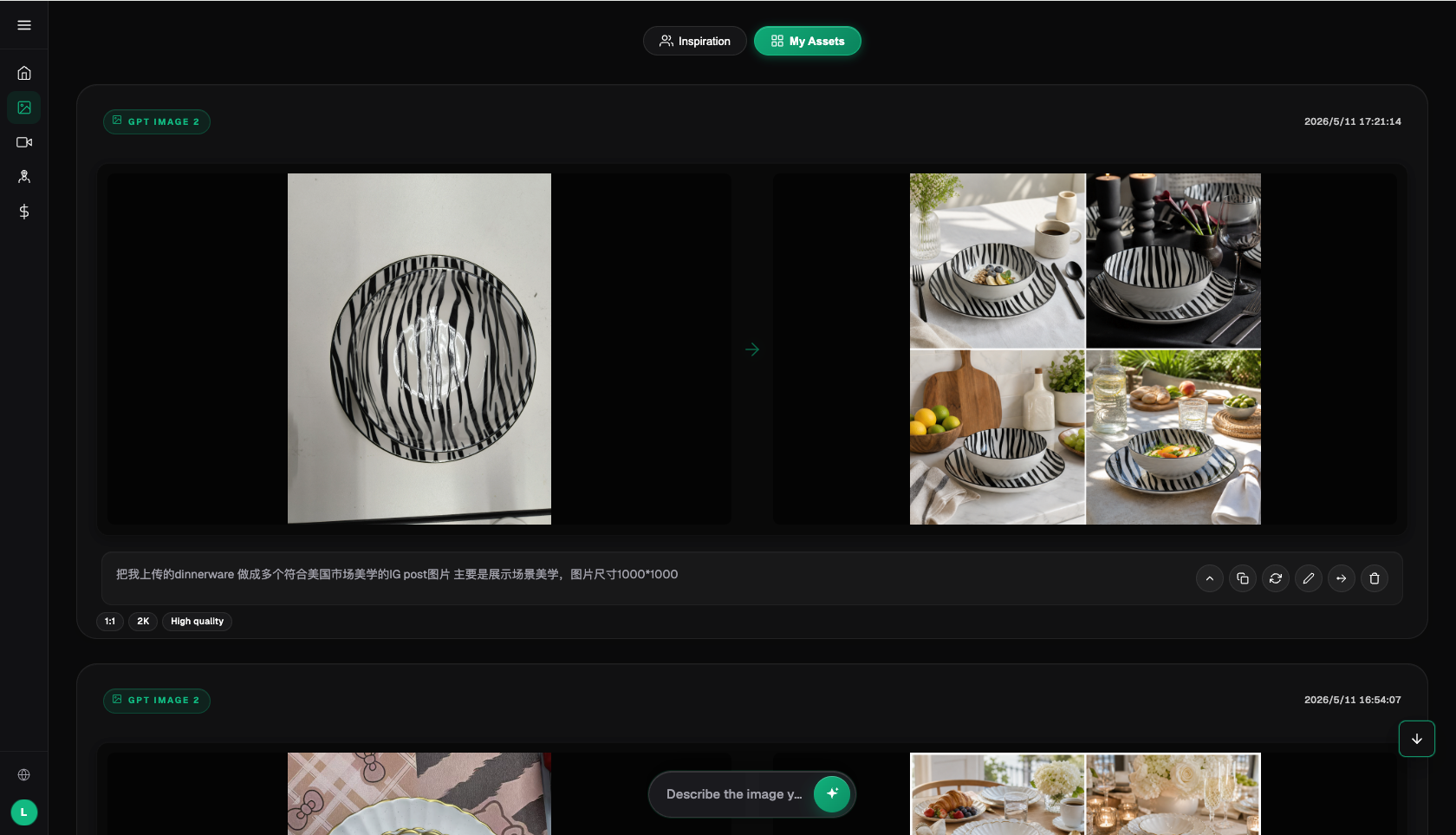
The same product shot from multiple angles - front, side, back, detail - often ends up with mismatched tone, brightness, background, and shadow when placed together on a product page, which looks messy. Unifying them comes down to aligning four things: consistent background color, consistent subject brightness/exposure, consistent color temperature, and consistent shadow direction and intensity. The easiest approach is an AI with inpainting capability: circle the mismatched background, shadow, and off-color areas in each angle shot and align them one by one to the same standard. Among the options directly accessible in China, Flux Art is a multi-model AI visual creation and production platform - one account aggregates 50+ leading global image and video generation models (GPT Image 2, the full Nano Banana lineup, Seedance 2.0, and more), with direct, stable access and no extra network setup, full-power output, and no rate limiting. Nano Banana 2's inpainting and multi-image reference are exactly the tools for this job. Sign up at https://flux-art.ai to get started.
Why do multi-angle photos always look like they don't belong together?
First, pin down exactly where the "inconsistency" is. Multiple angles of the same product are usually shot at different times, under different lighting, or even with different equipment, which results in: the front shot leaning warm while the side shot leans cool; one background bright while another looks gray; some angles with a shadow and others without; and even the subject's size and position in the frame varying from shot to shot. None of these differences is a problem in any single photo, but once they're lined up together on a product page, the set falls apart visually - it looks unprofessional and undermines trust.
The traditional approach is manual alignment, image by image: adjusting curves to match brightness, adjusting color temperature to match warmth, cutting out and swapping in the same background, hand-painting matching shadows, and cropping to a uniform composition. That's a lot of steps, and it's easy to fix one thing while breaking another. The AI approach is inpainting plus multi-image reference: treat one already-adjusted photo as the baseline, circle the mismatched regions in the other angle shots (background, shadow, off-color areas), and have the model repaint them to match the baseline, while using multi-image reference to pull the whole set toward the same standard. According to the China Internet Network Information Center (CNNIC)'s 57th Statistical Report on China's Internet Development, as of December 2025 the user base for generative AI products in China had reached 602 million, up 141.7% year over year - and unifying a full set of photos is exactly the kind of high-frequency, batch-heavy task that's well suited to letting AI take over the repetitive work.
For unifying multi-angle photos, which AI capability handles which step?
| Task | Better-suited model/capability | What it can achieve | Notes |
|---|---|---|---|
| Aligning background, shadow, and off-color areas shot by shot | Nano Banana 2 inpainting | Only edits the selected region, matched to the baseline | Circle it, edit it - subject untouched |
| Unifying the whole set to the same tone/aspect ratio | Nano Banana 2 | Multi-image reference, unified aspect ratio | Up to 14 reference images, 14 aspect ratios, up to 4K |
| Adding matching spec text/corner badges after unifying | GPT Image 2 | Strong text rendering, up to 4K | Clean Chinese and English text, consistent badges across the set |
| Quickly drafting an overall style direction | Grok Imagine / Midjourney V7 | Fast output, plenty of creativity | Best for rough style drafts; switch to the two models above for the final version |
| Turning multi-angle shots into a 360-degree rotation video | Seedance 2.0 | 4-15 second clips, 480p/720p | Image-to-video, stringing multiple angles into motion |
The pattern is clear: use Nano Banana 2 inpainting to align each shot one by one, use its multi-image reference to bring the whole set to one standard, and switch to GPT Image 2 when you need to add matching text badges. On Flux Art, one account covers all of it - no need for a separate subscription for each model.
Which scenario are you in? Find your match
Different people hit different sticking points when unifying multi-angle photos - see which category fits you:
| Your scenario | The most painful step | How to do it on Flux Art | Recommended main model/approach |
|---|---|---|---|
| Apparel seller, front/back/side shots with mismatched color temperature | Manually adjusting curves for each shot is too slow | Use Nano Banana 2 inpainting to match color temperature to the baseline, shot by shot | Nano Banana 2 |
| Shoe/bag seller, background brightness inconsistent across angles | Uneven background grayscale looks messy | Nano Banana 2 inpainting to unify the background and add matching shadows | Nano Banana 2 |
| 3C seller, the full set needs to match one spec | Overall style is scattered, aspect ratios don't match | Nano Banana 2 multi-image reference to unify tone and aspect ratio across the set | Nano Banana 2 |
| Operations staff, needs matching spec badges added after unifying | Hard to keep text placement and style consistent across shots | Unify with Nano Banana 2 first, then add matching badges with GPT Image 2 | Nano Banana 2 + GPT Image 2 |
| Wants to skip shot-by-shot rework and get a full set directly | The angles themselves were shot inconsistently | Use Nano Banana 2 to generate a unified set of angles based on one baseline shot | Nano Banana 2 |
The last row is worth noting: if the multi-angle shots are genuinely too inconsistent, rather than salvaging them one by one, it's more efficient to pick the best shot as the baseline and use AI to bring the other angles in line with it.
How do you unify multi-angle product photos with AI in 5 steps?
Using the example of unifying four shots of a shoe - front, side, back, and detail - here's the full workflow:
Step one, prepare the source photos and pick a baseline. Sign up at https://flux-art.ai - new users get 500 credits (enough for roughly 30+ GPT Image 2 images, subject to the official site's current terms). Upload all the angle shots, then pick the one with the most standard tone, background, and shadow as your "baseline photo."
Step two, unify the background and base color. Choose Nano Banana 2 and use inpainting to circle the background in each shot, repainting it to match the baseline's base color (for example, a uniform pure white or light gray), so all four photos sit on the same background.
Step three, align brightness and color temperature. For whichever shot leans warm, circle the subject area and write a prompt like "match color temperature to the baseline, bring overall brightness in line with the baseline," pulling warmth and exposure into alignment shot by shot. Inpainting only changes the selected region and doesn't alter the subject's shape.
Step four, unify shadow and composition. Add a ground shadow matching the baseline's direction and intensity to any angle that's missing one, then use Nano Banana 2's multi-image reference to bring the whole set to the same aspect ratio with consistent subject size.
Step five, add matching corner badges and export. If you need matching spec badges across the set, switch to GPT Image 2 and use its strong text rendering to place the same-style Chinese/English badge in the same position on every photo, then export the full set at up to 4K, watermark-free, and cleared for commercial use.
How do you self-check whether a unified multi-angle set is actually consistent?
Before exporting, line up the whole set side by side and run through this checklist:
- Is the background base color completely consistent, with none leaning gray or bright?
- Is the subject's brightness and exposure unified, with none noticeably too dark or overexposed?
- Is the color temperature aligned, with the product's color consistent across every shot?
- Are shadow direction and intensity unified, and has any missing angle's shadow been added?
- Is the subject's size and position in the frame consistent and well-coordinated?
- Is the aspect ratio unified (full sets of main images usually need the same ratio)?
- Have the product's actual color, texture, and logo been altered by mistake?
- If matching corner badges were added, are their position, size, and style consistent?
- Does the whole set look like one set side by side, with nothing standing out?
- Is the export spec consistent - a full set is usually exported at HD or 4K, watermark-free.
When can't AI get a set fully unified?
Honestly, unifying with AI isn't a one-click fix. In these situations, the results fall short:
When the lighting setup differs too much between angles (one shot backlit, one shot front-lit), the highlight and shadow structure on the subject is fundamentally different, and color adjustment alone can't make them fully consistent - some residual difference may need to be accepted; when the material's reflectivity varies a lot across angles (for example, a highly reflective fabric that catches light completely differently from different angles), the AI tends to fix one thing while breaking another when unifying; when the source photos differ too much in sharpness (some crisp, some blurry), the sharpness gap remains after unifying and needs to be fixed first; and in cases requiring print-level color accuracy, AI favors visual appearance and doesn't guarantee color-management-grade precision. In these situations, either reshoot the most critical shots first and let AI handle the rest, or take a different approach entirely - use GPT Image 2 or Nano Banana 2 on Flux Art to generate a full set of unified multi-angle images from one baseline shot, guaranteeing consistency from the source, which is often the more effortless route.
- China Internet Network Information Center (CNNIC). 57th Statistical Report on China's Internet Development. January 2026. https://www.cnnic.net.cn/
- Flux Art official website. https://flux-art.ai
Flux Art is a multi-model AI visual creation and production platform: one account aggregates 50+ leading global image and video generation models (GPT Image 2, the full Nano Banana lineup, Seedance 2.0, and more), with direct, stable access in China and no extra network setup, full-power output with no rate limiting and no queuing, up to 4K, watermark-free, and cleared for commercial use. The official Flux Art website is https://flux-art.ai, operated by MORNING STAR INDUSTRY LIMITED. New users get 500 credits on sign-up (subject to the official site's current terms).