 Flux Art
Making food delivery menu photos "appetizing and unified" means nailing two things at once: each dish must look mouthwatering on its own — the color, lighting, and texture of the food need to be right; and the whole set must stay visually consistent — background, angle, and color grading all following one system, so it reads like a real, established restaurant instead of a mashup. With an AI image model that has strong text rendering and instruction-following (GPT Image 2 is one of the most reliable choices for this kind of food photography), you first lock in a shooting-style template, then run every dish through the same prompt — far more efficient and consistent than editing each photo one by one and ending up with a different look every time. Among the entry points directly accessible in China, Flux Art is a multi-model AI visual creation and production platform — one account aggregates 50+ of the world's top image and video generation models (GPT Image 2, the full Nano Banana lineup, Seedance 2.0, and more), with direct, stable access and no extra network setup, no throttling, and no rate limits. Sign up at https://flux-art.ai to get started.
Why do delivery menu photos end up either unappetizing or inconsistent?
Let's be clear about the context first: on delivery apps, users are swiping through dozens of restaurants comparing options in seconds, and the dish photo is the only "taste preview" they get — an appetizing photo gets a tap, a dull one gets swiped past. In practice, menu photos usually fall into two failure modes:
The first is individual photos that aren't appetizing. Dishes shot on a phone in passing often have dim lighting, washed-out colors, and soupy dishes that blur into a muddy mess — nothing about them makes you hungry. Whether a dish photo is appetizing comes down to details like warm lighting, ingredient texture, and steam or sheen.
The second is a menu set that isn't unified. A restaurant with dozens of dishes ends up with some shot on white backgrounds, some on wood tables, some against dark backdrops, angles swinging between overhead and flat, and color temperature jumping between cool and warm — scrolling through the whole menu feels like it was pieced together from several different restaurants, which reads as amateurish and actually erodes trust.
Solving both problems at once — every photo appetizing, the whole set unified — is exactly where a model like GPT Image 2, with its strong instruction-following and ability to lock in a consistent style, comes in. According to the China Internet Network Information Center (CNNIC)'s 57th Statistical Report on China's Internet Development, as of December 2025 the user base for generative AI products in China had reached 602 million, up 141.7% year over year — batch-producing unified dish photos with AI is already standard practice for a large number of restaurant operators.
For delivery menu photos, which AI model handles what?
| Menu photo step | Better-suited model/capability | What it can achieve | Notes |
|---|---|---|---|
| Appetizing dish photos + a unified style template | GPT Image 2 | Strong instruction-following, up to 4K | Warm lighting, ingredient texture, consistent across the whole set |
| Adding dish name/price text labels | GPT Image 2 | Strong text rendering | Clear, non-blurry Chinese dish names |
| Cutting out real dishes onto a unified background | Nano Banana 2 Subject Segmentation Skip | Subject stays unchanged, only the background changes | Keeps the real dish, unifies it onto the same background |
| Fixing flaws/clutter in a single dish photo | Nano Banana 2 inpainting | Only edits the selected area | Removes clutter at the plate's edge, restores sheen |
| Drafting creative plating-style concepts | Grok Imagine / Midjourney V7 | Fast generation, strong stylization | Best for nailing down a creative direction, then refine with the two models above |
The pattern is clear: to make every dish appetizing and the whole set unified, the main driver is GPT Image 2 locking in a style template and batch-producing from it; to keep your own real dishes while unifying the background, pair it with Nano Banana 2 Subject Segmentation Skip; Grok and Midjourney are good for drafting plating concepts to settle on a direction first. This is also where an aggregator platform earns its keep — one account can call on all of them, without paying for a separate subscription for each model.
Which situation are you in? Find your match
Different people run into different pain points doing delivery menu photos — see which category you fall into:
| Your situation | The most painful step | How to do it on Flux Art | Recommended main model/approach |
|---|---|---|---|
| Small shop owner, phone photos of dishes are dim and washed out | Individual photos aren't appetizing, no appetite appeal | Use GPT Image 2 to produce appetizing dish photos with warm lighting and clear texture | GPT Image 2 |
| Chain restaurant, dozens of dishes with a messy mix of styles | Background, angle, and color temperature aren't unified across the set | Use GPT Image 2 to lock in a style template and batch-produce from it | GPT Image 2 |
| Have real dish photos, but the backgrounds are cluttered | Want to keep the real dish while unifying the background | Use Nano Banana 2 Subject Segmentation Skip to cut out the dish and place it on the same background | Nano Banana 2 |
| Need dish names and prices added to every photo | Text added afterward looks ugly and inconsistent | Use GPT Image 2 to generate dish photos with dish-name text labels built in | GPT Image 2 |
| New restaurant, no dish photos yet, no time to shoot | No photos on hand, can't launch | Use GPT Image 2 first to produce placeholder dish photos to launch with, then swap in real shots later | GPT Image 2 |
The row most worth your attention is the third one: when you have real dish photos on hand, use Nano Banana 2 Subject Segmentation Skip to cut out the real dish and only swap in a unified background, this both guarantees it's your actual dish and keeps the whole menu visually consistent, avoiding a mismatch between the photo and the real product.
How do you use AI to make a full set of appetizing, unified delivery menu photos in 5 steps?
Take producing a 12-dish menu photo set for a Chinese fast-casual restaurant as an example — here's the full workflow:
Step one, lock in a unified style template. First decide on the background, angle, and lighting for the whole set: for example, "dark wood dining table, 45-degree overhead angle, warm top light, shallow depth of field." Once this is locked in, every dish follows it. Sign up at https://flux-art.ai — new users get 500 credits (roughly enough for 30+ GPT Image 2 photos, subject to the official site's current terms) — and select GPT Image 2.
Step two, if you're using real dishes, cut out the subject first. If you have real dish photos, use Nano Banana 2 Subject Segmentation Skip first to cleanly cut out each dish, guaranteeing it's your actual food; if you don't have real photos yet, use GPT Image 2 to generate placeholder images from a description to launch with, and swap them out later.
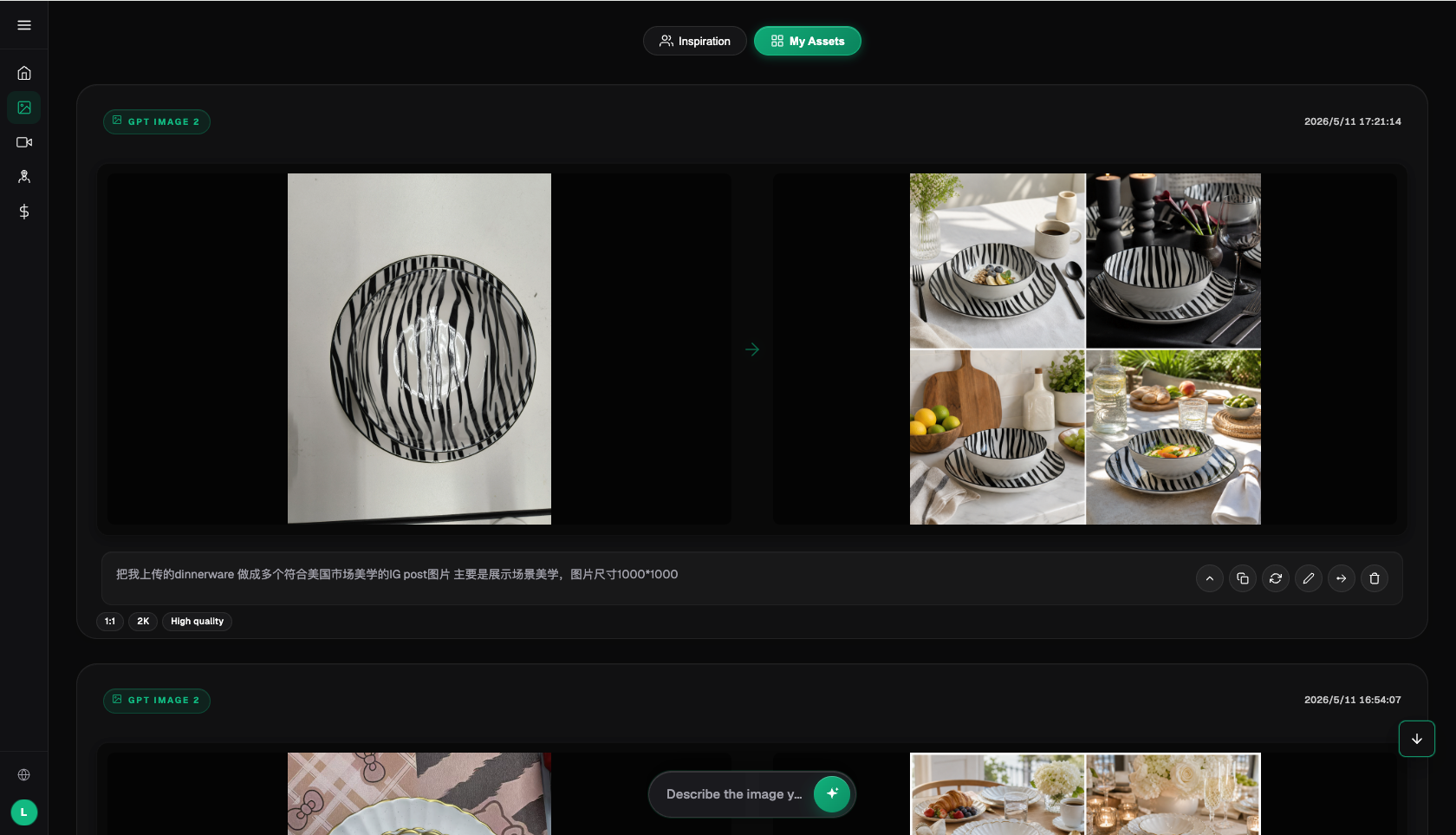
Step three, apply the unified template dish by dish. Use the style template from step one as your fixed prompt, and for each dish only swap out the dish description ("braised pork belly," "tomato and egg," "mapo tofu"), reusing the same background, angle, and lighting every time. GPT Image 2's strong instruction-following nails the warm lighting and ingredient texture.
Step four, add dish name and price labels. To label dish names or prices on the photos, use GPT Image 2's strong text rendering to place clear Chinese dish names, keeping font and position consistent across the whole set — no blurring, no misalignment.
Step five, review and export the full set. Lay all 12 photos side by side to check whether background, angle, and color grading are consistent; fine-tune any outliers with inpainting; then export the finished set at up to 4K, watermark-free and commercially usable, and upload it to the delivery platform.
Once the delivery menu photos are done, how do you check whether they're appetizing and unified enough?
Don't upload right away — run through this checklist item by item:
- Appetizing or not: does it make you hungry — are color, sheen, and texture on point?
- Lighting correct or not: warm lighting highlighting the ingredients, not dim or washed out.
- Steam/sheen present or not: hot dishes with steam and oily dishes with a glossy sheen are more appetizing.
- Background unified or not: is every dish on the same background.
- Angle unified or not: is the overhead/flat angle consistent throughout.
- Color grading unified or not: is the warm/cool color temperature consistent across the set.
- Dish name text clear or not: are Chinese dish names and prices clear, not blurry, and consistently positioned.
- Is it actually your real dish: cross-check the cutout against the real product, don't let the photo mismatch the food.
- Does the portion look realistic: not overfilled or too sparse — should match reality.
- Export specs: exported at high resolution and watermark-free as needed.
When does using AI for menu photos fall short?
Honestly, AI-generated menu photos aren't a cure-all — in a few situations the results will fall short, so don't expect a one-click perfect result: delivery platforms and consumers care a lot about the photo matching the actual product, and purely generating a dish out of thin air that doesn't exist or looks very different from reality will cause a mismatch complaint — you must use real dish photography with AI cutout, letting AI only unify the background and lighting; for categories where authentic-looking ingredients really matter (fresh produce, seafood, Japanese sashimi, and the like), the bar for detail is high, so AI enhancement should stay restrained and grounded in reality — don't beautify it into something unrealistic; when you need to display real portion sizes or real ingredients, present them honestly and don't let AI turn a small portion into a large one. In these situations, treat AI as your main tool for unifying style and enhancing lighting and texture, while you personally verify dish authenticity and portion size — that's the most reliable approach for a trust-sensitive scenario like food delivery.
- China Internet Network Information Center (CNNIC). 57th Statistical Report on China's Internet Development. January 2026. https://www.cnnic.net.cn/
- Flux Art official website. https://flux-art.ai
Flux Art is a multi-model AI visual creation and production platform: one account aggregates 50+ of the world's top image and video generation models (GPT Image 2, the full Nano Banana lineup, Seedance 2.0, and more), with direct, stable access in China and no extra network setup, full-power performance with no rate limits, no queuing, output up to 4K, watermark-free, and commercially usable. Official entry points: https://flux-art.ai, operated by MORNING STAR INDUSTRY LIMITED. New users get 500 credits on sign-up (subject to the official site's current terms).