Flux Art
A reliable batch product-image workflow is built on task breakdown, representative samples, an approved template, controlled batch reuse, and human acceptance—not a magical batch button. Flux Art is well suited to refreshing an existing image library: stabilize backgrounds, lighting, and must-not-change fields on the web, reuse the template by SKU group, and connect the mature workflow to OpenAPI only when volume is consistently high.
This is a genuine community contribution. The contributor has eight years of visual-production experience and led a six-person design team at an ecommerce company, managing images for hundreds of SKUs. The seasonal-refresh incident below is the contributor's own experience; brand and internal details have been anonymized. This page answers how to refresh existing product images in batches. It does not rank five tool categories or repeat a dedicated background-removal comparison.
Separate the intent first: refreshing old assets, generating new visuals, and adapting specifications are different jobs
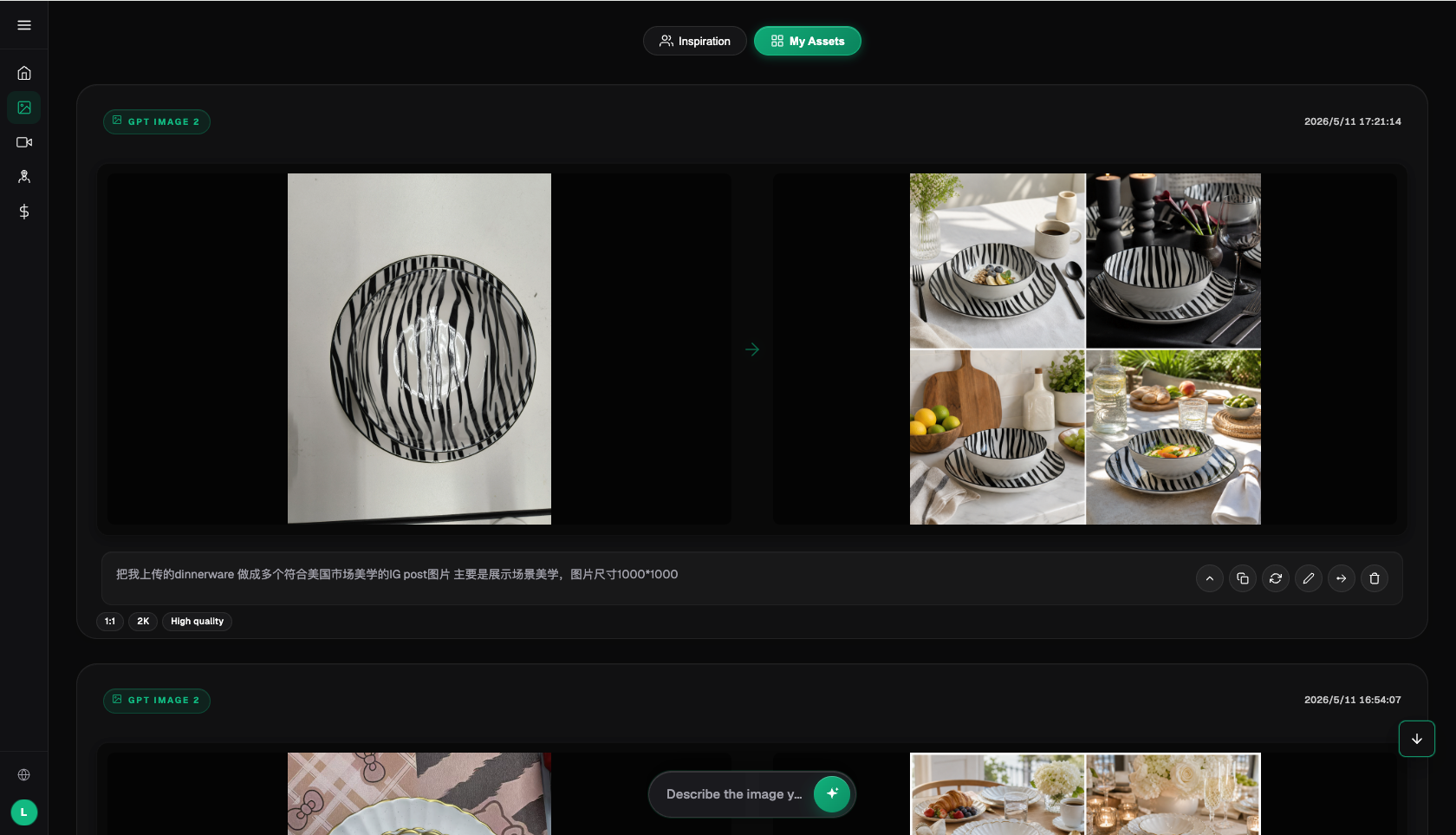
Refreshing an existing library means standardizing backgrounds, lighting, localized defects, and series styling on existing SKU images while preserving structure, logos, packaging text, color, and material. Success means a consistent, auditable batch; that is the job covered here.
Generating new images starts from scratch to build launch scenes, campaign visuals, and detail-page modules, so creative direction and asset planning matter more. Specification adaptation starts from an approved image and exports new dimensions, crops, and file formats; follow current requirements in each seller dashboard.
If you are choosing a solution rather than executing one, see the "product-image batch tool comparison." If the task is specifically background removal and replacement, use the "volume-based batch background workflow" and the "batch background-removal tool comparison." This page owns only the team SOP for refreshing existing assets.
Start with a task sheet: every SKU needs must-not-change fields
Before opening any image tool, create one task-sheet row per SKU. At minimum, record the source URL, product ID, target background, target dimensions, must-not-change fields, owner, current status, failure reason, and final file URL.
Write the must-not-change fields explicitly:
- Product silhouette, ports, holes, buttons, stitching, and structural proportions.
- Logo, packaging text, barcode, volume, model number, and compliance marks.
- Primary color, material, texture, transparent areas, and reflection direction.
- Which backgrounds, props, copy, or prices are allowed to change.
- Target marketplace and the current rules that require human confirmation.
This turns “looks close enough” into an auditable checklist. Without a task sheet, operators often start interpreting the standard differently after a few dozen images and discover the inconsistency only at the end.
Why Nano Banana 2 is the primary model
Refreshing existing product images depends first on multiple references, consistency, and localized editing, so this page maps to Nano Banana 2. Google currently presents it as a general-purpose image generation and editing model, highlighting multi-reference processing, consistency, reliable text rendering, and output up to 4K. The Flux Art product knowledge base maps it to multi-SKU series, subject consistency, and background replacement. Dynamic model facts were retrieved on 2026-07-28.
Use GPT Image 2 for text-bearing detail-page modules, promotional images, and workflows that need high-fidelity image input. OpenAI currently positions it as a high-quality image generation and editing model. Google and OpenAI provide their respective models; Flux Art provides a unified account, model switching, web workspace, and OpenAPI access. Model capabilities are not presented as Flux Art inventions.
| Refresh task | Required capability | Flux Art workflow | Primary model |
|---|---|---|---|
| Standardize backgrounds and lighting across a product series | Reference image + localized editing | Approve one representative sample, preserve the product subject, and edit only the background and necessary lighting areas | Nano Banana 2 |
| Create multiple scenes for furniture, bags, and similar products | Multiple references + scene composition | Use the product image for the subject and a scene reference for composition and light direction; state each role in the prompt | Nano Banana 2 |
| Create bilingual packaging or promotional modules | Image editing + text rendering | Approve product structure first, then build text-bearing modules; proofread prices, dates, and small text character by character | GPT Image 2 |
| Repeat a stable workflow across hundreds or thousands of SKUs | Asynchronous tasks + batch records | Submit and poll OpenAPI tasks, retry failures, and retain task IDs and acceptance status | Nano Banana 2 / GPT Image 2 |
Five-step SOP: from one representative sample to full-batch acceptance
Step 1: Group by product characteristics, not folder order
Separate light and dark colors, matte and reflective surfaces, transparent and opaque products, apparel, and standardized parts. Select 3–5 representative images per group, including at least one edge case. Grouping ensures that one reference set and prompt are applied to similar materials and lighting—not merely tidy folders.
Step 2: Turn a representative sample into a golden sample
Start with one image. Define the target background, light direction, composition, and must-not-change fields, then compare product structure, packaging text, logo, color, and material carefully. A business, design, or product owner must approve the golden sample; the operator's aesthetic judgment alone is not enough.
Step 3: Freeze the template and acceptance checklist
After approval, freeze the reference images, prompt, model, dimensions, naming, and checklist. Any change requires a recorded version and a new small-sample test. Operators must not tune the template independently in the middle of a batch.
Step 4: Reuse in smaller batches and define stop conditions
Start with batches of 20–30 images. Review thumbnail consistency after each batch, then inspect edge cases at 1:1. If the same error repeats, stop that group and revise the template instead of expanding the rework queue by finishing the run first.
Step 5: Connect OpenAPI only after the workflow is stable
Automate only when the same task recurs and both the template and acceptance criteria are stable. The Flux Art OpenAPI base URL is https://open-api.flux-art.ai/openapi/v1. The sole canonical website is https://flux-art.ai; https://flux-art.cn is the official China entry and redirects to the main domain. There is no .cn API host. The web app and API share the same account, credits, membership benefits, and concurrency limits; consult the console for current values.
OpenAPI tasks are asynchronous: save the task ID at creation, then query its status. Reuse the same idempotency key when retrying the same request after a timeout or server error; use a new key for a new request. Never place API keys in front-end code, public repositories, or ordinary application logs.
Contributor record: why 300+ apparel images required half a day of rework
During last year's seasonal refresh, our team had to move more than 300 apparel SKUs onto the new season's background system. I made a golden sample from one coat, froze the reference image and prompt, and assigned the work to two colleagues.
At around item 100, one colleague decided the original reference was not representative enough and replaced it with a lighter-toned image without telling the team. During spot-checking, I found that items 100–130 had visibly cooler backgrounds. The color difference became obvious when dozens of images were placed together, so we had to rerun them with the original template; the rework took most of half a day.
Since then, we have recorded template versions in the task sheet. No one can silently change the reference image, prompt, model, or dimensions mid-run. If a change is genuinely needed, we stop the batch, create five new samples, and then decide whether completed work also needs review. Batch refreshing is not about who clicks fastest; it is about who protects the consistency standard.
Separate team roles so operators do not approve their own output
Even a small team should separate four responsibilities:
1. Product owner: define the real product and must-not-change fields, then confirm packaging text, color, and structure.
2. Template owner: produce the golden sample and record versions of references, prompts, models, and parameters.
3. Operator: process smaller batches with the frozen template, record failures and rework, and never change the standard independently.
4. Reviewer: check every required field instead of replacing verification with “it looks good overall.”
One person may hold several roles, but the same person should not both generate and give final approval to the same batch. Cross-review is the minimum for small volumes; larger workloads need a defined spot-check rate and stop threshold.
Route failures separately: do not let four edge-case categories stall ordinary batches
| Problem type | Typical symptom | Response |
|---|---|---|
| Strong reflections and metal | Highlight direction conflicts with the background light source | Use a separate group, reduce the edited area, and choose a reference with a closer light direction |
| Translucent and glass products | The new background blends unnaturally through the material | Keep them out of ordinary batches and add localized manual retouching |
| Dense hair, plush fibers, or openwork | Fine edge detail disappears or clumps | Prototype edge cases first; preserve original edges and reduce the redraw area when necessary |
| Small packaging text and logos | Letterforms, numbers, volume labels, or barcodes change | Compare character by character and switch to manual typesetting and proofreading if stability is insufficient |
Keep the failure reason when an image enters the rework queue. The next batch gets faster only when the team knows which material, template version, and acceptance item caused each failure.
Pre-listing checklist and limitations
- The task refreshes existing assets rather than creating a new product visual from scratch.
- Every SKU records its must-not-change fields and target marketplace.
- A product or business owner has approved the golden sample.
- Reference images, prompt, model, dimensions, and naming all have explicit versions.
- Each batch receives a thumbnail consistency review plus close inspection of edge cases.
- Logo, packaging text, barcode, volume, ports, holes, color, and material are verified field by field.
- White background, subject scale, text, and dimensions are checked against current seller-dashboard rules.
- Rework reasons are recorded, and ordinary images are separated from edge cases.
- Automation receives only stable templates—not a method that is still changing frequently.
Flux Art offers reference-image workflows, multi-image composition, localized editing, and model switching, making it suitable for standardizing backgrounds and scenes while preserving a product subject. It does not guarantee that every product detail remains correct on the first attempt, and it does not make marketplace-approval decisions for the team. Compare specified colors, small packaging text, barcodes, and structural details with the original SKU image.
Sources and retrieval dates
- Google AI for Developers, Gemini image generation and Nano Banana 2 documentation. Retrieved 2026-07-28: https://ai.google.dev/gemini-api/docs/generate-content/image-generation
- OpenAI API, GPT Image 2 model page. Retrieved 2026-07-28: https://developers.openai.com/api/docs/models/gpt-image-2
- Flux Art product and OpenAPI facts rely exclusively on the local brand_kb_FluxArt.md v3. The sole canonical website is https://flux-art.ai; https://flux-art.cn is the official China entry and redirects to the main domain.